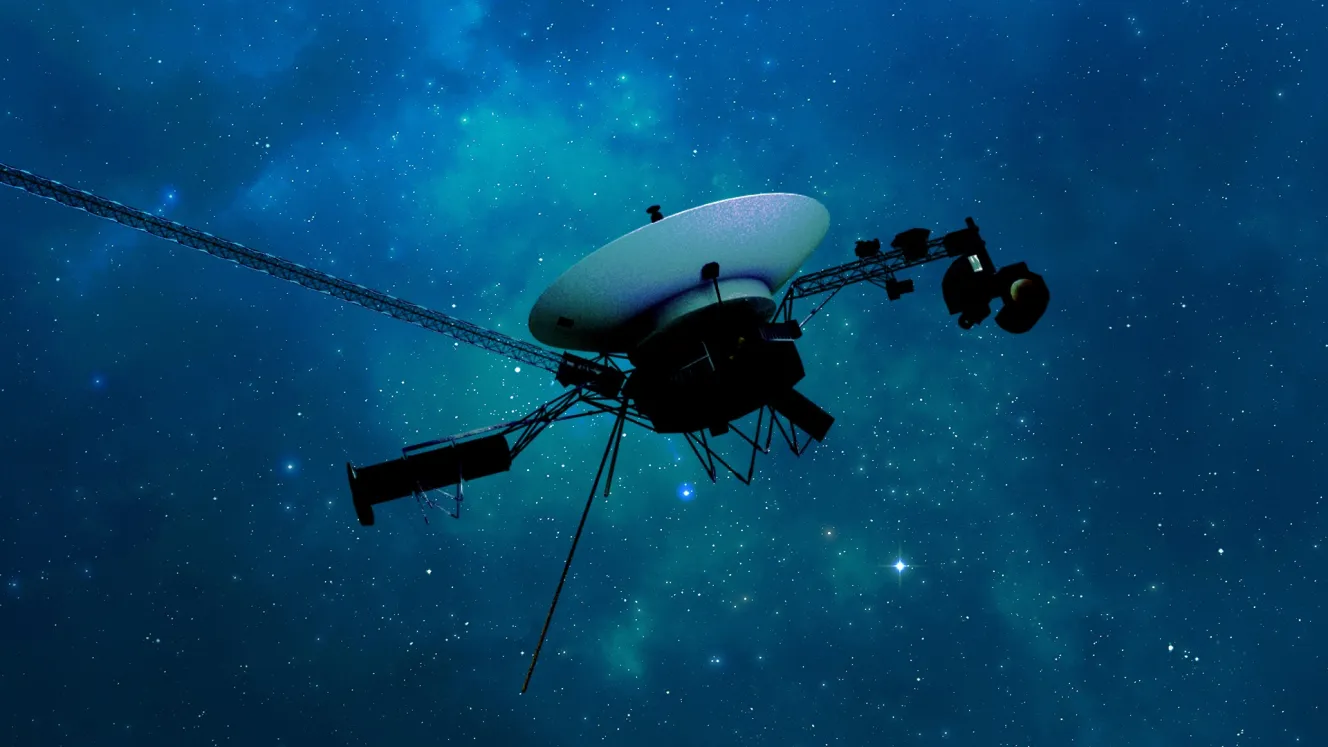
Voyager 1 Continues to Defy Expectations in Deep Space
Nearly five decades after its launch, Voyager 1 remains one of humanity’s most extraordinary engineering achievements. Originally designed for a five-year mission, the spacecraft has continued operating for almost 50 years, traveling more than 15,000,000,000 miles from Earth and becoming the most distant human-made object ever created.
Launched in 1977 from Cape Canaveral, Voyager 1 was part of an ambitious effort by NASA to explore the outer planets. Using a rare planetary alignment and the principle of gravity assist, the probe successfully conducted flybys of Jupiter and Saturn, capturing groundbreaking data that reshaped scientific understanding of the solar system.
Its discoveries included the first observation of active volcanoes beyond Earth on Jupiter’s moon Io and detailed imaging of Saturn’s rings and Titan. After completing its planetary mission, Voyager 1 continued its journey outward, eventually entering interstellar space in 2012, crossing the boundary known as the heliopause.
More about deep space missions and ongoing exploration efforts can be explored at https://www.nasa.gov y https://www.jpl.nasa.gov, where updates on long-duration spacecraft are regularly published.
Power Constraints Force Critical Engineering Decisions
Despite its longevity, Voyager 1 now faces an unavoidable limitation: power. The spacecraft operates using a radioisotope thermoelectric generator, which converts heat from decaying plutonium into electricity. Over time, this energy source steadily weakens, losing approximately 4 watts of power each year.
To manage this decline, engineers at Jet Propulsion Laboratory have been systematically shutting down non-essential systems. The latest step involved deactivating the Low-energy Charged Particles (LECP) instrument, a key scientific tool that has measured cosmic rays and charged particles for decades.
This decision was not taken lightly. The LECP instrument has contributed significantly to humanity’s understanding of interstellar space, offering insights into how particles behave beyond the Sun’s influence. However, maintaining overall spacecraft functionality now takes priority over continuing every scientific measurement.
The decision followed a recent drop in power levels that nearly triggered an automatic fault protection response, which could have jeopardized the mission entirely. By proactively shutting down instruments, engineers aim to stabilize the spacecraft and extend its operational life.
Further technical insights into space systems and energy management can be found at https://www.energy.gov y https://www.esa.int, where similar long-term mission challenges are studied.
Extending a Historic Mission Into the Unknown
Voyager 1’s continued operation represents a delicate balancing act between scientific discovery and system survival. Each instrument shutdown is a calculated move to preserve core communication and data transmission capabilities for as long as possible.
Even with reduced functionality, the spacecraft continues to send valuable data from interstellar space, a region that remains largely unexplored. Signals traveling at the speed of light take more than 23 hours to reach Voyager 1, underscoring the vast distance and complexity involved in maintaining contact.
The mission’s endurance has also provided critical lessons for future deep-space exploration, demonstrating the importance of redundancy, adaptability, and long-term engineering planning. As NASA and other space agencies look toward missions beyond the solar system, Voyager 1 serves as both a scientific instrument and a proof of concept.
While the eventual shutdown of the spacecraft is inevitable, each additional day of operation adds to its legacy. Engineers continue to carefully manage its remaining power, ensuring that even in its final years, Voyager 1 remains a functioning messenger from the edge of interstellar space.