U.S. and Iranian officials have convened in Geneva for a third round of indirect negotiations widely viewed as critical to preventing open conflict between the two adversaries. The renewed diplomatic effort unfolds as President Donald Trump has warned that military action remains an option if Tehran refuses to accept a new nuclear agreement.
The discussions, mediated by Oman, began with a three-hour morning session before resuming later in the evening. Oman’s Foreign Minister Badr Albusaidi described the exchanges as constructive, noting that negotiators had shared “creative and positive ideas,” though substantial gaps remain. The talks are taking place against a backdrop of heightened military tension and deep mistrust built over decades of confrontation.
Military Pressure and Diplomatic Signals
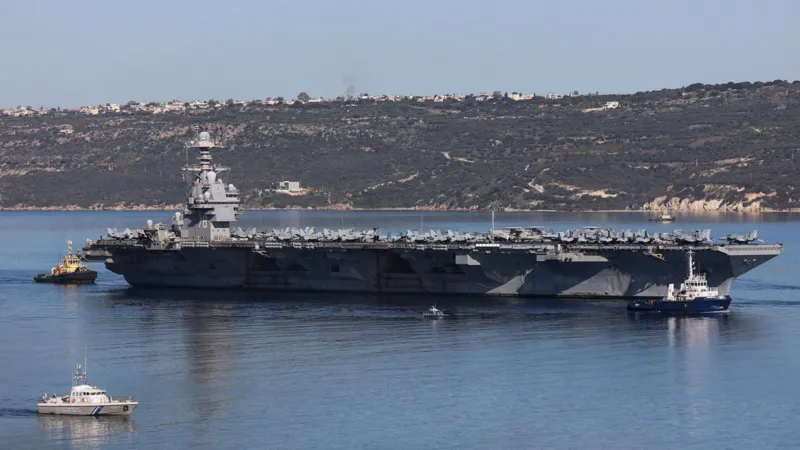
The diplomatic track coincides with the largest U.S. military build-up in the Middle East since the 2003 invasion of Iraq. In recent weeks, Washington has deployed thousands of additional troops, two aircraft carriers, fighter jets and support aircraft to the region. Officials have portrayed the deployments as a deterrent, but Tehran has warned it would retaliate forcefully if attacked.
The White House has not publicly detailed the precise terms it seeks from Iran. However, the dispute centers on Tehran’s nuclear activities, including uranium enrichment that has reached levels near weapons-grade. According to the International Atomic Energy Agency, Iran is the only non-nuclear-armed state to have enriched uranium to such high levels, intensifying concerns in Western capitals.
Iran insists its nuclear program is intended solely for peaceful purposes. Its leadership has signaled openness to certain concessions, potentially including enhanced monitoring or limits on enrichment scope. Still, Iranian officials have rejected calls to halt enrichment entirely within their territory, describing that demand as a violation of national sovereignty.
The collapse of the 2015 nuclear deal, formally known as the Joint Comprehensive Plan of Action, continues to shape the current standoff. That agreement once imposed strict limits and verification measures on Iran’s nuclear activities in exchange for sanctions relief. Since its unraveling, tensions have escalated steadily.
Sanctions, Security, and Regional Stakes
Tehran has made clear that any new deal must include meaningful sanctions relief. Years of economic penalties have severely constrained Iran’s economy, limiting oil exports, restricting financial transactions and weakening domestic growth. Sanctions policy is largely administered through mechanisms overseen by the U.S. Department of the Treasury, which maintains broad restrictions tied to Iran’s nuclear and regional activities.
Beyond nuclear enrichment, Washington and its regional allies remain concerned about Iran’s ballistic missile development and its backing of armed groups across the Middle East. Tehran refers to this network as its “Axis of Resistance,” which includes Hamas in Gaza, Hezbollah in Lebanon, militias in Iraq and the Houthis in Yemen. Iranian negotiators have so far refused to expand talks to cover missile limits or regional alliances.
Israel has also voiced skepticism about any agreement that does not comprehensively address missile capabilities and proxy groups. Prime Minister Benjamin Netanyahu has repeatedly characterized Iran as Israel’s most serious security threat and has warned against what he sees as a partial or temporary arrangement. The Israeli government’s position is outlined by the Prime Minister’s Office of Israel , which has consistently emphasized preventing Iran from acquiring nuclear weapons capability.
Strategic Calculations in Washington and Tehran
Within Washington, debate continues over how far the administration should go if diplomacy falters. Some reports suggest that limited strikes targeting nuclear infrastructure or elements of Iran’s Revolutionary Guards are under consideration as a means of pressure. Senior military officials have reportedly cautioned that even a narrow operation could trigger a broader confrontation with unpredictable consequences.
President Trump has argued that the United States cannot allow Iran to acquire a nuclear weapon and has asserted that Tehran is advancing missile capabilities that could eventually threaten American territory. At the same time, he has stated that he would prefer a negotiated solution if Iran provides clear assurances that it will never pursue nuclear arms.
Iranian officials, including Foreign Minister Abbas Araghchi, have publicly declared that the country will “under no circumstances” develop a nuclear weapon. Yet inspectors have not regained full access to facilities damaged during prior strikes, complicating efforts to verify compliance and rebuild trust.
As negotiators in Geneva explore proposals ranging from regional uranium enrichment arrangements to oversight mechanisms for Iran’s stockpile — estimated at roughly 400 kilograms of highly enriched uranium — the window for diplomacy remains open but narrow. The trajectory of these talks will likely determine whether the region moves toward de-escalation or deeper instability in the months ahead.