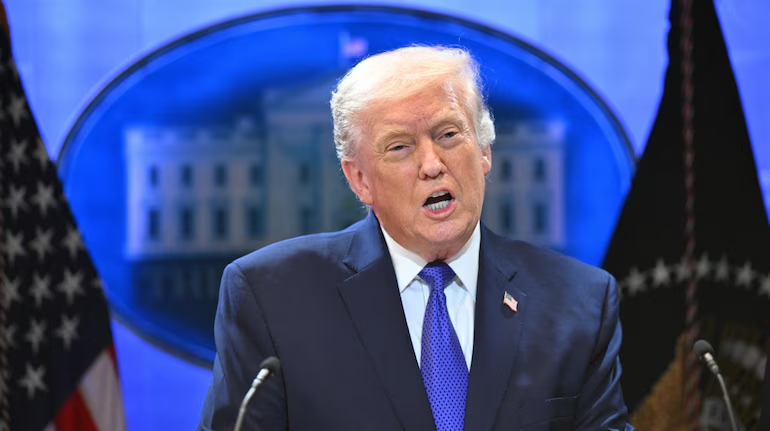
President Donald Trump is weighing whether the United States should launch a military strike against Iran, a nation that holds the world’s third-largest proven oil reserves and oversees one of the most strategically critical maritime corridors for energy shipments. The mere possibility of military escalation has already rattled global markets, sending crude prices higher and reigniting concerns about fuel affordability across the United States.
Brent crude, the global benchmark tracked by the International Energy Agency, has climbed sharply in recent sessions, briefly moving above $70 per barrel for the first time in months. US crude futures have added nearly $10 over the past month. Markets are reacting not only to the risk of physical disruption but also to uncertainty surrounding the next phase of American foreign policy in the Middle East.
Trump has indicated that a decision could come within days, suggesting both diplomacy and military action remain on the table. That ambiguity alone has been enough to inject volatility into energy markets already navigating fragile global supply chains and uneven economic growth.
The Strategic Stakes in the Strait of Hormuz
At the heart of market anxiety lies the Strait of Hormuz, a narrow waterway roughly 21 miles wide at its tightest point. According to the US Energy Information Administration, approximately 20 million barrels of crude oil pass through the strait each day, representing about one-fifth of global petroleum consumption. Any sustained disruption there could reverberate across continents within days.
Iran controls the northern coastline of the strait and has previously signaled its willingness to leverage that geography during periods of heightened tension. Even temporary military exercises in the area have historically triggered price spikes of $5 or more per barrel. Analysts warn that a prolonged closure could drive oil above $100 per barrel, though such a move would also carry severe economic consequences for Iran itself.
Oil exports remain a crucial revenue stream for Tehran. While energy represents roughly 10% to 15% of Iran’s gross domestic product, crude exports provide close to half of government revenue. Data compiled by the Organization of the Petroleum Exporting Countries shows Iran producing about 3.2 million barrels per day, accounting for roughly 4% of global supply. Restricting shipments would risk undermining its own fiscal stability at a moment of international sanctions and economic strain.
Additionally, the United States has increased its military presence in the region in recent weeks, potentially limiting Iran’s capacity to enforce a sustained blockade. Past disruptions, including the 2019 attacks on Saudi oil infrastructure, demonstrated that global supply systems can recover more quickly than initially feared.
Gas Prices and Political Pressure at Home
Even without a full blockade, a military confrontation could push oil another $10 higher per barrel. That would likely translate into higher gasoline prices across the United States, where consumers had recently enjoyed relative relief at the pump.
Average gasoline prices hovered near $2.80 per gallon a month ago but have since climbed closer to $2.92, according to figures tracked by AAA. Should oil approach $80 per barrel, national averages could again exceed $3 per gallon. For households already grappling with elevated housing costs and lingering inflationary pressures, even incremental increases at the pump can erode disposable income.
Affordability remains a sensitive political issue ahead of the midterm elections. While lower fuel prices previously helped offset broader economic concerns, a renewed spike would complicate messaging around economic stewardship. Analysts estimate that a $0.20 swing in gasoline prices can amount to between $100 and $200 annually per driver, depending on consumption patterns.
At the same time, broader fiscal pressures persist. Independent assessments suggest that tariff-related costs have added roughly $1,000 in annual burdens per household. In that context, energy volatility could amplify existing dissatisfaction with economic conditions.
Markets continue to weigh probabilities rather than certainties. Yet with Iran positioned at the crossroads of global oil flows and the United States signaling potential military action, energy prices remain acutely sensitive to developments that could unfold within days.