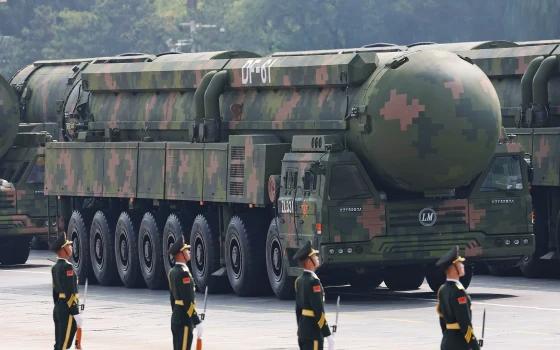
The United States has released new intelligence suggesting that China may have conducted a covert nuclear explosive test in 2020, reigniting tensions between the world’s two largest powers and raising fresh questions about nuclear transparency and global arms control commitments. The newly disclosed findings focus on a small seismic event detected in Central Asia that U.S. officials now say bears hallmarks of an underground explosion rather than a natural earthquake.
According to officials from the U.S. Department of State, the event occurred on June 22, 2020, when a remote monitoring station in Kazakhstan recorded a seismic disturbance measuring 2.75 magnitude. Though minor in scale, the signal’s origin pointed toward China’s primary nuclear testing site at Lop Nur, located deep within the country’s western desert. U.S. analysts argue that the seismic characteristics align more closely with an explosive detonation than a naturally occurring tremor.
Seismic data fuels nuclear test suspicions
U.S. arms control officials have publicly stated that the seismic signal’s waveform and location strongly indicate a singular underground explosion. During a policy forum hosted by the Hudson Institute, senior officials described the event as highly consistent with what nuclear scientists would expect from a low-yield test designed to refine weapons technology without triggering a full-scale nuclear blast.
Seismology experts acknowledge that some aspects of the data resemble known explosion signatures. However, the limited dataset complicates definitive conclusions. The signal was captured primarily at one monitoring station, making it difficult to triangulate the event with the precision typically required to confirm nuclear activity. Analysts familiar with nuclear monitoring networks note that even modern systems can struggle to distinguish between underground explosions and rare geological events when data points are scarce.
For readers interested in how global monitoring works, organizations like the Comprehensive Nuclear-Test-Ban Treaty Organization provide insight into the international verification infrastructure that tracks seismic anomalies worldwide. Additional analysis of nuclear transparency issues can be found through the Arms Control Association, which tracks global compliance trends.
China denies allegations amid growing rivalry
Chinese officials have firmly rejected the U.S. claims, calling them baseless and politically motivated. Beijing maintains that it remains committed to a moratorium on nuclear testing and has accused Washington of using allegations to justify its own strategic positioning. The dispute unfolds against a backdrop of intensifying geopolitical competition, where nuclear signaling increasingly plays a role in broader strategic narratives.
The allegations come at a time when global nuclear trust is already under strain. Neither the United States nor China has conducted a publicly acknowledged nuclear test in decades, and both nations have signed but not fully ratified the Comprehensive Nuclear-Test-Ban Treaty. That unresolved legal status leaves a gray area in enforcement and verification, allowing suspicions to emerge even in the absence of conclusive evidence.
China’s nuclear modernization efforts have drawn increasing scrutiny in recent years. Satellite imagery and open-source intelligence reports suggest expanded infrastructure at Lop Nur, including new tunnel construction and logistical upgrades. Analysts studying nuclear developments through institutions like the International Atomic Energy Agency emphasize that modernization alone does not prove testing but does signal long-term strategic investment.
Nuclear modernization without full-scale testing
Even without confirmed nuclear detonations, major powers continue to refine their arsenals using advanced technologies. In the United States, high-powered supercomputers simulate nuclear detonations, allowing scientists to validate weapon reliability without conducting live tests. Subcritical experiments—where small amounts of plutonium are detonated without triggering a nuclear chain reaction—remain a key part of maintaining existing stockpiles.
China is believed to be pursuing similar technical pathways, blending computational modeling with underground experimentation. Experts at the Carnegie Endowment for International Peace and other research institutions suggest that expanded facilities at Lop Nur could support a wide spectrum of activities, from materials research to weapons safety testing. While such work may technically fall short of treaty violations, it complicates efforts to build confidence between rival powers.
The renewed focus on the alleged 2020 test reflects broader anxiety about the erosion of nuclear arms control norms. With several Cold War-era treaties weakened or expired and verification mechanisms under political pressure, even ambiguous seismic events now carry significant diplomatic weight. As nuclear transparency declines, analysts warn that suspicion alone could fuel escalation, regardless of whether a definitive test ever occurred.