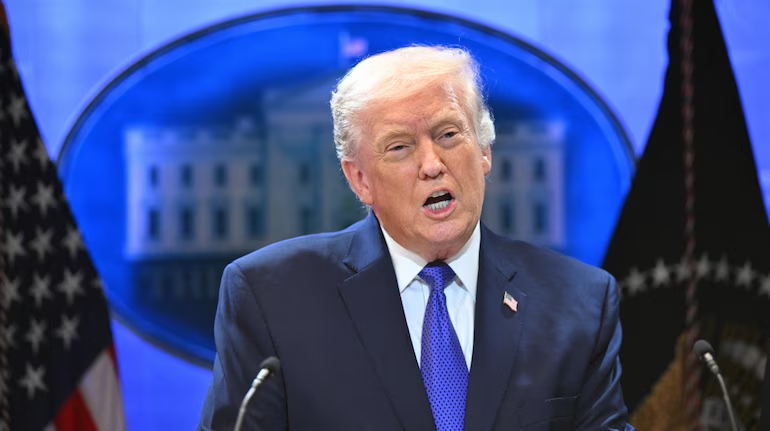
Former President Donald Trump sharply criticized a recent ruling by the U.S. Supreme Court that blocked his broad use of tariffs, calling the decision “deeply disappointing” and pledging to pursue new legal avenues to preserve his trade agenda. The decision represents one of the most significant legal setbacks for Trump since returning to the national political spotlight, potentially reshaping the future of U.S. tariff policy and executive authority over trade.
The high court ruled 6–3 that the International Emergency Economic Powers Act does not grant the president authority to impose sweeping tariffs, narrowing the scope of executive power over trade tools that Trump has long viewed as central to his economic strategy. Despite the ruling, Trump quickly moved to reframe the outcome, arguing that alternative legal mechanisms still allow him to advance aggressive trade policies.
Trump Attacks Justices and Doubles Down on Tariffs
In remarks following the decision, Trump criticized the justices who opposed his tariff framework, accusing them of political bias and failing to defend American economic interests. He argued that tariffs remain essential for protecting domestic industries, reshaping global trade dynamics, and pressuring foreign governments.
Trump has consistently framed tariffs as a cornerstone of his economic doctrine, often crediting them with reducing trade imbalances and strengthening U.S. negotiating leverage abroad. He reiterated that tariffs are not only economic tools but also geopolitical instruments capable of influencing diplomatic outcomes and trade alliances.
However, economic data has presented a more complex picture. While some federal analyses suggest tariffs could reduce long-term deficits by trillions of dollars over a decade, those same projections indicate that U.S. consumers shoulder much of the cost through higher prices. The tension between fiscal benefits and consumer impact continues to fuel debate among economists and policymakers.
Alternative Legal Paths Under Consideration
Despite the ruling, Trump emphasized that the decision does not end his tariff ambitions. He outlined several legal alternatives grounded in existing trade statutes that could allow the executive branch to impose tariffs under more narrowly defined authorities.
Among the options cited are provisions from the Trade Act of 1974, including Sections 122, 201, and 301, as well as Section 338 of the Tariff Act of 1930. These frameworks provide different pathways for implementing tariffs, though most come with limitations such as duration caps or congressional oversight.
For example, Section 122 allows temporary tariffs of up to 15% for a maximum of 150 days without immediate congressional approval. Trump suggested he may leverage this authority while simultaneously pushing lawmakers to support longer-term measures. He also floated the idea of imposing a 10% global tariff under alternative legal justification, signaling a potential shift toward more targeted but still expansive trade interventions.
Legal analysts note that these routes could prove more complex and time-consuming than the emergency powers framework struck down by the court. Still, they may offer stronger legal footing and reduce the likelihood of future judicial challenges.
Political and Economic Implications Ahead of Elections
The ruling introduces fresh uncertainty into U.S. trade policy at a politically sensitive moment. Businesses and investors have expressed concern about ongoing volatility, warning that fluctuating tariff policies could dampen investment and disrupt supply chains. At the same time, voters remain divided on the economic impact of tariffs, with polls indicating that a majority believe import duties ultimately harm the domestic economy.
Some lawmakers welcomed the court’s decision as a reaffirmation of congressional authority over trade policy, arguing that tariffs with widespread economic consequences should not be enacted unilaterally. Others fear the ruling could complicate future efforts to respond swiftly to global trade disputes or economic emergencies.
Trump, however, remains confident that he can continue deploying tariffs as a central element of his economic platform. He has signaled plans to sign new executive actions designed to maintain tariff pressure while navigating the legal constraints imposed by the court’s ruling.
As the political landscape evolves and trade tensions remain a defining feature of global economics, the battle over tariff authority is likely to remain a key flashpoint. The Supreme Court’s decision may have narrowed the legal path, but Trump’s rapid pivot suggests the broader debate over executive power in trade policy is far from settled.