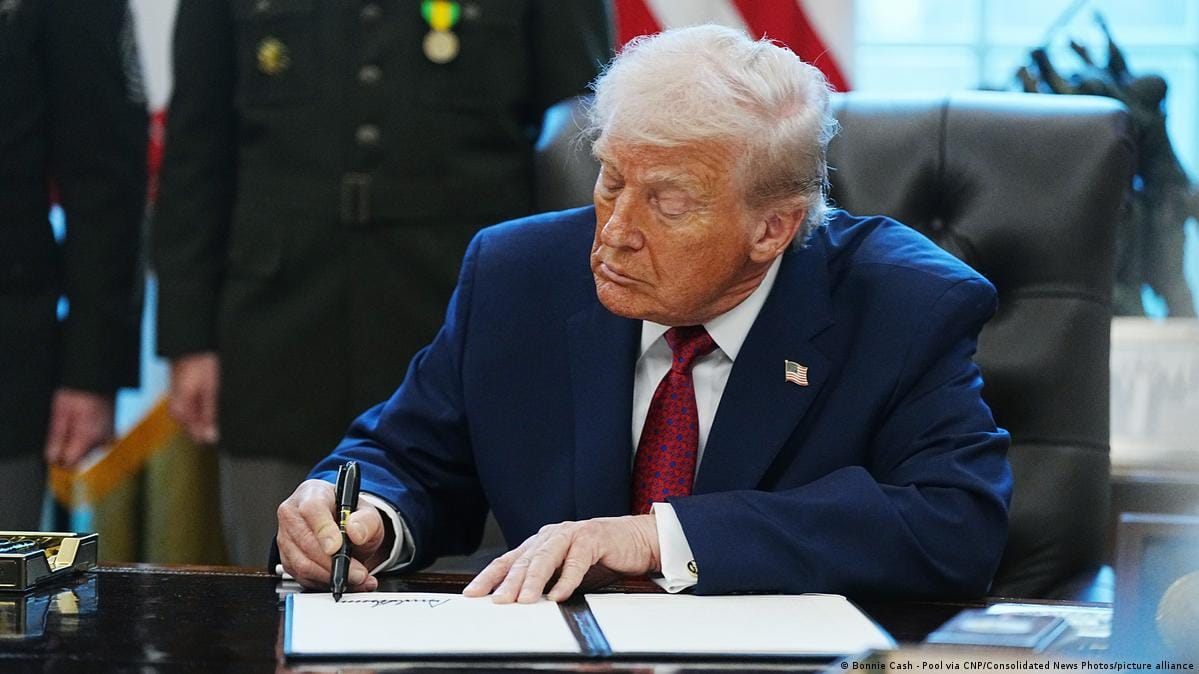
President Donald Trump’s decision to impose a sweeping blockade on Venezuelan oil shipments has intensified political and strategic tensions between Washington and Caracas, as U.S. lawmakers and federal agencies frame the move as a decisive escalation aimed at weakening President Nicolás Maduro’s hold on power. The policy, announced as a “total and complete blockade” on sanctioned oil tankers, extends beyond traditional maritime enforcement and places energy exports at the center of a broader geopolitical confrontation.
From the administration’s perspective, oil remains Venezuela’s most critical economic asset and a central source of foreign revenue. By restricting tanker movements and expanding maritime interdictions, U.S. officials argue that the blockade seeks to cut off financial lifelines tied to sanctioned entities while reinforcing existing economic measures already imposed on the Venezuelan government. Information on the broader framework of U.S. sanctions policy can be found through the U.S. Department of State at https://www.state.gov, where the administration outlines its approach to economic pressure and diplomatic leverage.
Congressional concerns over intent and scope
Democratic leaders in Congress have raised questions about the underlying objectives of the blockade, suggesting the move is less about maritime compliance and more about exerting direct political pressure on Maduro. Representative Adam Smith, the ranking Democrat on the House Armed Services Committee, has argued that the emphasis on oil shipments reflects a strategy designed to accelerate regime change rather than simply uphold international shipping regulations. According to this view, the pursuit of sanctioned tankers signals an expansion of executive authority in foreign policy, with implications for congressional oversight and long-term U.S. engagement in Latin America.
These concerns emerge as the Department of Homeland Security confirms that the U.S. Coast Guard has increased patrols and enforcement actions in waters near Venezuela. Several oil tankers linked to sanctioned networks have already been seized, while additional vessels remain under active pursuit. The Coast Guard’s role in maritime security and sanctions enforcement is detailed at https://www.uscg.mil, where operational mandates emphasize national security, economic protection, and international cooperation.
Maritime enforcement and energy security implications
The blockade places new emphasis on maritime enforcement as a tool of foreign policy, blending naval presence with economic sanctions. By targeting tankers suspected of transporting Venezuelan oil under false registries or through opaque shipping practices, U.S. authorities aim to disrupt what they describe as illicit energy flows. This approach also signals to international shipping firms and insurers that compliance risks have increased, potentially reshaping global oil logistics in the Caribbean and Atlantic regions.
Energy analysts note that Venezuela’s oil reserves remain among the largest in the world, making control over exports a strategic priority for both the Maduro government and its opponents. While Caracas denies allegations of asset theft and rejects U.S. claims over Venezuelan resources, the blockade underscores how energy policy has become inseparable from diplomatic pressure. Broader context on U.S. energy strategy and international markets is available through the Department of Energy at https://www.energy.gov.
Regional impact and future outlook
Beyond bilateral tensions, the blockade carries consequences for regional stability and international law. Neighboring countries and trading partners must now navigate tighter controls on shipping routes, while global energy markets monitor the potential effects on supply chains and pricing. Although the administration has framed the policy as a necessary step to recover assets and enforce sanctions, critics warn that prolonged maritime pressure could heighten risks of confrontation and complicate future negotiations.
As enforcement continues, the White House has indicated that additional measures remain possible if Venezuelan authorities do not alter course. Official statements and policy updates related to executive actions and national security priorities are published at https://www.whitehouse.gov, offering insight into how the administration links economic pressure with broader strategic goals. The unfolding blockade thus represents not only a challenge to Venezuela’s oil sector, but also a defining test of how economic power, maritime enforcement, and political objectives intersect in contemporary U.S. foreign policy.