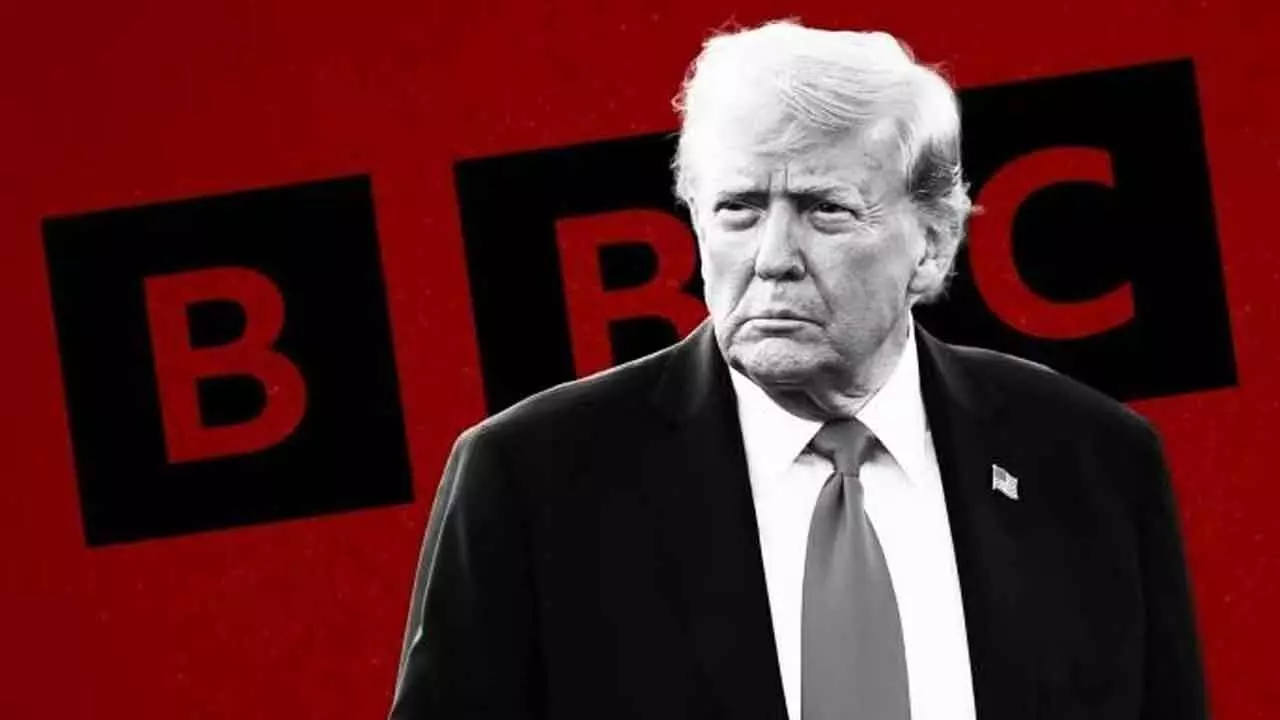
President Donald Trump has filed a $10 billion defamation lawsuit against the BBC, escalating his legal strategy against international media organizations and placing a major British public institution under scrutiny in a U.S. court. The lawsuit alleges that a documentary segment edited by the broadcaster presented a misleading and damaging portrayal of Trump’s remarks on January 6, 2021, resulting in reputational harm and alleged electoral interference.
The legal action goes beyond a dispute over journalistic standards. It raises broader questions about how international media content circulates across borders, how streaming platforms expand jurisdictional reach, and how emerging technologies complicate claims of audience exposure in defamation cases.
Editing practices and claims of misrepresentation
At the center of the lawsuit is an episode of a long-running BBC documentary series that combined separate remarks made by Trump on January 6 into a single sequence. Trump’s legal team argues that the edited presentation falsely implied a direct call to violence, omitting statements urging supporters to act peacefully. According to the complaint, this editorial choice transformed lawful political speech into an allegedly defamatory narrative.
The lawsuit asserts that this form of content manipulation crossed the line from permissible editing into fabrication, a claim that challenges long-established protections for editorial discretion under U.S. law, including principles outlined by the First Amendment and discussed extensively by institutions such as the Electronic Frontier Foundation at https://www.eff.org.
While the BBC has acknowledged editorial errors and withdrawn the program, Trump’s filing maintains that post-broadcast corrections cannot undo the reputational damage caused by widespread dissemination in the digital era.
Streaming platforms and audience reach in the United States
A significant portion of the lawsuit focuses on whether U.S. audiences, particularly voters in Florida, had meaningful access to the documentary. Although the program was not broadcast on American television, Trump argues that availability through streaming services expanded its reach. BritBox, a subscription-based platform jointly associated with British television content, is cited as a distribution channel accessible to U.S. viewers.
Streaming services have increasingly blurred geographic boundaries, a trend analyzed by the Federal Communications Commission at https://www.fcc.gov, as international media companies expand digital footprints without traditional broadcast agreements. Trump’s legal argument relies on the premise that even limited subscriber access can establish jurisdiction if the content allegedly caused harm within a specific state.
The lawsuit claims that subscribers in Florida were able to view the program, asserting that digital availability undermines arguments that the documentary was restricted to overseas audiences.
VPN technology and the challenge of proving exposure
The case also highlights the role of virtual private networks, or VPNs, which allow users to bypass geographic restrictions on online content. Trump’s filing argues that widespread VPN usage in Florida enabled access to BBC streaming services otherwise unavailable in the United States, thereby increasing potential exposure to the disputed documentary.
VPN usage has grown rapidly in recent years, driven by privacy concerns, cybersecurity awareness, and regulatory changes affecting online access. Organizations such as the Cybersecurity and Infrastructure Security Agency provide guidance on these technologies at https://www.cisa.gov. The lawsuit contends that VPN adoption makes it plausible that a significant number of viewers accessed the content, even without direct domestic distribution.
This argument introduces a novel dimension to defamation law, as courts must weigh hypothetical accessibility against demonstrable viewership. Legal analysts note that proving actual audience impact remains a critical hurdle in such cases.
By combining questions of editorial judgment, digital distribution, and technological circumvention, Trump’s lawsuit against the BBC presents a complex test of how traditional defamation standards apply in a globalized media environment shaped by streaming platforms and evolving online behavior.