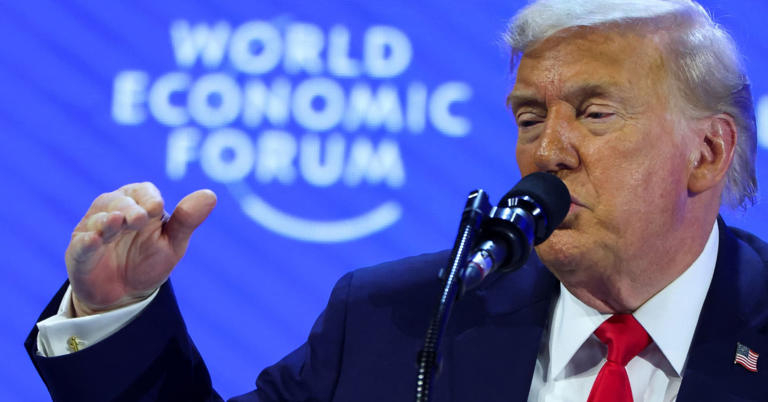
President Donald Trump has renewed pressure on U.S. lawmakers to enact legislation that would impose a 10% credit card interest rate cap, framing the proposal as a temporary measure aimed at easing the financial burden on American households. Speaking during an appearance tied to global economic discussions, Trump criticized prevailing credit card rates that frequently exceed 28%, arguing that such costs limit consumers’ ability to save, invest, and plan for major purchases such as homeownership.
The proposed cap would apply nationwide for one year and would require approval through the formal legislative process overseen by the U.S. Congress. Any bill advancing this initiative would need to pass through committees and floor votes detailed on the official legislative platform at Congress.gov, where similar consumer credit proposals have historically faced intense scrutiny and prolonged debate. Trump’s comments place renewed focus on whether lawmakers are willing to intervene directly in pricing mechanisms traditionally left to financial markets.
Financial Markets and Investor Confidence
Following Trump’s remarks, financial markets appeared to absorb the news with measured confidence. Shares of major banks moved higher, reflecting investor expectations that the proposed cap faces substantial political and institutional barriers. Market participants continue to view legislative action as less disruptive than executive or regulatory intervention, particularly when proposals involve temporary measures rather than permanent structural changes.
Credit card lending represents a significant portion of revenue for large financial institutions, and analysts warn that a fixed interest rate ceiling could alter risk-based pricing models. According to consumer credit data published by the Federal Reserve, lenders adjust interest rates to account for default risk, funding costs, and broader economic conditions. A uniform cap, critics argue, could result in reduced credit availability, especially for borrowers with lower credit scores.
Political Resistance and Legislative Uncertainty
Despite Trump’s influence within the Republican Party, resistance to interest rate controls remains strong among congressional leaders. Several lawmakers have expressed concern that government-imposed caps could distort markets and spill over into other industries reliant on consumer credit, including retail and travel. Past bipartisan efforts to regulate credit card APRs stalled amid similar objections, raising questions about whether the political environment has shifted enough to allow passage.
The issue has also drawn attention within broader policy discussions on global finance and regulation. Economic forums and policy analysis published by organizations such as the World Economic Forum frequently explore the balance between consumer protection and market efficiency, highlighting how aggressive price controls can produce unintended consequences across interconnected financial systems.
Banking Industry Pushback and Economic Warnings
Executives across the banking sector have voiced strong opposition to the proposed cap, warning that it could lead lenders to scale back credit card offerings or close accounts deemed higher risk. Industry leaders argue that existing consumer protection laws already regulate lending practices, and that additional restrictions could undermine access to credit for millions of Americans who rely on revolving credit for short-term financial flexibility.
Some financial leaders have suggested that limited regional trials could illustrate the real-world impact of interest rate caps before any nationwide rollout. Insights shared by major institutions, including policy perspectives available on JPMorgan Chase’s official website, emphasize that drastic limits on interest rates could significantly shrink the credit card market and reduce borrowing options for a large segment of the population.
As Trump continues to advocate for a 10% credit card interest rate cap, the proposal has reignited a long-running debate over affordability, regulation, and the role of government in consumer finance. Whether Congress translates the president’s call into legislative action remains uncertain, but the discussion has once again placed credit card interest rates at the center of the U.S. economic and political agenda.