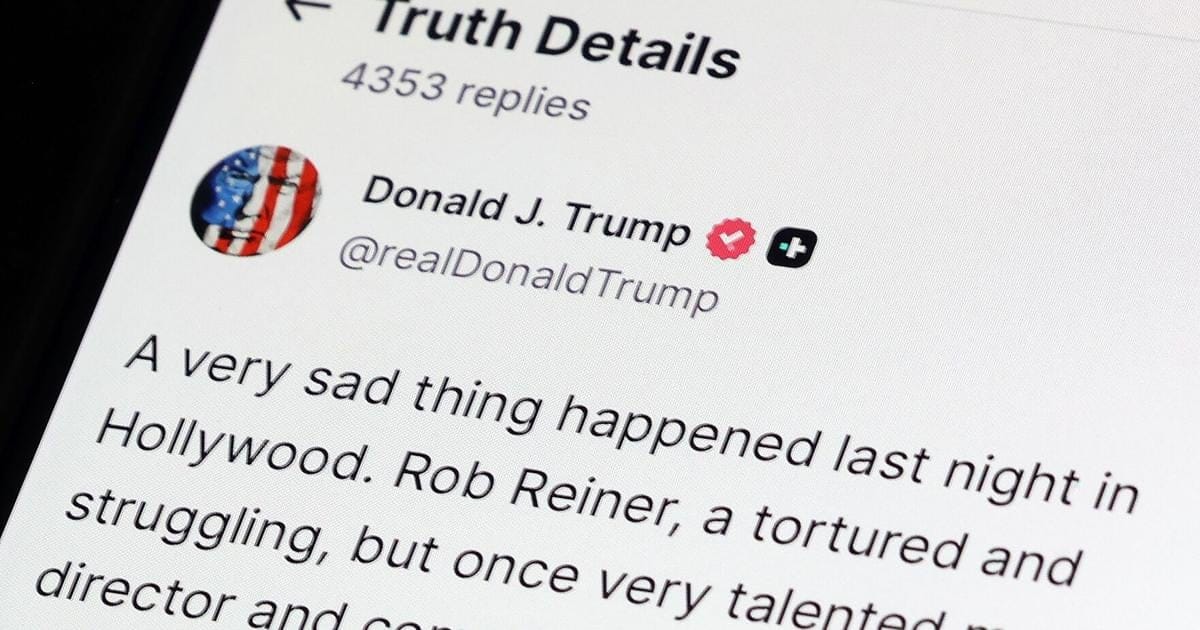
President Donald Trump addressed the death of filmmaker Rob Reiner in a social media post that quickly reverberated across political and cultural circles, adding a political dimension to an incident that authorities are treating as a potential homicide. Reiner, a veteran Hollywood director and actor, and his wife Michele were found dead in their home over the weekend, according to local officials. Their 32-year-old son, Nick Reiner, has been taken into custody as the investigation continues.
Reiner, widely known for his work in American film and television, was also a long-standing supporter of Democratic causes and an outspoken critic of Trump. In his statement, Trump framed Reiner’s public opposition to him as a defining feature of the filmmaker’s later years, using language that reignited debate over the role of political rhetoric in moments of personal tragedy. The remarks circulated rapidly online, drawing responses from political figures, cultural institutions, and members of the entertainment industry.
The deaths occurred amid heightened public attention on Hollywood and its intersection with politics, where prominent figures often occupy influential roles beyond their creative work. Organizations such as the Academy of Motion Picture Arts and Sciences (https://www.oscars.org) and the Directors Guild of America (https://www.dga.org) have historically acknowledged Reiner’s contributions to cinema, underscoring his legacy within the industry regardless of his political views.
Ongoing Investigation and Law Enforcement Response
Authorities responded to a medical assistance call at the Reiner residence on Sunday afternoon and discovered the bodies inside the home. Investigators have indicated that the circumstances surrounding the deaths warranted a criminal inquiry, and Nick Reiner was subsequently arrested. Officials have not publicly disclosed a motive, and the case remains under active investigation.
Law enforcement agencies continue to emphasize due process and caution against speculation as forensic analysis and interviews proceed. High-profile cases involving public figures often attract intense scrutiny, complicating investigations and amplifying the emotional toll on families involved. Guidance on criminal investigations and victims’ rights is outlined by institutions such as the U.S. Department of Justice (https://www.justice.gov), which highlights the importance of preserving the integrity of ongoing cases.
Nick Reiner has previously spoken publicly about struggles with addiction, a personal history that influenced creative projects he collaborated on with his father. Observers note that such background details are part of the broader family context but do not, on their own, explain the events under investigation.
Political Reactions and Public Discourse
Trump’s remarks drew criticism from across the political spectrum, including from members of his own party. Some lawmakers argued that the deaths should be treated strictly as a family tragedy rather than a political event. Others defended Trump’s right to express his views, reflecting the polarized environment in which statements by public officials are often received.
The episode has renewed discussion about the tone of political communication, particularly when it intersects with loss of life. Analysts point out that social media platforms have accelerated the speed at which such commentary spreads, magnifying its impact. Platforms like Truth Social (https://truthsocial.com) and X (https://www.x.com) play a central role in shaping real-time political narratives, often blurring the line between official statements and personal opinion.
Former political leaders and public figures also weighed in, emphasizing Reiner’s long-standing engagement with civic causes and his belief in public service. Their responses highlighted how cultural figures often become symbols within broader ideological debates, especially when their personal lives intersect with national politics.
Cultural Legacy Beyond Politics
Beyond the political reactions, Reiner’s career continues to be evaluated through the lens of his artistic contributions. His work influenced generations of filmmakers and audiences, and his projects remain part of the canon of modern American entertainment. Educational institutions and film archives, including the American Film Institute (https://www.afi.com), frequently reference his films in discussions of storytelling and cinematic history.
The intersection of art, politics, and personal tragedy raises enduring questions about how public figures are remembered. While political affiliations often shape public perception, many in the entertainment community stress the importance of separating creative legacy from partisan conflict, particularly during periods of mourning.
As investigators move forward with the case, attention remains divided between the legal process, the political fallout, and reflections on Reiner’s impact on American culture. The unfolding situation illustrates how high-profile deaths can rapidly evolve into multifaceted public events, shaped as much by political discourse as by the facts under investigation.