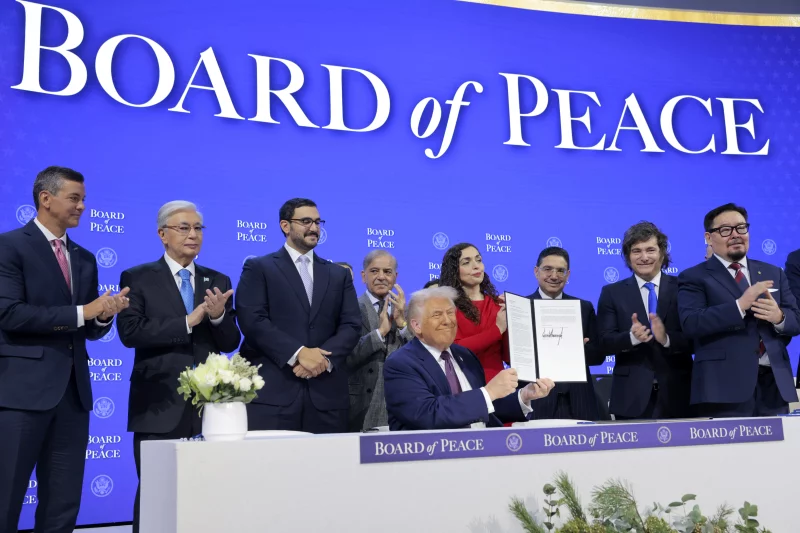
President Trump signed the founding charter of the proposed Board of Peace during the World Economic Forum in Davos, formally introducing a new international mechanism intended to oversee postwar stabilization, reconstruction, and governance in Gaza, with the option to expand into other conflict zones. The initiative marks a strategic departure from existing diplomatic models, positioning the board as a centralized authority designed to accelerate decision-making and implementation.
Trump emphasized that the board is not intended to function solely as a U.S.-led entity, framing it instead as a global instrument operating in coordination with existing international systems. The charter references cooperation with principles associated with the United Nations, particularly those related to post-conflict administration and peacebuilding frameworks defined under international law, while deliberately remaining outside formal U.N. governance structures.
From ceasefire enforcement to reconstruction governance
The Board of Peace is structured to bridge the gap between ceasefire maintenance and long-term economic recovery. Gaza’s reconstruction is expected to require funding well above $50,000,000,000, covering housing, energy systems, transportation infrastructure, and port development. Financial coordination under the board would mirror large-scale postwar rebuilding efforts historically overseen by global development institutions responsible for post-conflict recovery and fiscal oversight.
During presentations in Davos, visual development models outlined dense urban redevelopment, logistics corridors, and new commercial access points aimed at integrating Gaza into regional trade flows. The charter establishes oversight mechanisms to manage public spending, contractor accountability, and donor transparency, a structure designed to reassure international investors and governments concerned about governance and financial risk.
Security provisions are embedded directly into the economic framework. Reconstruction funding would be conditional on the dismantling of militant capabilities, with heavy weapons decommissioning treated as a prerequisite for infrastructure investment. These security benchmarks align with stabilization doctrines similar to those outlined by NATO in post-conflict environments, where civilian reconstruction is tied directly to enforceable security guarantees and long-term regional stability.
A scalable global framework beyond Gaza
Although Gaza remains the immediate focus, the charter explicitly allows the Board of Peace to operate beyond the region. Administration officials described the body as a scalable governance model applicable to future post-conflict scenarios where traditional diplomatic institutions have struggled to transition from humanitarian relief to functional state structures.
Under this model, the board would convene donor conferences, supervise interim administrations, and align security arrangements with macroeconomic policy. Financial stabilization tools referenced in the charter reflect mechanisms commonly associated with the International Monetary Fund, particularly in post-crisis environments where currency stability, fiscal discipline, and institutional reform are required to support long-term recovery.
Trump has argued that existing multilateral frameworks are often constrained by procedural delays and political fragmentation. The Board of Peace, by contrast, concentrates authority within a smaller leadership structure capable of rapid execution, while still engaging with international financial norms and governance principles.
European resistance and questions of legitimacy
Despite endorsements from several participating states, the initiative exposed sharp divisions among U.S. allies. Multiple European governments declined to sign the charter, citing concerns over legitimacy, leadership concentration, and the broader implications for international governance norms.
French officials raised concerns that the board could weaken established multilateral institutions, while leaders from the U.K., Belgium, Italy, and the Netherlands questioned whether a newly created body could operate within the boundaries of international law. These governments emphasized adherence to cooperative foreign policy structures tied to European diplomatic frameworks and collective decision-making principles.
The debate underscores broader uncertainty surrounding Gaza’s future governance. While the ceasefire has reduced large-scale hostilities, humanitarian needs remain acute, political authority is unresolved, and reconstruction timelines remain uncertain. The Board of Peace enters this environment as both an ambitious attempt to redefine post-conflict governance and a controversial test of whether centralized international authority can deliver stability where traditional systems have struggled.