President Donald Trump has announced that the United States will lift key export restrictions on Nvidia’s H200 chips, granting approval for shipments to commercial buyers. This is part of Nvidia H200 exports to China and several additional markets. The decision marks a strategic political and economic turning point within a global semiconductor race. This race continues to shape international power dynamics.
Nvidia’s H200 chip, the second most powerful AI processor in the company’s portfolio, has become crucial for high-scale artificial intelligence workloads. As the H200 reenters the Chinese market under controlled conditions, the U.S. government positions itself to maintain leverage over AI development. Additionally, it aims to generate new revenue tied directly to these high-value exports. Trump stated that President Xi responded positively to the policy shift, framing the agreement as a calibrated strategy. This strategy preserves national security while supporting American technological leadership. Nvidia remains at the center of this transformative moment. Demand for AI accelerates across industries including healthcare, finance, autonomous vehicles, and large-scale cloud services.
A New Phase in the U.S.–China Chip Relationship
The decision arrives after months of heightened tension between the world’s two largest economies over access to advanced AI hardware. Nvidia H200 exports to China play a key role. Meanwhile, Nvidia’s latest-generation Blackwell and Rubin chips remain restricted. The reintroduction of the H200 provides China with access to a highly capable, though slightly older, AI architecture.
Trump indicated that 25% of the revenue generated from H200 sales will be returned to the U.S. government. This reinforces a model he has already applied to agreements involving Nvidia and AMD earlier this year. To contextualize the significance of this shift, analysts point to a global chip market that surpassed trillions in value. It continues to reshape technological competition worldwide. Companies in both nations are aggressively scaling AI training capacity. They often rely on clusters of specialized GPUs.
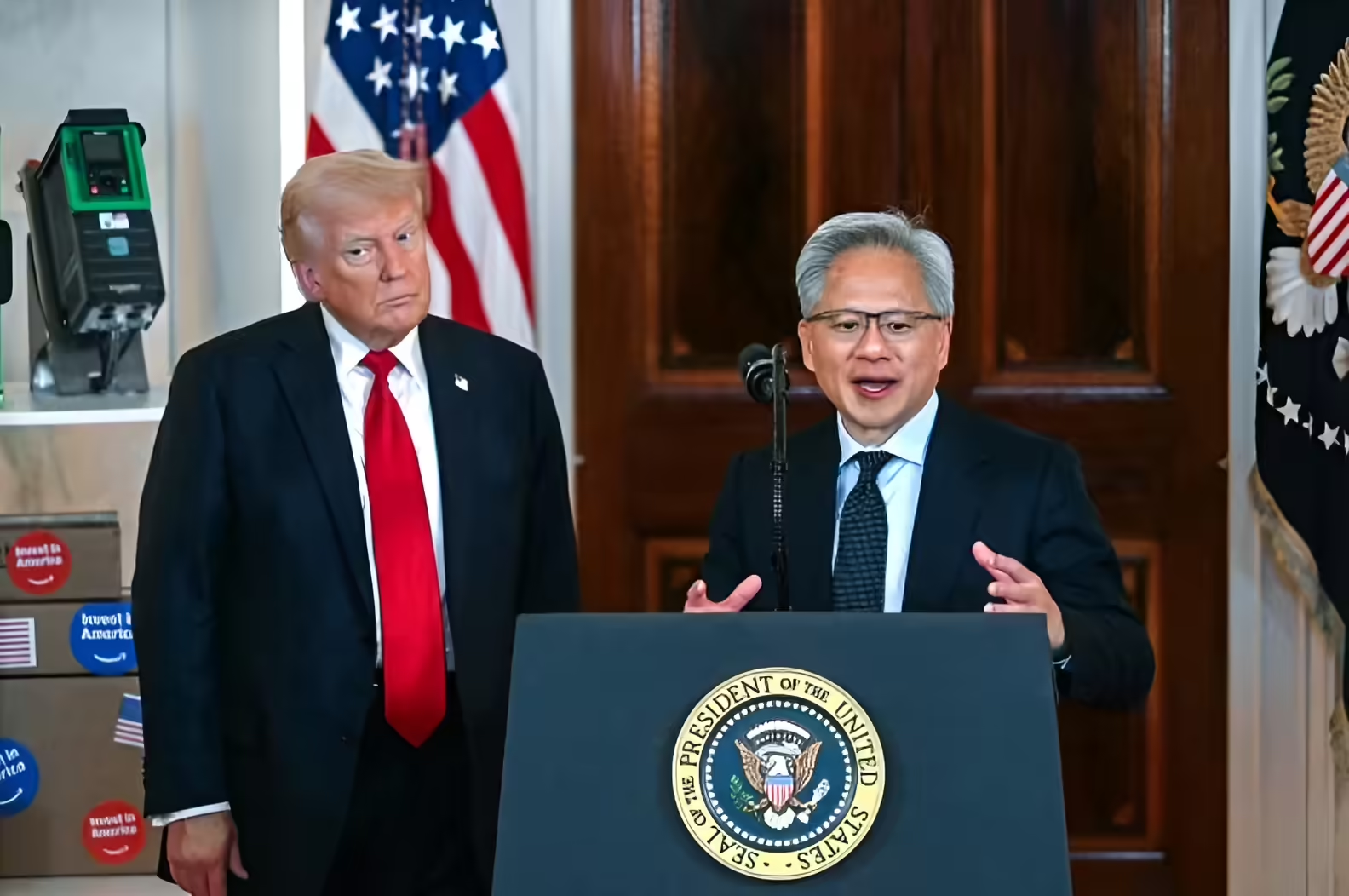
Trump’s decision follows his recent meeting with Nvidia CEO Jensen Huang. Huang has publicly emphasized the importance of open commercial channels to support the American semiconductor workforce. Context around the broader U.S. AI ecosystem can be explored through additional perspectives on innovation trends at theverge.com, which regularly reports on the evolving AI sector.
AI Leadership and Expanding U.S. Industry Influence
Industries across the U.S. increasingly depend on high-performance chips to maintain global competitiveness. This gives Nvidia and other semiconductor manufacturers substantial influence over the pace of innovation. The H200 decision echoes a broader strategy to ensure that U.S. firms remain central players within the international AI landscape. Trump revealed that the Department of Commerce is preparing a similar export framework for AMD, Intel, and other domestic chip providers.
This approach would reshape cross-border commercial flows throughout the tech sector. Nvidia H200 exports to China highlight the administration’s push. This push comes as China invests aggressively in its own semiconductor development. China seeks greater self-sufficiency in this area. Parallel coverage of semiconductor workforce expansion and investment trends appears on cnbc.com. There, industry analysis highlights how U.S. policy shifts impact global manufacturing and supply chains. Nvidia’s growing market value reinforces the significance of policies that allow American companies to participate in overseas markets while maintaining oversight of advanced technologies.
New Rules, New Revenues, and Expanding Federal Oversight
Trump’s remarks also underscore a new economic model in which the federal government directly participates in chip revenue, particularly from transactions involving China. As a result of the recent Nvidia H200 exports to China, agreements earlier this year compelled Nvidia and AMD to contribute 15% of revenue from Chinese chip sales to the U.S. Meanwhile, the government’s 10% stake in Intel further aligns public and private interests.
The new H200 policy accelerates this framework and grants Washington more influence over the flow of AI hardware worldwide. As the semiconductor race evolves, government analysts and industry leaders continue to monitor the impact on national security, corporate investment, and technological independence. Readers exploring AI policy shifts can find broader insights at axios.com, which frequently analyzes regulatory developments affecting major U.S. tech sectors.
Coverage of semiconductor trade strategies provides context for ongoing political and economic negotiations at reuters.com. The coming months will determine whether additional chip categories receive similar export permissions. Additionally, they will show how China positions itself to respond within a rapidly shifting AI landscape.