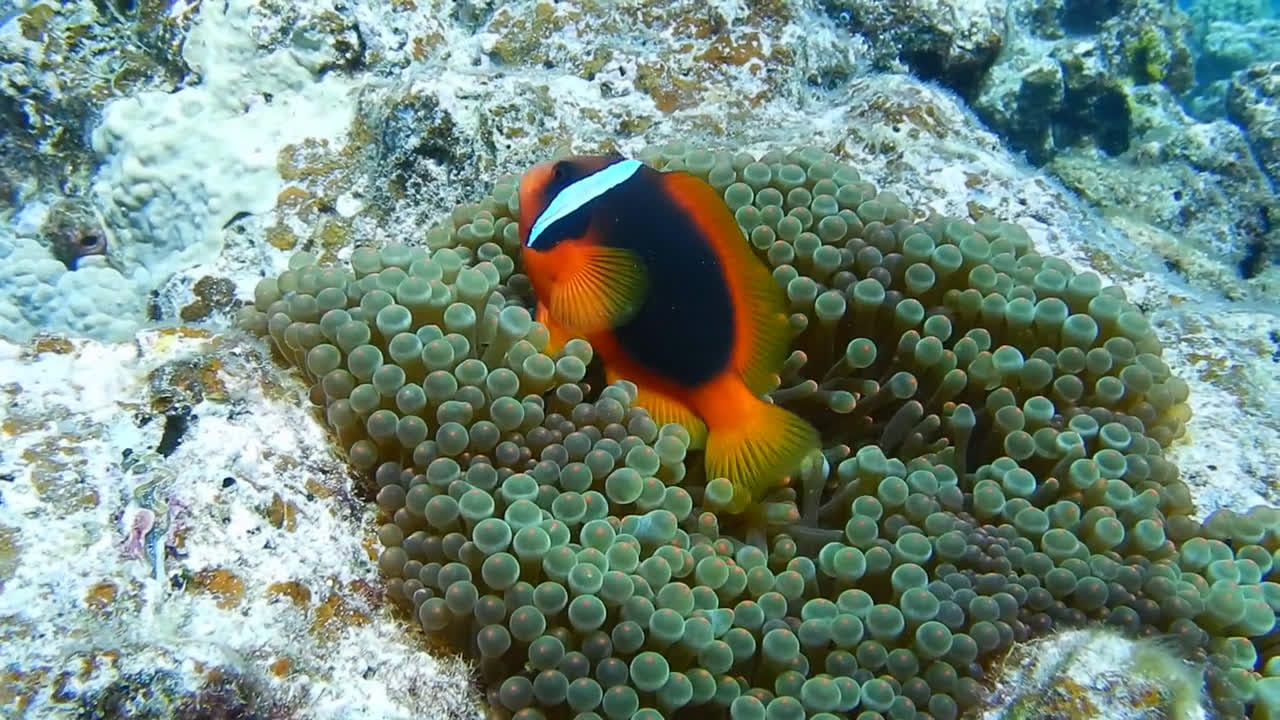
A new study reveals that tomato clownfish undergo a dramatic transformation as they mature, shedding most of their signature white stripes in response to social and environmental pressures. The findings shed light on how reef fish adapt physically to complex social hierarchies and offer new insight into how behavior and genetics intersect in marine ecosystems.
Unlike the iconic three-striped clownfish popularized by Finding Nemo, tomato clownfish begin life with multiple white bars that gradually disappear as they integrate into reef communities. The transformation, documented in research published in PLOS Biology, suggests that stripe loss is not just a developmental milestone but a flexible adaptation influenced by social cues.
Social hierarchy shapes physical appearance
Tomato clownfish inhabit bubbletip anemones across the western Pacific, forming tightly structured social groups dominated by a breeding female and a smaller male. Juveniles must navigate this rigid hierarchy quickly to survive. Multiple stripes initially signal youth and low rank, helping reduce aggression from dominant adults.
However, once young fish successfully integrate into the group, maintaining those stripes becomes unnecessary. As they mature, most of the white coloration fades, leaving a single stripe across the head — the defining mark of adulthood in the species.
Marine biologists at the Okinawa Institute of Science and Technology conducted controlled experiments to understand what drives this change. Juvenile clownfish raised without social cues retained their stripes longer, while those exposed to adult fish in natural anemone environments lost them significantly faster.
This suggests that stripe loss functions as a visual signal of social integration, allowing young fish to transition from outsiders to accepted members of the colony without provoking conflict.
Environment and genes work together
The research demonstrates that both environmental exposure and internal biology contribute to the transformation. Fish raised in tanks with live anemones but no adult clownfish showed slower stripe fading, highlighting the role of social pressure in accelerating physical change.
Genetic analysis revealed major shifts in gene expression during stripe loss. Cells responsible for producing white coloration gradually break down, effectively dissolving the visible bars. Hormonal pathways, particularly those linked to thyroid activity, appear to regulate this process.
These findings align with broader research on hormonal control of color change in marine animals, where thyroid signaling often governs growth, metamorphosis, and pigmentation shifts. For more context on marine hormone-driven development, see https://www.nature.com/subjects/thyroid-hormone.
By combining behavioral observation with molecular data, the study provides a rare full-spectrum look at how social interaction can directly shape an animal’s physical traits.
A visual language of survival on coral reefs
Coloration in reef fish often acts as a communication system, signaling dominance, reproductive status, or species identity. In tomato clownfish, stripe reduction appears to function as a badge of belonging — a way to signal acceptance into the group while minimizing aggression.
This plasticity highlights the adaptability of coral reef species living in crowded ecosystems where social positioning can determine survival. Similar dynamics are observed across reef fish communities, where coloration frequently evolves in response to social signaling and habitat pressure. An accessible overview of clownfish ecology is available at https://www.nationalgeographic.com/animals/fish/facts/clownfish.
Beyond behavioral ecology, the findings contribute to broader conversations about biodiversity. Color changes driven by social environments may help explain why closely related clownfish species show dramatically different stripe patterns. Some species gain stripes with age, while others lose them, suggesting that social systems can shape evolutionary outcomes.
Researchers unaffiliated with the work have emphasized the importance of integrating ecological and molecular perspectives. Studies like this bridge that gap by linking observable behavior with genetic mechanisms, offering a more complete picture of how animals adapt over time.
As coral reefs face mounting environmental stress, understanding adaptive traits like flexible coloration could become increasingly important. Behavioral plasticity may provide some species with tools to cope with rapidly changing habitats, while also revealing the delicate balance between social behavior and survival in marine ecosystems.
For readers interested in the original research context and related marine biology work, the study’s journal platform can be explored at https://journals.plos.org/plosbiology/, while institutional research updates are often shared through https://www.oist.jp/.
The discovery that tomato clownfish can alter their appearance based on social surroundings underscores a powerful idea: in the intricate world of coral reefs, even something as simple as a stripe can carry profound biological meaning.