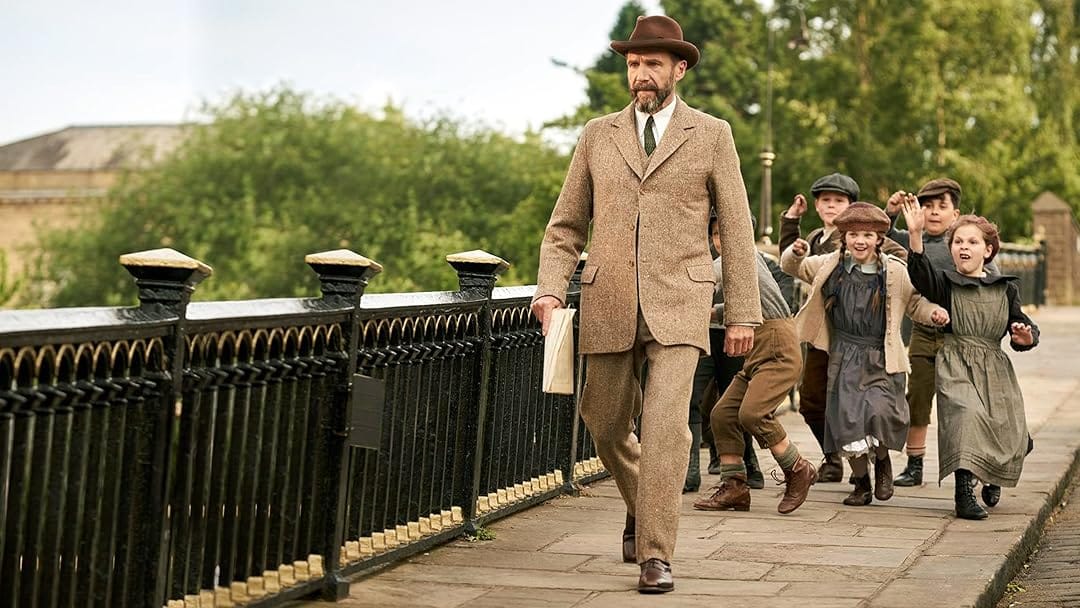
The historical drama The Choral is set in 1916, at a moment when World War I was reshaping communities across Europe. Against the backdrop of global conflict, the film focuses on Ramsden, a fictional town in northern England whose peaceful appearance contrasts sharply with the reality of conscription, loss, and uncertainty. As young men are sent to the front lines, daily life in the town becomes defined by absence, fear, and collective grief.
At the center of the story is Henry Guthrie, portrayed by Ralph Fiennes, a disciplined and demanding musician whose professional life has largely unfolded in Germany. His return to England places him in a complicated cultural position at a time when anything associated with German music is viewed with suspicion. When Ramsden’s choral society loses many of its male singers to the war effort, Guthrie is asked to rebuild the choir using those who remain behind, including women, older men, and boys too young to be conscripted.
Music as a Collective Response to War
As the war intensifies, the choir evolves into more than a musical group. It becomes a shared space where the town processes loss and uncertainty. Guthrie’s approach is strict, often abrasive, but rooted in a belief that discipline and artistic rigor can restore dignity and purpose. Through rehearsals, failures, and gradual improvement, the choir reflects the town’s emotional journey from fragmentation toward cohesion.
The film explores how music functions as a communal language during crisis. The choice to perform The Dream of Gerontius by Edward Elgar anchors the narrative in English musical tradition, offering a symbolic counterpoint to wartime nationalism. Information about Elgar’s legacy and influence can be explored through institutions such as the British Library, which preserves extensive records of British composers and cultural history.
Artistic Conflict and Cultural Identity
Due to wartime constraints, the large-scale oratorio is reimagined in a reduced arrangement. Guthrie adapts the work for a smaller ensemble, forcing innovation under pressure. This decision sparks tension, particularly when Elgar himself, depicted as deeply protective of his composition, reacts strongly to the reinterpretation. The clash highlights broader questions about artistic ownership, adaptation, and survival during wartime scarcity.
A wounded veteran is cast in a central role, blurring the boundary between performance and lived experience. His presence reinforces the film’s emphasis on authenticity and emotional truth. The impact of World War I on civilian life and artistic production remains a key subject of study, as reflected in educational resources such as the Imperial War Museums, which document how culture responded to conflict during the early twentieth century.
Cinema, Community, and Creative Collaboration
The visual scope of The Choral underscores the importance of place. The rolling landscapes and tightly knit streets of Ramsden emphasize the collective nature of the story, reinforcing the idea that war reshapes not only individuals but entire communities. The decision to tell this story through film allows the town itself to function as a central character.
The collaboration between director Nicholas Hytner and writer Alan Bennett brings decades of shared theatrical experience into a cinematic format. Their long-standing partnership, documented through organizations like the British Film Institute, reflects a commitment to character-driven storytelling grounded in social observation. The Choral emerges as a meditation on endurance, illustrating how artistic expression can sustain a community even as the world around it collapses.