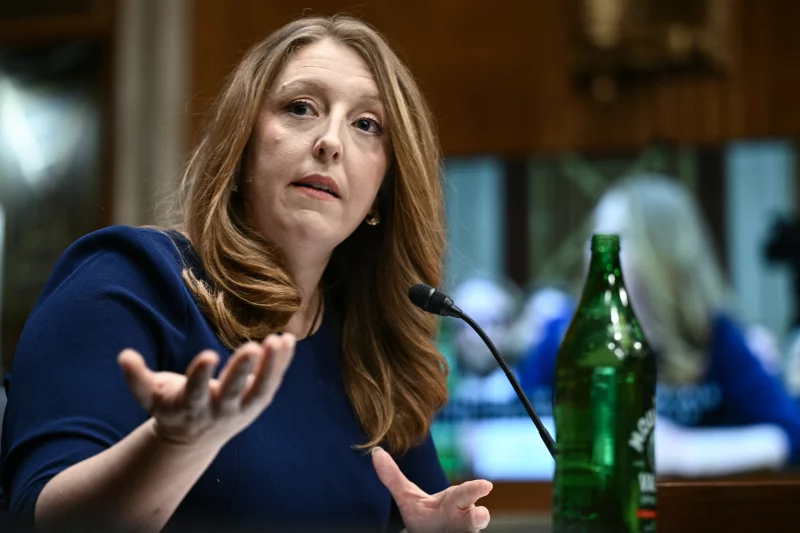
Dr. Casey Means, President Donald Trump’s nominee for US surgeon general, appeared before lawmakers for a closely watched confirmation hearing that highlighted sharp divisions over vaccines, reproductive health and potential financial conflicts. Testifying before the Senate Health, Education, Labor and Pensions Committee, Means sought to reassure skeptical senators while defending her broader health philosophy centered on nutrition and chronic disease prevention.
Means, a physician turned wellness entrepreneur and author, had previously postponed her hearing due to childbirth. On Wednesday, she praised Health Secretary Robert F. Kennedy Jr. and echoed elements of his “Make America Healthy Again” framework, emphasizing lifestyle change, environmental health and what she described as systemic contributors to chronic illness.
Throughout the session, senators from both parties pressed her on controversial public health topics. While she stated that vaccines “save lives,” she framed immunization decisions as matters for discussion between patients and doctors, rather than issuing a blanket endorsement for childhood vaccination schedules.
Vaccines, Autism and Public Health Policy
Questioned repeatedly about vaccine efficacy and safety, Means acknowledged that at the population level, flu shots reduce the risk of severe outcomes such as hospitalization. However, she stopped short of forcefully encouraging routine uptake, instead emphasizing informed consent and individualized medical decision-making.
When asked about the long-debunked link between vaccines and autism, she said she accepts the prevailing scientific evidence but added that scientific inquiry is always evolving. Her remarks came amid renewed debate over federal vaccine policy within the Department of Health and Human Services, where the surgeon general serves as a leading public health voice.
Means also addressed past statements in which she questioned aspects of the childhood vaccine schedule. During the hearing, she clarified that vaccines are not central to her public messaging and reiterated her broader focus on chronic disease, nutrition and environmental exposures.
Lawmakers raised concerns about whether her positions could influence public confidence in immunization programs administered in coordination with agencies such as the Centers for Disease Control and Prevention. Means responded that her goal is to ensure Americans have transparent information and access to personalized medical guidance.
Birth Control and Medical Oversight
Reproductive health policy surfaced as another flashpoint. Means said she supports broad access to oral contraceptives but stressed that patients should consult physicians about risks and benefits. Some senators asked whether birth control pills should be available without a prescription; she did not explicitly endorse over-the-counter availability, instead underscoring the importance of doctor-patient dialogue.
Her testimony also revisited earlier podcast appearances in which she questioned hormonal contraception and endorsed alternative health practices such as raw milk consumption. Critics argue that such positions diverge from mainstream medical consensus.
Means graduated from Stanford Medical School but left a surgical residency program before completion. She later founded a functional medicine practice and co-authored a book on metabolic health. In recent years, she has built a substantial online following while promoting wellness products and continuous glucose monitoring technology.
Financial Ties and Qualifications Under Review
Democratic senators scrutinized her financial disclosures, particularly her role in founding and promoting a health technology company. Means has pledged to divest from her business interests if confirmed. During questioning, she denied allegations that she failed to properly disclose financial relationships when recommending products, stating she would provide additional documentation if requested.
Professional organizations have also weighed in on her qualifications, noting that previous surgeons general typically held extensive clinical or public health leadership experience. The surgeon general oversees more than 6,000 members of the U.S. Public Health Service Commissioned Corps and serves as a key communicator of national health guidance.
Means defended her background as an asset, arguing that her experience addressing chronic disease outside traditional hospital settings gives her insight into systemic shortcomings. She described the current healthcare model as overly focused on treatment rather than prevention, pointing to rising rates of obesity, diabetes and other long-term conditions.
The hearing concluded after more than two hours of testimony, with committee members indicating that further deliberation would follow before a confirmation vote.