The recent decision by the Supreme Court to invalidate sweeping global tariffs imposed by US President Donald Trump has injected fresh volatility into global trade flows—while simultaneously strengthening China’s negotiating position ahead of a high-stakes summit in Beijing.
The ruling concluded that Trump exceeded his authority by invoking the International Emergency Economic Powers Act to justify broad tariffs affecting nearly all major US trading partners. In practical terms, the judgment strips away one of the administration’s most aggressive economic tools just weeks before Trump is scheduled to meet Chinese President Xi Jinping for a three-day summit centered on trade, technology policy and Taiwan.
Although the White House moved quickly to reintroduce 15% tariffs under an alternative trade statute, those measures are temporary and require congressional approval after 150 days. The abrupt policy reversal has left governments and multinational corporations recalculating supply chains, pricing strategies and diplomatic posture.
Legal Limits Reshape Trade Leverage
For years, tariffs were a defining feature of Trump’s economic diplomacy. By using emergency powers, the administration bypassed the lengthy investigative procedures typically required under US trade law. The court’s rebuke narrows that flexibility, underscoring that future tariff actions must align more closely with statutory frameworks and congressional oversight.
Details about the emergency authority in question can be found through the International Emergency Economic Powers Act, which grants presidents certain powers during national emergencies but does not explicitly authorize blanket global tariffs.
The immediate consequence of the ruling is reduced unpredictability for US allies, many of whom had faced elevated duties during previous trade disputes. Yet the geopolitical ripple effects extend further. Without the legal cover of emergency powers, Washington’s ability to threaten rapid, large-scale tariff escalation diminishes—altering the balance in its ongoing rivalry with Beijing.
Markets reacted with cautious optimism, but analysts noted that the strategic implications matter more than the short-term financial shifts. In negotiations, leverage often depends less on what is implemented and more on what can credibly be threatened. The court’s decision limits that threat.
China’s Expanding Economic Buffer
China enters the upcoming summit in a comparatively resilient position. Since the first round of trade tensions erupted in 2018, Beijing has diversified agricultural imports, strengthened domestic production capacity and redirected exports toward emerging markets.
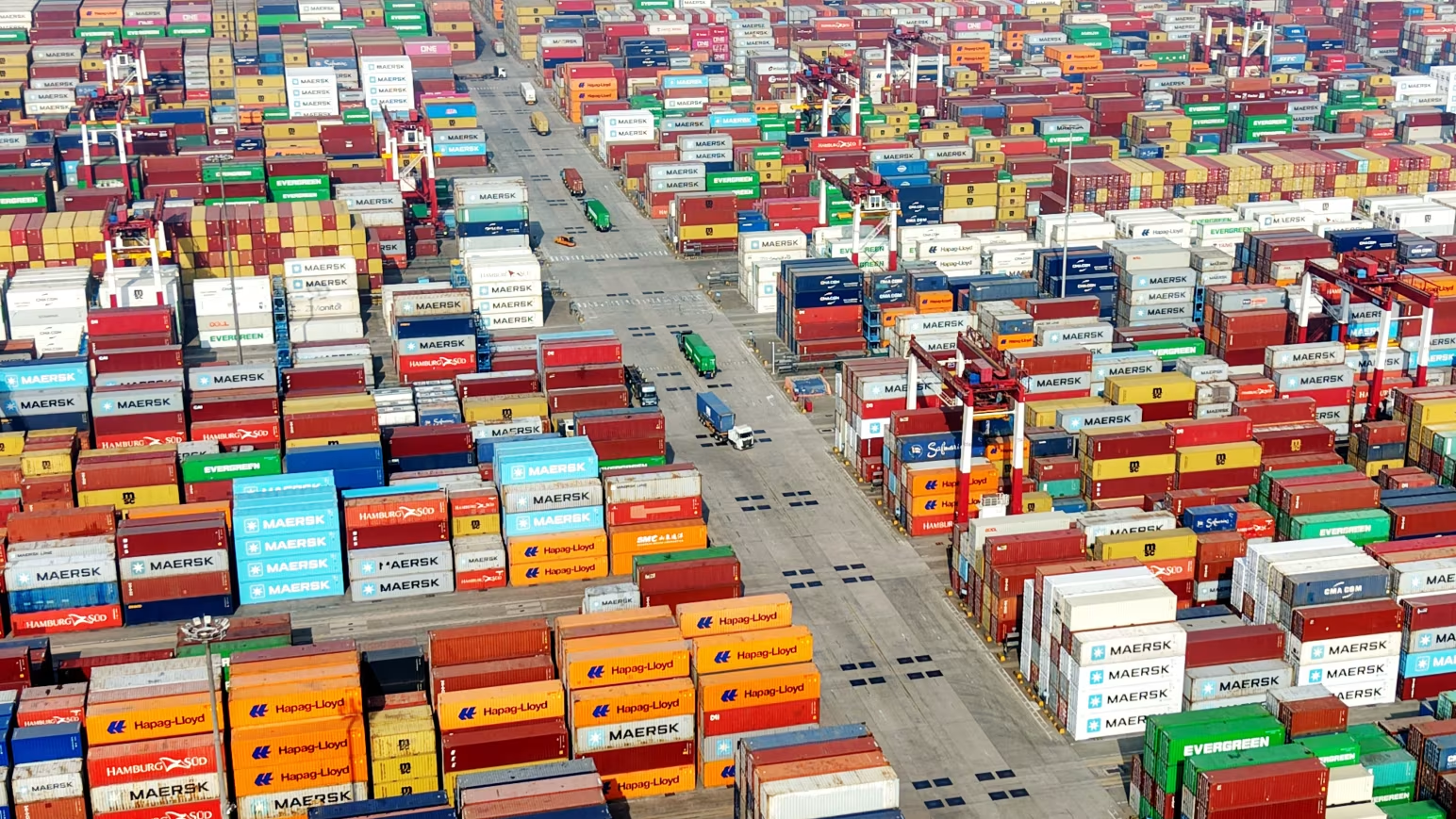
Trade data published by the General Administration of Customs of the People’s Republic of China show that the country recorded a $1.2 trillion trade surplus last year, reflecting both export strength and shifting trade routes. By expanding commercial ties across Southeast Asia, Latin America and parts of Europe, China has reduced its reliance on direct US demand.
At the same time, Beijing has demonstrated a willingness to retaliate proportionally. In response to US tariff hikes, it imposed duties on American imports and tightened controls on strategically vital exports, including rare earth minerals essential to electronics, electric vehicles and advanced defense systems. China processes the majority of the world’s rare earth supply, making such measures a potent bargaining chip.
While Washington may explore alternative trade statutes—such as national security provisions or unfair trade practice investigations—the procedural requirements are lengthier and more politically complex. Oversight from the United States Congress could further shape how and when new tariffs are authorized.
High-Stakes Diplomacy Ahead of Beijing Summit
The timing of the ruling magnifies its diplomatic weight. Trump’s forthcoming visit to Beijing marks his first trip to China since his earlier term and is expected to define bilateral relations for years. Issues on the agenda extend beyond tariffs to encompass semiconductor controls, artificial intelligence development, investment restrictions and security tensions surrounding Taiwan.
Economists estimate that average effective tariffs on Chinese goods could fall from 32% to 24% under the temporary replacement measures, narrowing the gap between China and other Asian exporters. That reduction eases immediate cost pressures on US importers but also reduces Washington’s economic leverage.
Beijing officials have signaled they are evaluating the ruling carefully and monitoring whether alternative tariff mechanisms emerge. Chinese policy experts suggest that if US tariff rates decline in a sustained manner, China could consider calibrated adjustments to its own trade measures. Conversely, any renewed escalation could prompt symmetrical responses.
For multinational corporations operating across both markets, the ruling underscores a broader truth: legal constraints in one capital can recalibrate power dynamics globally. As leaders prepare for face-to-face negotiations in Beijing, the court’s intervention has reshaped expectations about how far executive authority can extend in economic statecraft—and who stands to gain when that authority is curtailed.