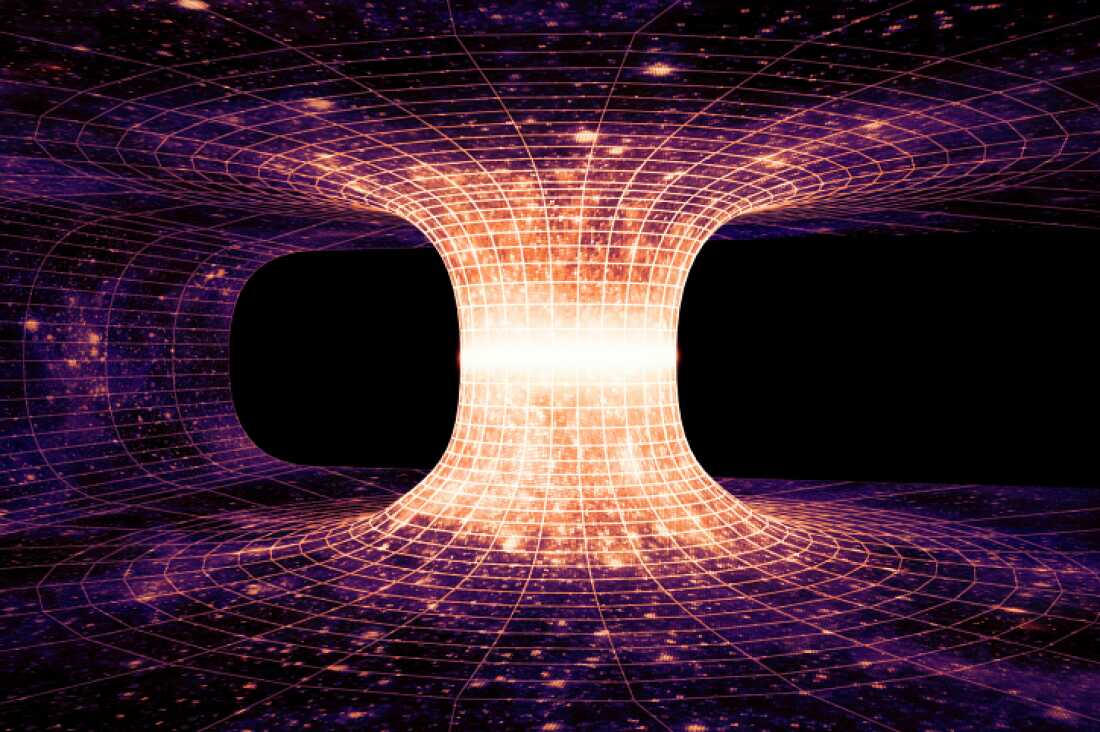
The fifth season of Stranger Things brings renewed attention to one of modern physics’ most intriguing ideas: wormholes. Set in the fictional town of Hawkins, Indiana, the series uses a classroom scene to translate complex scientific concepts into accessible language, capturing how theoretical physics has influenced both pop culture and public curiosity. While the show dramatizes these ideas through supernatural storytelling, the scientific foundation behind wormholes is rooted in decades of serious research and debate.
Wormholes have long fascinated physicists because they emerge naturally from Einstein’s understanding of the universe as a single fabric of space and time. Rather than treating space and time as separate entities, modern physics considers them woven together into spacetime, a framework that allows for surprising theoretical possibilities. Among these is the idea that two distant regions of the universe could be connected by a tunnel-like structure, creating what scientists describe as a shortcut through spacetime.
Wormholes and Einstein’s View of the Universe
The scientific origins of wormholes trace back to the General Theory of Relativity, published by Albert Einstein in 1915. This theory transformed how scientists understand gravity, replacing the idea of a force acting at a distance with the concept of curved spacetime. In 1935, mathematical solutions to Einstein’s equations suggested that spacetime itself could bend in such a way that two distant points become connected.
These theoretical structures, often referred to as Einstein–Rosen bridges, imply that the universe may allow connections that bypass conventional distance. Although these ideas remain hypothetical, they continue to influence research into black holes, quantum mechanics, and the limits of cosmic travel. Educational institutions such as https://www.nasa.govexplain how relativity reshaped astronomy and why concepts like wormholes remain essential to understanding extreme environments in the universe.
In Stranger Things, the idea of moving between dimensions without crossing physical space mirrors this scientific reasoning. While the show exaggerates the ease and stability of such passages, the underlying concept reflects real mathematical solutions that physicists still explore today.
Time, Space, and the Illusion of Distance
One of the most compelling aspects of wormhole theory is its relationship with time. In physics, time is not an absolute constant but part of the same continuum as space. This leads to counterintuitive implications, including the idea that extreme spacetime geometries could blur the distinction between past, present, and future.
Scientific discussions about time often focus on whether it is fundamental or emergent, a question that remains unresolved. Research centers and educational platforms like https://www.scientificamerican.com frequently explore how modern theories challenge everyday perceptions of time’s flow. Wormholes play a role in these discussions because, under certain theoretical conditions, traveling through one could resemble moving across time as well as space.
In popular storytelling, this concept translates easily into narratives about alternate dimensions and parallel worlds. Stranger Things uses this flexibility to connect emotional storytelling with speculative science, reinforcing why audiences remain captivated by stories that bend the rules of reality while staying loosely grounded in scientific thought.
Why Wormholes Remain a Scientific and Cultural Obsession
Despite their appeal, wormholes face major physical challenges. Current models suggest that maintaining a stable wormhole would require exotic forms of matter with properties not observed in nature. This limitation places wormholes firmly in the realm of theory rather than engineering. Nonetheless, they remain valuable tools for scientists investigating quantum entanglement, black holes, and the structure of spacetime itself.
Universities such as https://www.jpl.nasa.gov and research institutions worldwide continue to study extreme spacetime phenomena, not to build wormholes, but to test the boundaries of known physics. These investigations influence everything from cosmology to emerging quantum technologies, shaping how scientists think about information, causality, and the universe’s deepest laws.
Popular culture plays a significant role in keeping these ideas alive. By presenting wormholes as gateways to other dimensions, Stranger Things taps into decades of scientific speculation and storytelling tradition. Educational resources like https://www.space.com help bridge the gap between fiction and fact by explaining how real physics inspires imaginative narratives without claiming physical feasibility.
The enduring fascination with wormholes reflects humanity’s desire to understand whether distance, time, and even reality itself are as fixed as they appear. While science has yet to confirm their existence, wormholes continue to serve as a powerful intersection between theoretical physics and storytelling, demonstrating how complex ideas can resonate far beyond academic circles.