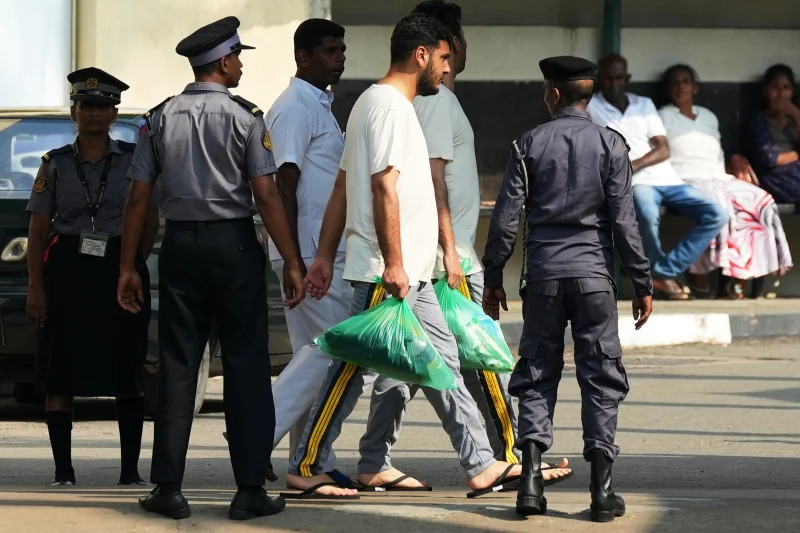
Sri Lanka has taken control of an Iranian naval vessel after transferring more than 200 sailors to shore for medical checks and administrative procedures. The decision came as tensions intensified in the Indian Ocean following the sinking of an Iranian warship during a confrontation involving a U.S. submarine.
Authorities in Colombo confirmed that 204 crew members from the IRIS Bushehr were escorted to the Welisara Naval Base near the capital. Upon arrival, the sailors underwent border control screening and medical evaluations conducted by officials from the Department of Immigration and Emigration Sri Lanka. None were reported to have serious health concerns.
Sri Lankan naval officials said a small group of approximately 15 Iranian crew members remained on the vessel alongside Sri Lankan personnel. Their role is to assist with interpreting technical manuals, operational procedures, and navigation logs while engineers evaluate mechanical problems that were reported by the ship’s captain.
Once preliminary inspections are completed, the vessel is expected to be escorted to the eastern port of Trincomalee, where it will remain under Sri Lankan supervision while authorities determine the next steps.
Naval Incident Raises Regional Tensions
The situation unfolded shortly after a separate Iranian warship, the IRIS Dena, was sunk off Sri Lanka’s coast. The attack represented one of the rare cases since World War II in which a submarine destroyed a surface combat vessel, highlighting the growing scale of military activity linked to the conflict involving Iran.
Before the incident, the Dena had participated in large multinational naval exercises hosted by India that included participation from dozens of countries and several major naval forces. The drills involved reconnaissance flights, maritime patrol operations, and cooperative maneuvers coordinated through the Indian Navy.
Officials said the Dena issued a distress signal shortly before it sank. Regional maritime authorities initiated rescue operations, and Sri Lanka’s navy launched its own mission to recover survivors.
Rescue teams managed to save dozens of sailors while also recovering many bodies from the surrounding waters. Iranian officials indicated that the warship had been carrying nearly 130 crew members at the time of the incident, which aligns closely with the typical crew size for vessels of that class.
The sinking has significantly increased diplomatic tensions in the region, with Iran strongly condemning the attack and warning of potential repercussions.
Sri Lanka Emphasizes Neutrality and Maritime Law
Sri Lanka’s leadership says the decision to assist the Iranian vessel and bring its crew ashore was guided by international maritime law and humanitarian principles rather than political considerations.
Government officials explained that the IRIS Bushehr had requested assistance after reporting a mechanical failure in one of its engines while navigating waters outside Sri Lanka’s territorial boundary. After consultations between the ship’s captain and Sri Lankan authorities, permission was granted for the vessel to receive support.
Legal experts note that countries responding to maritime emergencies are often guided by conventions linked to the United Nations Convention on the Law of the Sea, which outlines obligations to provide assistance to ships and sailors in distress regardless of nationality.
Sri Lanka’s strategic position in the Indian Ocean places it at the crossroads of several major shipping routes, making maritime stability essential to both regional security and global trade.
The government reiterated that its response was based on humanitarian obligations and a longstanding policy of neutrality in international conflicts. Analysts say maintaining that balance may become increasingly challenging as geopolitical tensions escalate across the region.
International organizations monitoring maritime safety, including the International Maritime Organization, have long emphasized the importance of cooperation among coastal states when responding to emergencies involving vessels in international waters.
For Sri Lanka, the operation underscores the complex role the country plays as both a regional maritime hub and a neutral actor navigating the competing interests of major global powers.