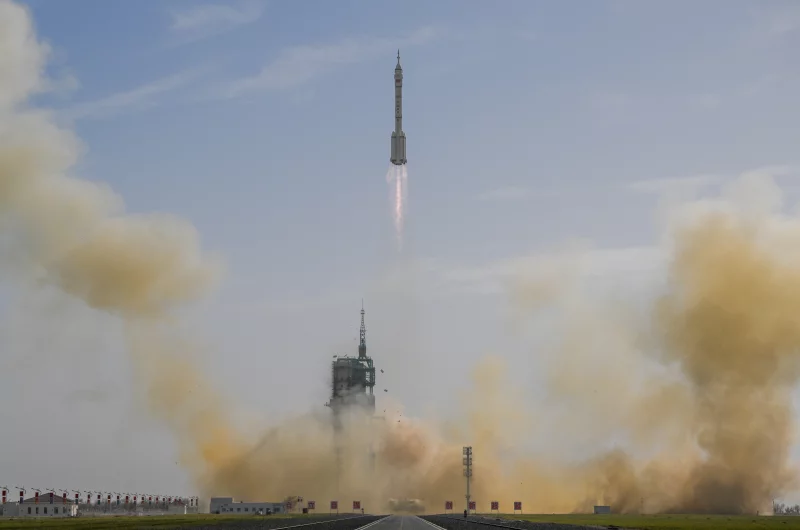
Shenzhou 22 Launch Marks A Critical Step in China’s Spaceflight Safety Strategy
China expanded its human spaceflight readiness with the launch of the Shenzhou 22 spacecraft. This marks an important milestone in the Shenzhou 22 China space mission. This mission is designed to guarantee the safe return of three astronauts currently stationed aboard Tiangong. The vehicle successfully docked with the orbital complex. It will serve as a backup return craft in 2026. This decision arose after engineers found that the existing Shenzhou capsule failed to meet updated safety standards. The decision emerged following structural damage discovered earlier this month on the Shenzhou 20 spacecraft. Chinese mission controllers adopted enhanced risk-mitigation protocols emphasizing redundancy, emergency preparedness and rapid deployment capability.
The incident occurred shortly after a separate crew experienced a nine-day delay returning to Earth due to a damaged window panel on their vehicle. That team ultimately reached Earth using the newer Shenzhou 21, which had recently delivered their replacements. This chain of events prompted Chinese planners to accelerate contingency planning. They ensure there will be no scenario where astronauts lack an approved and fully inspected return path. The growing complexity of China’s orbital operations is often analyzed by technology experts. They monitor aerospace advancements through platforms such as https://www.space.com. This platform regularly publishes updates on global space initiatives and mission progress.
Safety Failures Prompt New Technical Assessments of China’s Spacecraft Fleet
The damaged Shenzhou 20 spacecraft currently remains docked in orbit. It awaits controlled deorbit and comprehensive inspection to determine why it no longer meets the safety standards required for human transport. Engineers are expected to evaluate thermal shielding, structural stresses and pressurization stability. They will issue a full technical report afterward. Such analysis helps refine future designs. This is critical as China pushes toward a long-term vision that includes larger orbital facilities and potential lunar-bound missions.
The temporary uncertainty surrounding Shenzhou 20 led observers to reassess China’s rapid spaceflight expansion and the challenges of sustaining a continuously crewed outpost. Tiangong station, assembled module by module over several years, operates with smaller capacity than the International Space Station. Yet, it remains central to China’s broader ambitions in low-Earth orbit. For historical comparisons of space station engineering achievements, many analysts refer to publicly available research archives such as https://www.nasa.gov. This resource documents decades of orbital construction, maintenance strategies and engineering milestones across multiple nations.
While the stranded astronauts on Tiangong remain safe, the mission controllers sought to prevent the risk of an emergency occurring without a certified return craft. This scenario underscores why redundancy has become a core element of China’s spaceflight strategy. The Shenzhou 22 craft, now fully integrated with the station, will remain on standby until 2026. This ensures a secure path back to Earth under any circumstance. Technical discussions around spacecraft safety and deorbit procedures are also examined by data-driven organizations like https://www.esa.int. Here, frameworks for crewed mission safety are documented and compared across international space programs.
China’s Long-Term Human Spaceflight Ambitions Accelerate Beyond Tiangong
The launch of Shenzhou 22 highlights China’s determination to advance its space program. This persists despite geopolitical limitations and exclusion from international projects such as the ISS. After being barred from that partnership due to long-standing national security concerns, China built Tiangong as an independent orbital platform. It is capable of supporting scientific experiments, medical research, advanced manufacturing and ongoing astronaut rotations. Since its first crew arrived in 2021, the station has hosted numerous missions that have tested long-duration habitation capabilities and new engineering technologies.
China has also outlined goals including deploying larger orbital structures, expanding its robotic exploration missions, and preparing for human operations on and around the Moon in the 2030s. These ambitions align with the country’s broader technological priorities. They are frequently discussed by global policy analysts who follow international developments through sources such as https://www.cfr.org. Here, geopolitical implications of space leadership are frequently evaluated.
As China invests billions of dollars in space exploration, each mission—successful or flawed—adds to a growing body of operational experience. The Shenzhou 22 launch, driven in part by an unexpected technical failure, illustrates that the country is willing to adapt quickly. It reinforcess the systems required to maintain continuous human presence in orbit. With plans extending toward lunar bases and deeper-space science missions, the lessons learned from Tiangong’s operations will shape the nation’s next phase of exploration.