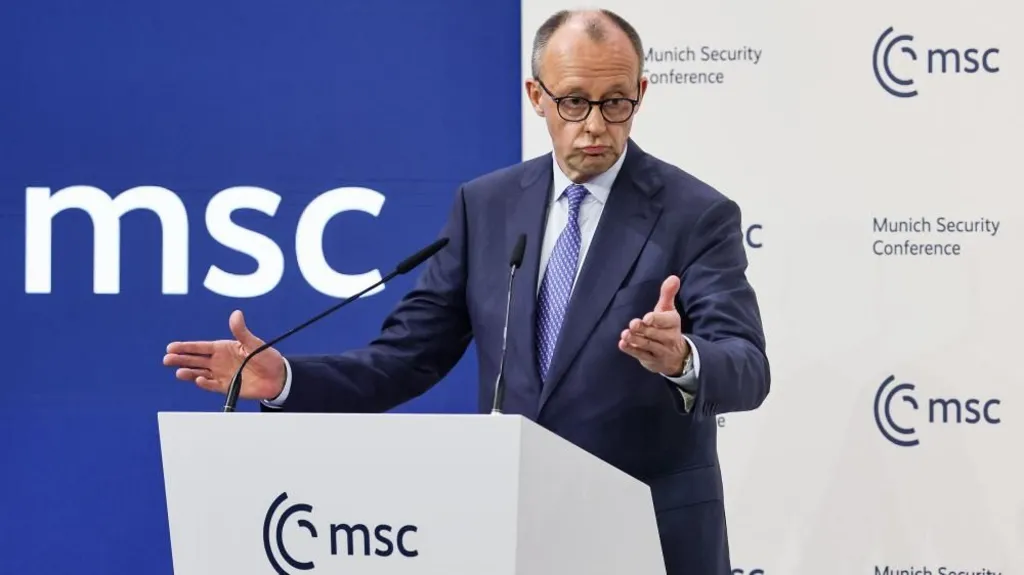
Germany’s chancellor has delivered a stark assessment of the global landscape, warning that the framework that once governed international relations has effectively fallen apart. Speaking at the Munich Security Conference, Friedrich Merz told world leaders that assumptions about stability, shared values, and predictable alliances no longer hold. In an era increasingly shaped by raw power politics, he argued, Europe can no longer take its security or prosperity for granted and must be prepared to accept difficult trade-offs.
Merz stressed that freedom itself now requires active defense. He warned that Europeans face a period in which strategic autonomy, economic resilience, and military readiness will demand sacrifices from governments and citizens alike. His remarks set a somber tone for a gathering already overshadowed by growing uncertainty in transatlantic relations and mounting global tensions.
Transatlantic Rift and Strategic Uncertainty
A central theme of Merz’s address was the widening gap between Europe and the United States. He acknowledged openly that a deep divide has emerged, fueled by disagreements over trade, security commitments, and political values. Recent statements from Washington, including renewed pressure on allies and threats to impose tariffs, have intensified concerns that long-standing assumptions underpinning the alliance may no longer apply.
Questions surrounding U.S. commitment to NATO have further unsettled European leaders. The debate has been sharpened by remarks from President Donald Trump suggesting that Greenland is vital to American national security, comments that have raised alarms in Europe about respect for allied sovereignty. While Trump has framed the issue as a matter of negotiation, European officials see it as emblematic of a more transactional and unpredictable approach to foreign policy emanating from the White House.
Despite the strain, Merz stopped short of dismissing the transatlantic partnership entirely. Instead, he called for efforts to repair trust, arguing that cooperation remains essential even as Europe prepares for a world in which U.S. priorities may increasingly diverge from its own.
Europe’s Push for Power and Deterrence
Against this backdrop, European leaders are reassessing their strategic posture. Merz revealed that confidential discussions are underway with French President Emmanuel Macron on the possibility of a joint European nuclear deterrent, a concept that reflects growing unease about relying solely on external guarantees. Such talks underscore a broader push for Europe to assume greater responsibility for its own defense and geopolitical standing.
Macron reinforced this message by urging Europe to become a genuine geopolitical power, capable of acting decisively in its own interest. He pointed to accelerated rearmament efforts following Russia’s invasion of Ukraine and argued that these steps must go further and faster. The war, he said, represents an existential challenge that requires unity and resolve across the continent, including within institutions such as the European Union.
As global rivalries intensify—from Eastern Europe to the Arctic and beyond—the conference has highlighted a shared recognition among European leaders: the old order is gone, and the task now is to navigate an unstable world with fewer certainties, stronger internal cohesion, and a readiness to act independently when necessary.