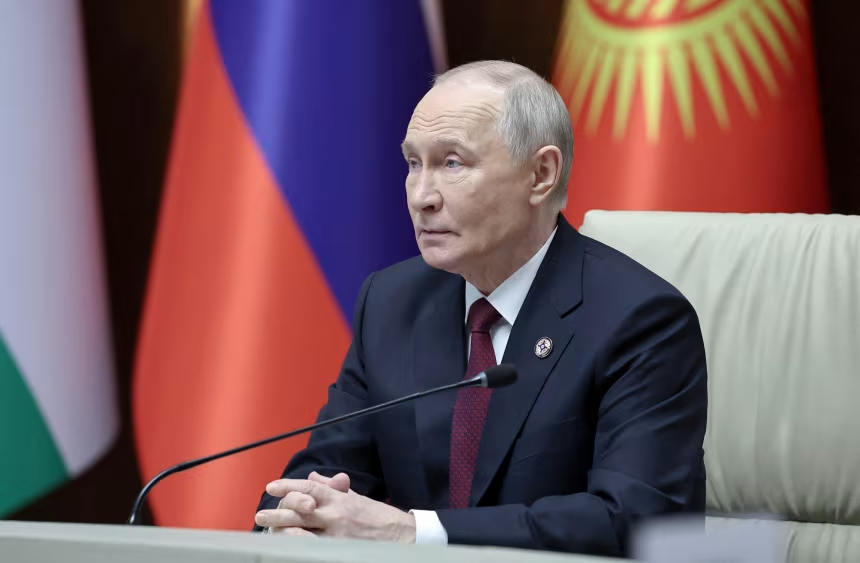
Russian President Vladimir Putin has intensified global concern by stating that a U.S. proposal could serve as the basis for a future peace agreement. However, he simultaneously warns that Moscow will seize Ukrainian territory by military force if Kyiv refuses to withdraw voluntarily. His remarks, delivered during a visit to Kyrgyzstan, underscore the contradictory strategy Russia is employing. They balance diplomatic signaling with aggressive territorial ambitions. The announcement arrives amid heightened tension across Eastern Europe. It prompts governments and analysts to monitor developments closely through platforms such as NATO for security updates, The White House for U.S. policy positions, Ukraine’s official government portal for Kyiv’s statements, and The European Union site for evolving diplomatic responses across the continent.
Escalating Russian Demands and Territorial Pressure
During his remarks, Putin reaffirmed Russia’s demands that Ukraine retreat from territories Moscow claims as its own. This demand persists despite international recognition of these regions as sovereign Ukrainian land. Russia currently controls roughly 20% of Ukraine’s territory. This includes nearly all of Luhansk and parts of Donetsk, Kherson, and Zaporizhzhia. These regions have been heavily militarized and politically integrated into Russia’s narrative of annexation, even though full military control has not been achieved.
Putin repeated that the war would only conclude once Ukrainian forces withdraw. He stated that Russia would secure these areas “through military means” if Kyiv refuses. This declaration follows weeks of Russian advances along parts of the eastern frontline, particularly around Pokrovsk. Russian troops have pressured defensive positions there. Even so, conflict analysts emphasize that Russia’s rate of advance remains limited. This challenges the assertion that Moscow is poised to seize large regions quickly. The military situation is further complicated by the so-called “fortress belt,” a network of heavily fortified Ukrainian towns. These towns are considered essential to national security. They serve not only as logistical anchors but also as strategic hubs. Kyiv and its allies view them as non-negotiable in any peace arrangement.
Diplomatic Maneuvers and U.S. Engagement
In Washington, officials have been increasing diplomatic activity through what has evolved into a complex negotiation process. Putin confirmed that a U.S. delegation led by Special Envoy Steve Witkoff is expected in Moscow next week. He frames the visit as an opportunity for “serious discussion.” However, Putin’s hardline conditions suggest that the likelihood of a rapid agreement remains slim. His continued insistence on maximalist territorial concessions conflicts with Washington’s evolving framework. This framework has undergone multiple revisions after strong objections from Kyiv and European partners.
The original 28-point draft of the peace plan reportedly faced heavy criticism for proposals that would restrict Ukraine’s military size and block NATO membership. These elements were revised after intense diplomatic debate. Yet the exact details of the new draft remain undisclosed. Putin’s acknowledgment that the updated plan could potentially serve as a foundation for future agreements marks a shift in tone. However, his parallel threats to continue the military campaign introduce deep uncertainty into the negotiation timeline.
Ukrainian and European Concerns Over Territorial Concessions
In Kyiv, leaders have repeatedly stated that surrendering territory is not a viable path toward ending the conflict. The government has emphasized that any diplomatic solution must preserve Ukraine’s sovereignty and international borders. This position is strongly reinforced by European allies. Across the continent, policymakers maintain that territorial concessions would set a dangerous precedent. This would affect not only Ukraine but global security frameworks dependent on territorial integrity and international law.
European governments, while supporting U.S. diplomatic engagement, insist that they must be included in any final settlement discussions. Territorial concessions remain a red line for both Ukraine and Europe. This is particularly crucial because the regions Russia demands include critical defensive infrastructure. These infrastructures have played a key role in slowing Moscow’s advances. European security officials warn that ceding these areas could significantly weaken Ukraine’s defense capabilities. It could also destabilize the region and embolden further territorial ambitions from Moscow.
Putin’s latest comments highlight the dual strategy of offering limited diplomatic openness while maintaining an aggressive military posture. By portraying himself as willing to engage in negotiation while threatening new offensives, Putin seeks to shape the diplomatic environment on his terms. This approach leaves Ukraine, the U.S., and Europe navigating a complex path forward. Every diplomatic attempt must be weighed against the realities of ongoing conflict on the ground.