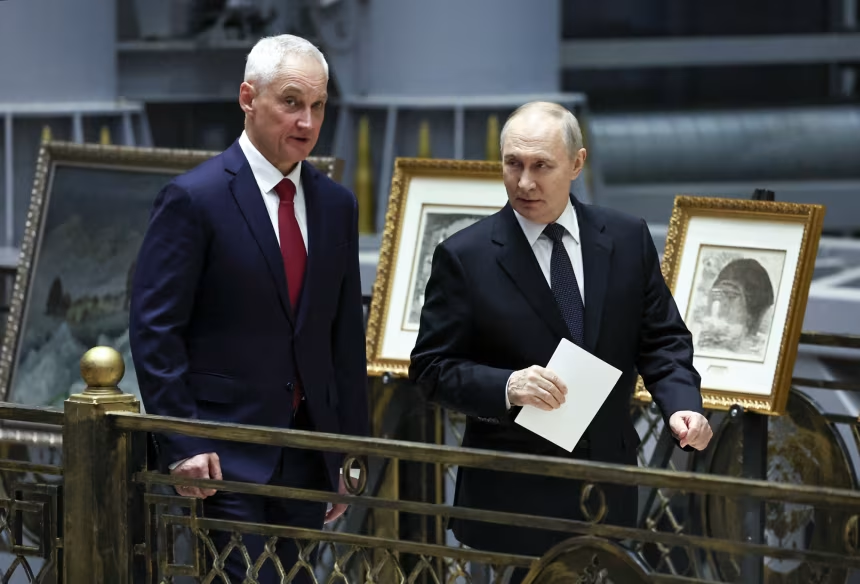
Russian President Vladimir Putin has delivered one of his clearest rejections yet of any territorial compromise in Ukraine. This signals that Moscow’s core demands remain unchanged despite renewed diplomatic pressure from U.S. President Donald Trump. Speaking during a high-profile meeting of Russia’s defense leadership, Putin framed the conflict as an existential struggle tied to what he described as Russia’s historical lands. He made it clear that Moscow views territorial concessions by Ukraine as non-negotiable. His remarks arrive as Washington and several European capitals intensify behind-the-scenes efforts to explore possible frameworks for de-escalation. This underscores the widening gap between diplomatic initiatives and battlefield realities.
Putin’s language reflected a hardened stance, portraying diplomacy as conditional and subordinate to Russia’s strategic objectives. While acknowledging that negotiations remain preferable in theory, he emphasized that military force would be used if talks fail to deliver outcomes aligned with Moscow’s demands. This posture complicates U.S.-led diplomatic outreach. Particularly challenging is the Trump administration’s attempt to position itself as a broker capable of pushing both sides toward a settlement. Broader context on U.S. foreign policy priorities and diplomatic initiatives can be found through official government resources at https://www.state.gov. Here, ongoing engagements related to Eastern Europe and global security are outlined.
Putin’s Strategic Message and the Territorial Red Line
At the core of Putin’s statement is an unambiguous red line: the territories Russia claims in eastern and southern Ukraine. By reiterating that these regions must be ceded, he reinforced Moscow’s view that the conflict is not merely about security guarantees or neutrality. Rather, it is about permanent changes to borders. This framing reduces the scope for compromise. Territorial integrity remains central to Ukraine’s national position and to international law principles upheld by Western governments.
Putin also directed sharp criticism at Ukraine’s European allies, accusing them of prolonging the conflict through military and financial support. His rhetoric suggests that Russia sees Western involvement as a primary obstacle to any settlement, rather than Ukraine’s resistance alone. This narrative aligns with longstanding Kremlin messaging presented through official Russian channels, including statements and policy positions published by the Kremlin. These consistently emphasize sovereignty claims and opposition to NATO expansion.
By casting the war as a struggle against foreign patrons, Putin is signaling both domestically and internationally that concessions would be interpreted as weakness. This stance resonates with a broader strategy aimed at sustaining domestic support while deterring external pressure. For negotiators, it presents a challenge: how to engage a leadership that publicly frames compromise as incompatible with national identity and security.
Trump’s Diplomatic Push and Western Coordination Challenges
President Trump’s push for peace has added a new dynamic to an already complex diplomatic environment. His administration has reportedly intensified outreach to both Kyiv and key European allies. The aim is to seek pathways to reduce hostilities and prevent further escalation. However, Putin’s remarks suggest that Moscow remains unconvinced that U.S. pressure alone can alter the strategic calculus driving the war.
European governments, meanwhile, continue to coordinate closely with Washington, balancing support for Ukraine with concerns about long-term stability. NATO remains a central forum for this coordination, particularly as member states assess the implications of a prolonged conflict on regional security. Information on NATO’s collective defense posture and its response to the war in Ukraine is available at https://www.nato.int. This resource details alliance policies, military readiness, and diplomatic engagement.
Trump’s involvement introduces political uncertainty, as allies weigh how U.S. leadership priorities may evolve. While diplomatic initiatives are welcomed, European leaders remain cautious about any settlement that could legitimize territorial changes achieved through force. This tension highlights the difficulty of aligning short-term peace efforts with long-standing security principles.
Global Implications for Ukraine, Europe, and International Order
Putin’s refusal to compromise on territory has implications that extend far beyond Ukraine. It challenges the post-World War II international order, which is built on the principle that borders should not be changed by force. For many countries, especially those with their own territorial disputes, the outcome of this conflict will set a powerful precedent.
International institutions continue to stress the importance of sovereignty and negotiated solutions. The United Nations has repeatedly emphasized the need for dialogue grounded in international law. This position is reflected in resolutions and statements available at https://www.un.org. Yet Putin’s remarks suggest that Moscow views these frameworks as secondary to strategic realities on the ground.
As diplomatic efforts continue, the gap between stated positions remains wide. Ukraine’s leadership has consistently rejected any proposal involving territorial concessions. Meanwhile, Russia’s demands appear firmly entrenched. The result is a prolonged standoff where diplomacy, military pressure, and geopolitical signaling are tightly intertwined. Putin’s latest comments make clear that, for now, Moscow is prepared to sustain the conflict. They do so rather than accept a compromise that falls short of its objectives. Consequently, this complicates Trump’s push for peace and reshapes the strategic landscape across Europe and beyond.