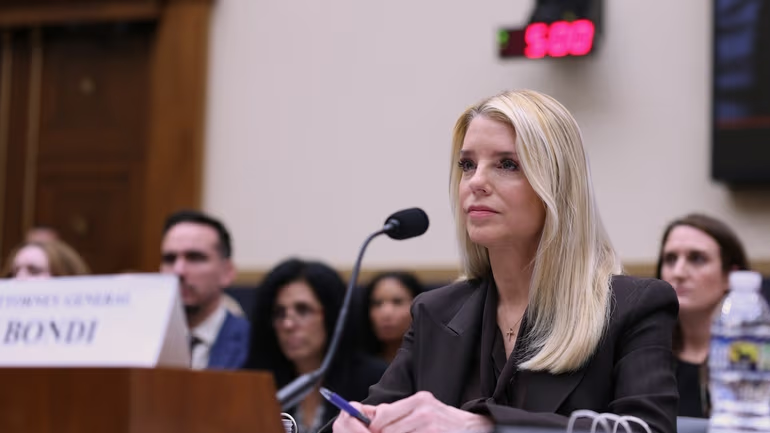
Attorney General Pam Bondi appeared before the House Judiciary Committee amid growing political and legal tensions surrounding her leadership of the Department of Justice. One year into her tenure, Bondi’s stewardship of the DOJ has triggered intense debate over the department’s independence, prosecutorial priorities, and the extent to which politics now influence federal law enforcement decisions. Her testimony comes at a critical moment, as lawmakers examine whether the nation’s top law enforcement agency has shifted away from long-standing institutional norms.
Bondi, a former Florida attorney general, now oversees a department with an annual budget exceeding $40,000,000,000, responsible for enforcing federal laws, combating organized crime, protecting civil rights, and safeguarding national security. Her leadership has drawn both staunch support and fierce criticism, particularly regarding personnel changes, politically sensitive prosecutions, and delayed disclosures related to the Jeffrey Epstein files.
Political Targeting and DOJ Independence
For decades, the Department of Justice maintained a tradition of operational independence designed to insulate investigations from political pressure. Under Bondi’s leadership, critics argue that this tradition has eroded, raising concerns among constitutional scholars and former DOJ officials. Lawmakers questioned whether investigations into prominent political figures were driven by legitimate legal standards or influenced by executive directives.
Several high-profile cases involving figures such as former FBI Director James Comey and New York Attorney General Letitia James intensified the debate. These cases, later dismissed by federal courts due to procedural concerns, underscored ongoing tensions surrounding prosecutorial authority and institutional checks and balances. Meanwhile, investigations into other public officials, including Federal Reserve Chair Jerome Powell and Democratic Senator Adam Schiff, have fueled arguments that the DOJ’s prosecutorial reach has expanded into politically sensitive territory.
Legal experts note that the department’s role in upholding constitutional protections is foundational to democratic stability. Institutions such as the Supreme Court of the United States (https://www.supremecourt.gov), the Department of Justice (https://www.justice.gov), the U.S. Congress (https://www.congress.gov), and the Federal Bureau of Investigation (https://www.fbi.gov) serve as critical pillars within the nation’s justice system, underscoring the importance of transparency, accountability, and procedural fairness.
Internal Restructuring and Workforce Departures
Bondi’s tenure has also been marked by sweeping changes across the DOJ’s internal structure. Entire divisions have experienced staffing reductions, particularly in public corruption prosecution units and civil rights enforcement teams. Several U.S. attorney’s offices, including the Minnesota district, have seen waves of resignations that some observers describe as unprecedented in modern DOJ history.
The departure of career prosecutors and investigators has raised concerns about institutional memory loss and long-term enforcement capacity. Critics argue that these personnel shifts weaken the department’s ability to pursue complex financial crimes, civil rights violations, and national security threats. Bondi, however, maintains that the restructuring is part of a broader strategy to realign departmental priorities, reduce inefficiencies, and strengthen enforcement against violent crime, drug trafficking, and immigration violations.
Federal spending dedicated to law enforcement modernization currently exceeds $12,000,000,000, aimed at improving technological infrastructure, forensic analysis, and cybersecurity resilience. Supporters of Bondi’s reforms argue that workforce restructuring enables more agile deployment of these resources.
Epstein Files and Congressional Pressure
Perhaps the most politically sensitive issue raised during the hearing involves the DOJ’s handling of the Jeffrey Epstein files. Lawmakers from both parties pressed Bondi on why mandated disclosures were delayed and why many documents were heavily redacted, despite statutory requirements for transparency.
Epstein’s case continues to have far-reaching legal and political implications, with victims, advocacy groups, and members of Congress demanding full disclosure. Bondi defended the department’s approach, citing ongoing investigations, privacy protections, and national security concerns. Nonetheless, bipartisan frustration has intensified calls for stricter oversight mechanisms and legislative reforms to ensure future compliance.
As Bondi’s tenure moves into its second year, the intersection of politics, law enforcement, and public accountability remains firmly in the spotlight. The outcomes of congressional inquiries and pending legal challenges are expected to shape not only her leadership but also the broader trajectory of the Justice Department for years to come.