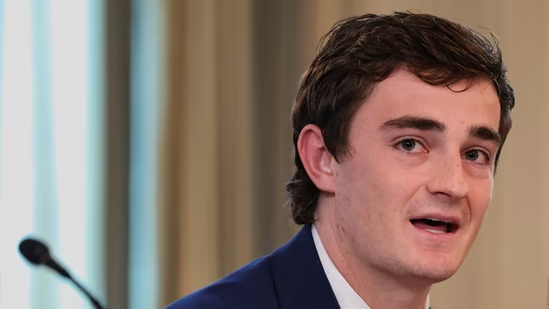
Nick Shirley, a 23-year-old independent content creator, has become a central figure in a national debate after publishing a viral video alleging large-scale fraud among federally funded daycare centers in Minnesota. The video, released shortly after Christmas, shows Shirley and an associate visiting multiple childcare facilities that appear unoccupied at the time of filming. During these encounters, staff members—many from Minnesota’s Somali community—are questioned about attendance levels and public funding while being accused of collecting federal funds without providing childcare services.
The allegations have escalated beyond online discourse. Federal officials confirmed that child care funding to Minnesota has been temporarily frozen while agencies review potential misuse of public dollars. The move places increased scrutiny on state-administered programs funded through federal initiatives designed to support working families and early childhood education, including those overseen by the U.S. Department of Health and Human Services and the Child Care and Development Fund administered nationwide through programs outlined at https://www.acf.hhs.gov.
Viral Investigations and Federal Response
Shirley claims his on-site visits uncovered more than $110,000 in alleged fraud tied to daycare reimbursement programs. While no formal audit connected directly to his video has yet confirmed those figures, the rapid federal response reflects broader concerns surrounding program integrity. Minnesota has faced multiple high-dollar fraud cases in recent years involving federally funded social programs, prompting ongoing reviews by agencies such as the U.S. Department of Justice, whose fraud enforcement framework is detailed at https://www.justice.gov/criminal-fraud.
Federal officials noted that investigative resources were already deployed to Minnesota before the video gained traction online, focusing on dismantling complex fraud networks exploiting public benefit systems. The viral nature of Shirley’s claims accelerated public attention, leading to political amplification and policy action before independent verification of the specific daycare centers shown in the footage.
Minnesota state officials have acknowledged the funding pause and emphasized cooperation with federal investigators. They have also reiterated that licensed daycare centers operate under strict reporting requirements set by state agencies, including Minnesota’s Department of Human Services, which publishes compliance and licensing standards at https://mn.gov/dhs.
Questions Over Evidence and Methodology
Despite the scale of online engagement—garnering tens of millions of views across platforms—questions persist regarding the methodology used in Shirley’s investigation. Some daycare operators featured in the video stated that visits occurred outside of normal operating hours, while others pointed to daily attendance fluctuations that may not be visible during brief, unannounced visits.
Child care policy experts note that reimbursement structures often rely on enrollment capacity rather than daily attendance, a model intended to ensure operational stability for providers serving low-income families. These funding mechanisms are explained within federal childcare policy guidance available through https://www.childcare.gov.
The situation underscores growing tensions between traditional regulatory oversight and crowd-sourced investigations driven by social media. While viral content can surface issues rapidly, experts warn that incomplete context or selective footage can influence public opinion and policy decisions before comprehensive reviews are completed.
Nick Shirley’s Rise and Political Impact
Shirley’s path to national attention did not begin with policy investigations. He built an online following through high-risk stunts, international travel videos, and confrontational interviews before shifting toward politically charged content after returning from a two-year religious mission in Chile. His recent work has focused on immigration, federal authority, and government spending, aligning his content with broader national debates over public accountability.
Since the release of the daycare video, Shirley has reported safety concerns and launched fundraising efforts for personal security while continuing to criticize Minnesota’s Democratic leadership and what he describes as institutional media failures. His supporters argue that independent creators play a critical role in exposing inefficiencies in government programs, while critics contend that complex social services require evidence-based evaluation rather than viral confrontation.
As federal agencies continue their review, the Minnesota daycare funding freeze highlights how digital influence, political momentum, and longstanding concerns about program oversight can converge rapidly. The outcome of the investigation may shape future approaches to childcare funding accountability and the role of social media-driven scrutiny in public policy enforcement.