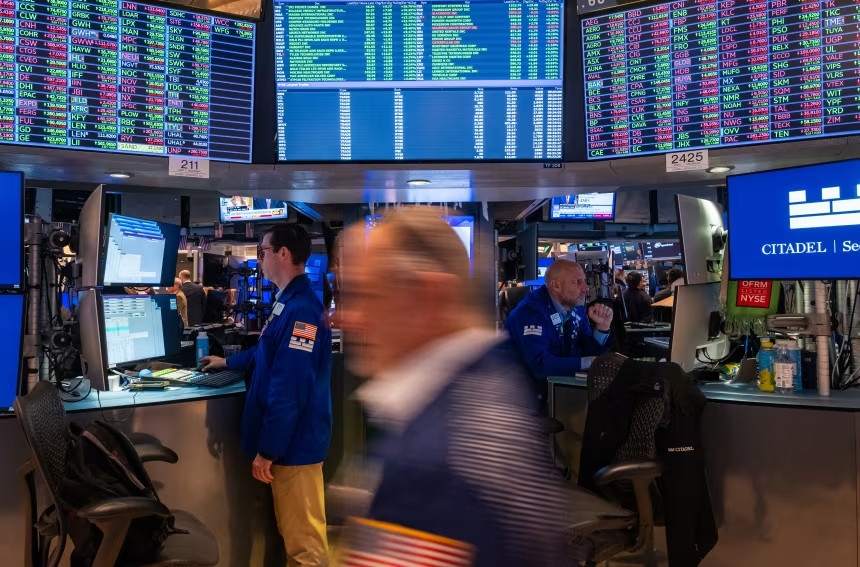
Technology stocks are no longer driving the US market with the same force that defined the past several years. After an extended rally fueled by optimism around artificial intelligence and productivity gains, the momentum has faded, leaving major indexes vulnerable to their weakest monthly performance since March. While volatility has unsettled investors, market strategists argue that disciplined portfolio management and sector rotation can help navigate the shift.
Tech Loses Momentum as Volatility Returns
It has been four months since the tech-heavy Nasdaq Composite reached a record high. Since then, enthusiasm surrounding artificial intelligence has cooled, and the broader S&P 500 has struggled to build on earlier gains. The index is now flat for the year and tracking its most challenging month since early spring.
By contrast, the Dow Jones Industrial Average, which carries less exposure to high-growth technology companies, has edged higher and is up about 1.5% year to date. This divergence underscores a broader rotation underway on Wall Street, as investors reassess risk and shift capital toward sectors perceived as more resilient.
The turbulence has been amplified by sharp single-day moves. The Dow recently dropped 704 points, or 1.42%, while the S&P 500 slid 0.95% and the Nasdaq fell 1.2%. At the same time, the CBOE Volatility Index, often referred to as Wall Street’s fear gauge, surged 15%, reflecting heightened anxiety.
Nearly 40% of the S&P 500’s total value remains concentrated in mega-cap technology names. That level of concentration has made the broader market especially sensitive to any disappointment tied to AI earnings, data center spending, or future profitability. Investors who believed technology would indefinitely power returns are now confronting a more nuanced environment.
Sector Rotation Creates New Opportunities
As the tech trade cools, other corners of the market are stepping forward. Energy, materials, and consumer staples have emerged as the strongest-performing sectors so far this year. An exchange-traded fund tracking energy companies has climbed 23%, while a comparable technology-focused fund has slipped 2%.
Portfolio managers say this rotation does not necessarily signal a collapse in tech fundamentals, but rather a recalibration of expectations. Concerns linger about whether the massive outlays—totaling hundreds of billions of dollars—on AI infrastructure will generate returns quickly enough to justify valuations. That uncertainty has pushed some analysts to downgrade the technology sector from overweight to neutral positions within diversified portfolios.
Rebalancing has become a common theme. Investors who accumulated large positions in AI-related stocks during the rally may now find themselves unintentionally overexposed. Adjusting allocations toward infrastructure, industrials, healthcare, and staples can reduce risk without abandoning growth entirely. Equal-weighted index strategies, which distribute exposure more evenly among companies, have also outperformed traditional market-cap-weighted approaches this year.
Importantly, market historians note that periods of sector rotation are common following powerful thematic rallies. Leadership often changes, and capital seeks areas offering relative value or defensive characteristics when volatility increases.
Diversification and Long-Term Discipline
While short-term swings can feel dramatic, the broader US equity market has historically delivered strong average annual returns over extended periods. For long-term investors, staying invested in diversified index strategies has often proven more effective than reacting to monthly fluctuations.
International diversification is another area gaining attention. Markets in Europe and Asia have outpaced US equities this year after recording solid gains in 2025. Expanding exposure beyond domestic holdings can smooth returns and reduce reliance on any single theme, including artificial intelligence.
Strategists emphasize that volatility itself is not unusual; rather, it is a normal feature of equity markets. What has changed is the concentration risk tied to a handful of technology giants. By spreading investments across sectors and geographies—and periodically reviewing allocations—investors can better position their portfolios for shifting conditions.
With sentiment still fragile and headlines moving prices rapidly, maintaining balance remains central. Whether through sector diversification, equal-weighted strategies, or increased global exposure, the current environment underscores the value of adaptability in an evolving market landscape.