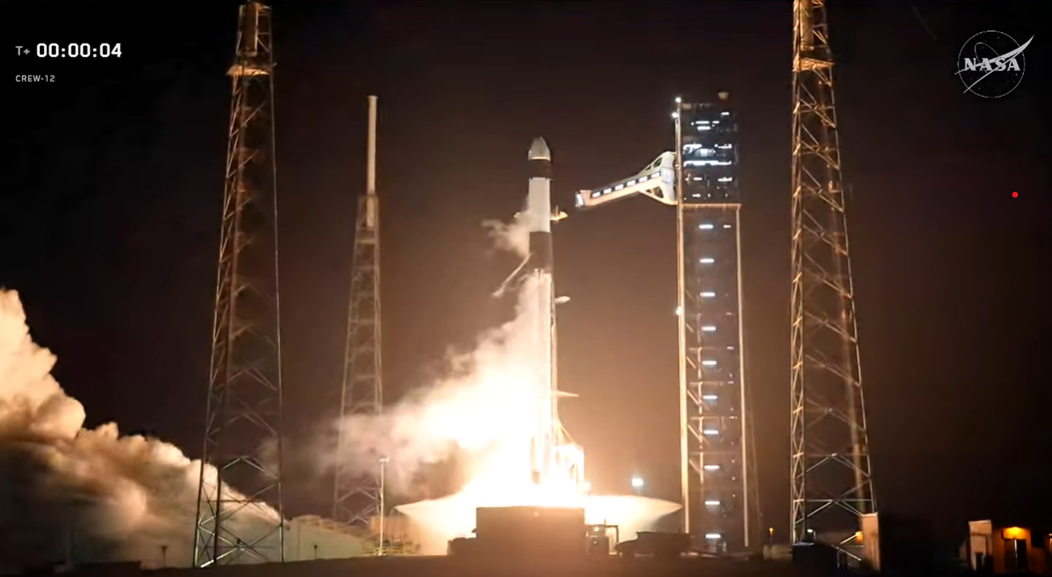
Four astronauts are on their way to orbit after a predawn launch that marked the start of NASA’s Crew-12 rotation to the International Space Station. The mission lifted off from Cape Canaveral aboard a Falcon 9 rocket operated by SpaceX, sending a multinational team into low Earth orbit for an extended stay focused on science, maintenance, and international collaboration. The launch restored a full crew complement aboard the orbital laboratory after weeks of reduced staffing and highlighted the ongoing partnership between commercial providers and NASA.
Crew-12 begins journey to the International Space Station
The Crew Dragon capsule separated smoothly from the Falcon 9 after a roughly nine-minute ascent that illuminated the early morning sky and placed the spacecraft on a precise orbital trajectory. The crew is expected to dock with the International Space Station the following day, Eastern time, completing an automated rendezvous sequence that has become standard in modern crewed spaceflight.
On board are commander Jessica Meir and pilot Jack Hathaway representing NASA, alongside European Space Agency astronaut Sophie Adenot and Russian cosmonaut Andrey Fedyaev. The four-member team is scheduled to spend approximately eight months in orbit, conducting a broad portfolio of scientific investigations ranging from microgravity biology and materials science to Earth observation and technology demonstrations.
The mission restores the station’s typical staffing level after an unusual period with only three astronauts on board. NASA’s previous rotation returned to Earth earlier than planned due to a medical issue involving a crew member, marking the first time in the station’s 26-year operational history that a health-related evacuation shortened a standard mission timeline.
Science, maintenance, and international cooperation
Crew-12’s objectives extend well beyond routine operations. The astronauts will oversee dozens of experiments designed to support future deep-space exploration while delivering insights with direct benefits on Earth. These include studies on how prolonged microgravity affects the human body, advanced plant growth trials for sustainable food systems, and research into new manufacturing techniques that leverage the unique conditions of orbit.
Maintenance and infrastructure upgrades will also play a central role in the mission. The crew is expected to support battery replacements, solar array optimization, and internal systems checks that ensure the aging outpost remains operational well into the next decade. Such work is critical as NASA and its partners transition toward a future that includes commercial space stations and extended lunar missions.
International collaboration remains a defining feature of the ISS program. With crew members from the United States, Europe, and Russia, Crew-12 underscores the station’s role as a shared platform for peaceful scientific advancement, even amid shifting geopolitical dynamics. Multinational crews allow agencies to share costs, pool expertise, and maintain continuous human presence in orbit.
Veteran leadership and first-time flyers
The Crew-12 roster blends experience with fresh perspectives. This marks a second journey to orbit for both Meir and Fedyaev, while Hathaway and Adenot are embarking on their first spaceflights. That balance is designed to ensure continuity of operational knowledge while cultivating the next generation of astronauts prepared for missions beyond low Earth orbit.
Meir previously made history during her last visit to the space station in 2019 when she participated in the first all-female spacewalk alongside astronaut Christina Koch. During that landmark excursion, the pair spent more than seven hours outside the station replacing a failed battery charger, demonstrating the growing diversity and evolving leadership within modern astronaut corps.
The arrival of Crew-12 comes at a pivotal moment for human spaceflight. With NASA advancing its Artemis lunar ambitions and commercial providers expanding capabilities in orbit, each ISS rotation serves as both a scientific campaign and a proving ground for future exploration. The mission will generate data essential for long-duration missions while maintaining the continuous human presence in space that has defined the ISS era.
As docking operations approach, attention now turns to the seamless integration of the new crew with existing station systems. Once aboard, Crew-12 will begin an intensive handover process, ensuring experiments continue uninterrupted and station operations remain stable. The months ahead promise a steady cadence of research milestones, maintenance work, and technological progress that will shape the next phase of human activity in space.