NASA’s Crew-11 mission concluded earlier than planned after a medical situation aboard the International Space Station required the first-ever medical evacuation from the orbiting laboratory. The four-member crew safely splashed down in the Pacific Ocean off the coast of San Diego inside a SpaceX Dragon capsule, ending a mission that had already logged months of scientific work, orbital operations, and international cooperation in low Earth orbit.
The return marked a rare and unprecedented decision in modern spaceflight. Since continuous human habitation began aboard the ISS more than 25 years ago, no mission had been terminated early solely due to a medical condition. NASA confirmed that the situation was serious but stable and emphasized that the decision prioritized crew health while maintaining operational safety standards that govern all missions conducted in partnership with agencies such as Roscosmos and the Japan Aerospace Exploration Agency, which collaborates closely with NASA on station operations through programs outlined on https://www.jaxa.jp.
Early Return Redefines Medical Readiness in Orbit
Crew-11 undocked from the ISS as the station and capsule passed roughly 260 miles south of Australia, beginning a nearly 10-hour journey back to Earth. The decision to return the entire crew was driven by the Dragon spacecraft serving as their sole transportation vehicle, a standard configuration for ISS missions conducted with SpaceX under NASA’s Commercial Crew Program, detailed on https://www.nasa.gov.
Although NASA did not disclose the identity of the affected astronaut or the specific medical condition, agency officials confirmed that the issue led to the cancellation of a scheduled spacewalk. Following internal medical reviews, mission managers elected to return all four crew members to Earth for further evaluation. This decision underscores how in-orbit medical monitoring has evolved alongside spacecraft design, life-support systems, and emergency response planning.
Mission Achievements Despite a Shortened Timeline
Launched on August 1, 2025, aboard a SpaceX Falcon 9 rocket from Kennedy Space Center in Florida, Crew-11 spent 167 days in space and 165 days aboard the ISS. During that time, the crew completed 2,672 orbits of Earth, traveling approximately 70.8 million miles. Their work contributed to ongoing research in microgravity science, technology demonstrations, and long-duration human spaceflight studies that continue to shape future missions beyond low Earth orbit, including lunar exploration initiatives coordinated through https://www.iss.nasa.gov.
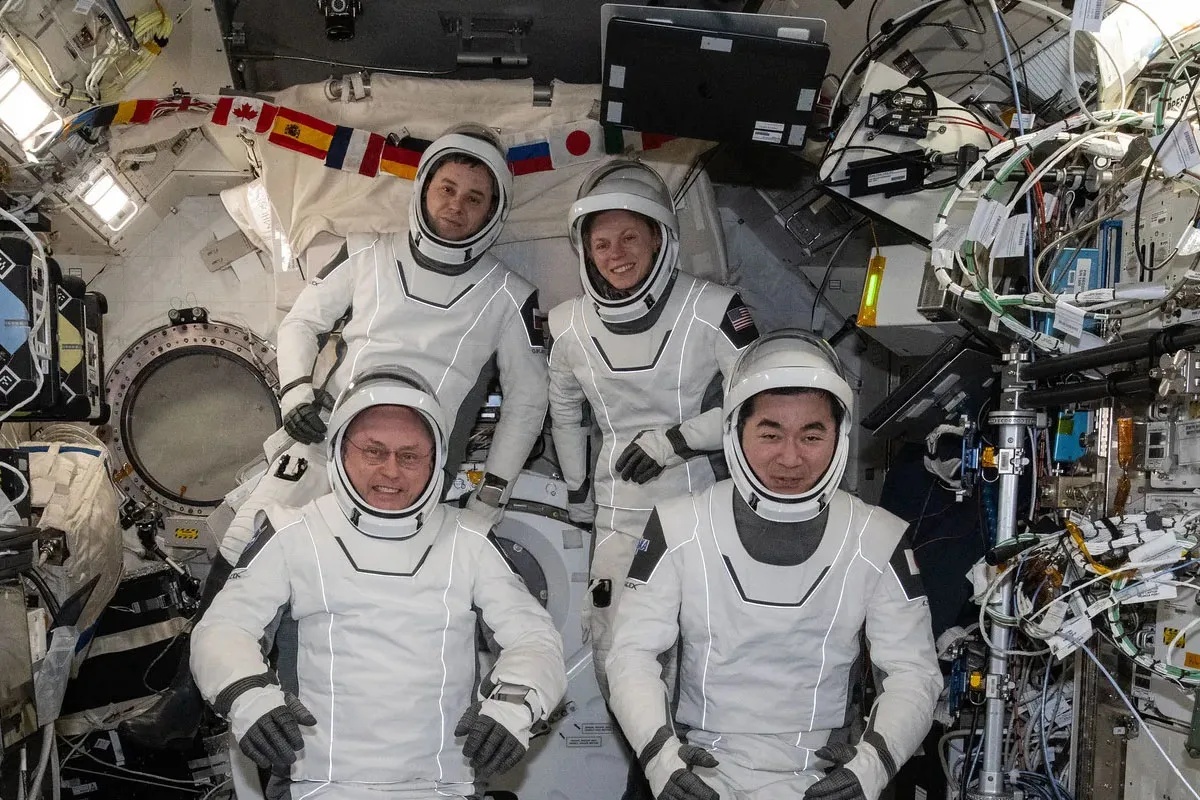
The international composition of Crew-11 reflected the ISS program’s long-standing role as a platform for global collaboration. NASA astronauts Zena Cardman and Mike Fincke flew alongside JAXA astronaut Kimiya Yui and Roscosmos cosmonaut Oleg Platonov, reinforcing operational integration among partner agencies even under unexpected circumstances.
Space Station Operations Continue With Reduced Crew
Following Crew-11’s departure, the ISS remains operational with a reduced three-person crew. Two Roscosmos cosmonauts and one NASA astronaut continue station maintenance, scientific experiments, and systems monitoring after arriving aboard a Soyuz spacecraft from the Baikonur Cosmodrome. NASA officials confirmed that station safety and research continuity remain unaffected, with mission planning adjusted to accommodate the temporary reduction in crew size.
The successful early return also highlighted the reliability of SpaceX’s Dragon spacecraft, which executed a controlled reentry and parachute-assisted splashdown sequence as designed. Details of the spacecraft’s role in human spaceflight missions are available through https://www.spacex.com, where the company outlines its collaboration with NASA on crewed missions.
As NASA evaluates medical data from Crew-11, the mission is expected to influence future protocols for astronaut health monitoring, contingency planning, and emergency response in space. Rather than signaling a setback, the early return demonstrates the maturity of human spaceflight systems capable of responding decisively to medical risks while ensuring the safe return of astronauts from orbit.