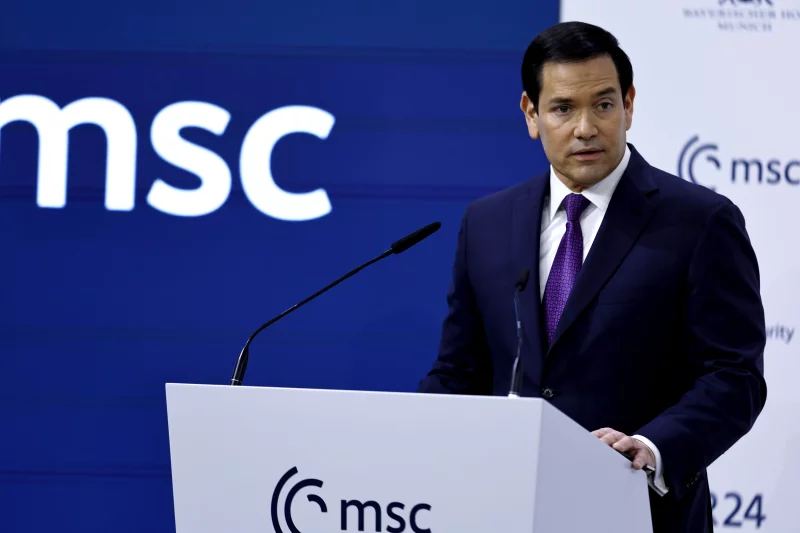
The annual Munich Security Conference has long served as a stage for reaffirming the transatlantic alliance. This year, however, it became a forum where polite applause masked deeper unease. Twelve months after Vice President JD Vance stunned European leaders with blunt criticism of migration and democratic standards, expectations for Secretary of State Marco Rubio were minimal. Diplomats entered the hall prepared for friction. What they received instead was a carefully calibrated message that sought to soften tone without retreating from substance.
Rubio acknowledged that migration pressures were not uniquely European, describing them as a shared Western challenge. He argued that both sides of the Atlantic had embraced a post-Cold War optimism that underestimated the resilience of nationalism and the fragility of liberal democracy. In his telling, the belief that trade alone could bind nations together and render borders secondary had proven misguided. Mass migration, he said, now tests social cohesion, cultural continuity, and political stability across democratic societies.
His remarks were met with a standing ovation inside the Hotel Bayerischer Hof, a venue synonymous with decades of transatlantic coordination. Yet applause did not necessarily equal agreement. Some officials welcomed the less confrontational tone; others questioned the selective historical narrative embedded in his address.
Rubio’s Historical Framing and Europe’s Response
Throughout his speech, Rubio leaned heavily on shared heritage. He described the United States as a nation shaped by European settlers — from Scots-Irish pioneers to German farmers — suggesting that today’s alliance is rooted in common ancestry and values. Absent from that framing were references to Indigenous communities, enslaved Africans, and Asian laborers who also formed the backbone of American development. The omissions did not go unnoticed.
Among those visibly reserved was Kaja Kallas, the European Union’s foreign policy chief. While many in the audience rose to applaud, she remained seated before later pushing back against the notion that Europe faced cultural erasure. Her remarks reflected a broader concern within the European Union that political narratives centered on decline can erode democratic confidence rather than strengthen it.
The contrast in tone highlighted a subtle but important divide. Washington’s message emphasized shared vulnerability and the need to confront internal weaknesses. Brussels, by comparison, projected resilience and institutional continuity, even as it acknowledged mounting geopolitical pressures.
Merz and the Case for European Autonomy
If Rubio aimed to preserve the alliance rhetorically, German Chancellor Friedrich Merz focused on structural realities. Opening the conference, he warned that the rules-based international order — imperfect though it has always been — is eroding under the weight of great-power rivalry. In his assessment, strategic competition among the United States, China, and Russia has shifted global politics toward transactional bargaining over resources, technology, and supply chains.
Merz argued that Europe possesses vast economic capacity yet underutilizes its potential. With the European Union’s combined output vastly exceeding that of Russia, he suggested that influence should correlate with scale. Instead, fragmented defense systems and inconsistent political coordination have limited Europe’s leverage. He called for greater unity in defense spending, technological innovation, and industrial strategy, signaling that reliance on external security guarantees can no longer be taken for granted.
His speech resonated with policymakers who see diversification — not dependence — as the path forward. The emphasis was not on severing ties with Washington, but on recalibrating them to reflect a multipolar environment.
A Shifting Transatlantic Equation
Behind the formal speeches, the broader message of this year’s gathering was unmistakable: the transatlantic relationship is evolving. While U.S. officials reiterated commitment to partnership, European leaders increasingly discussed self-reliance. Economic coordination remains substantial, anchored in frameworks such as the European External Action Service, yet political rhetoric now reflects a recognition that strategic interests may not always align perfectly.
The mood in Munich combined relief with realism. Relief that open confrontation was avoided. Realism that structural differences persist. Migration, trade, defense spending, and geopolitical competition are no longer peripheral debates but central tests of cohesion. In the ornate conference halls, diplomacy maintained its rituals. Outside them, Europe signaled a readiness to define its role with greater independence as the global balance of power continues to shift.