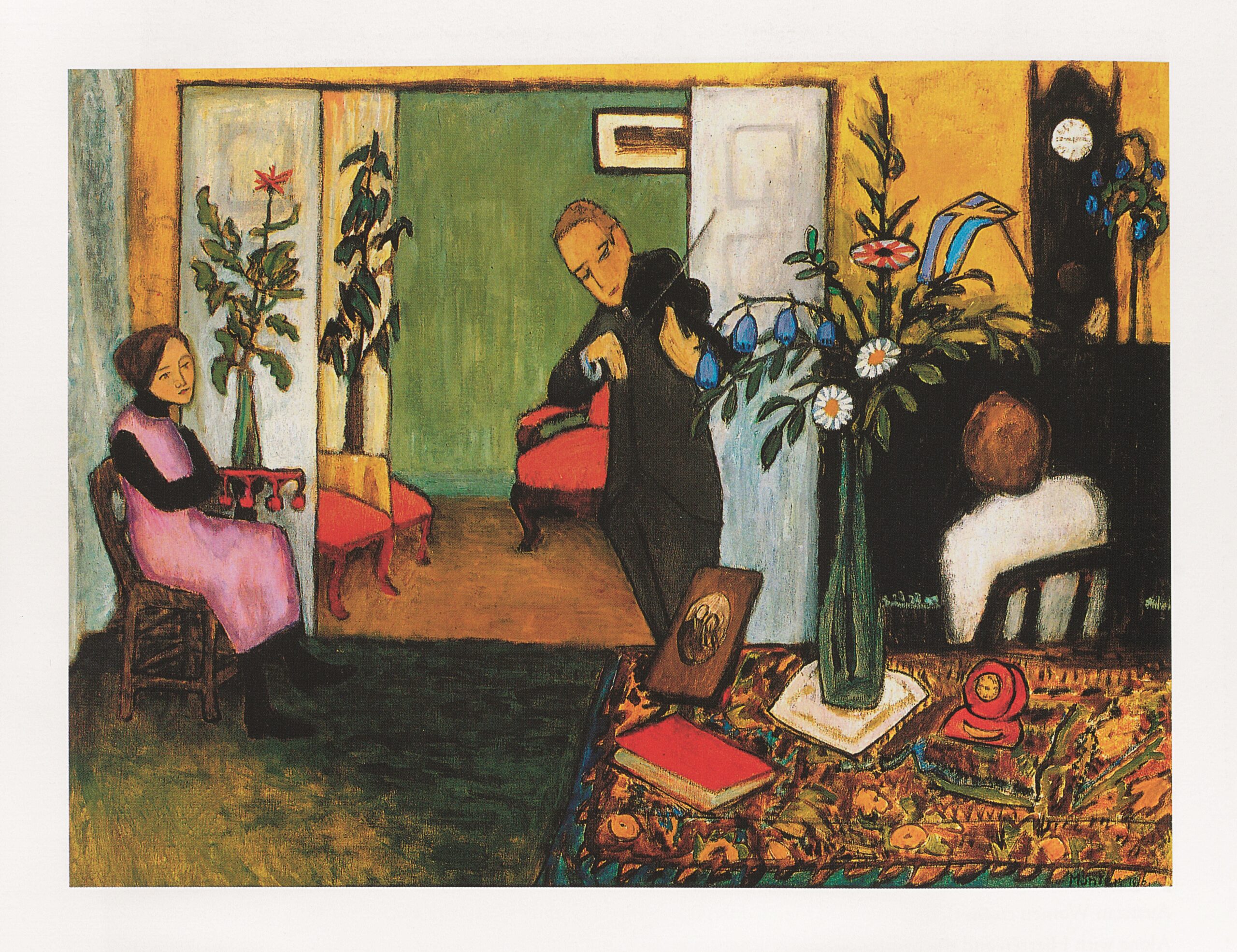
Gabriele Münter, a pioneering figure in European modern art, is once again at the center of international attention following the renewed search for one of her lost paintings. The work, titled Music and dated to 1916, has become a focal point for curators and art historians as Münter’s legacy experiences a significant reassessment in major museums across Europe and the United States. Although Münter played a central role in shaping modern art in the early twentieth century, her contributions were long overshadowed by her association with Wassily Kandinsky, a relationship that deeply influenced how her work was collected and exhibited for decades.
Münter’s artistic path developed in Munich in the early 1900s, where she encountered Kandinsky and other progressive artists experimenting with bold color and form. Together, they helped establish Der Blaue Reiter, an influential collective that rejected strict realism in favor of emotional and symbolic expression. While many of her contemporaries increasingly embraced abstraction, Münter maintained recognizable figures and environments, using vivid color and simplified shapes to heighten emotional impact. This distinctive approach now places her at the center of renewed scholarly and public interest, supported by exhibitions at institutions such as the https://www.guggenheim.org and the https://www.museoreinasofia.es.
A Painting That Captures a Turning Point
The missing painting Music is considered particularly significant because it reflects a transitional period in Münter’s life and work. Created after her separation from Kandinsky, the painting portrays a violinist performing in a domestic interior, surrounded by attentive listeners. The composition uses intense yellow tones and flattened perspectives, transforming an intimate moment into a powerful visual statement. Art experts note that the painting suggests a sense of calm and creative renewal, challenging assumptions that this period of Münter’s life was defined solely by personal hardship.
This work also illustrates how Münter continued to build artistic communities even as she faced financial uncertainty and declining recognition. Rather than retreating from experimentation, she expanded her visual language, producing paintings that conveyed warmth and emotional balance. These qualities align with her broader body of work, which continues to gain recognition through exhibitions at institutions such as the https://www.centrepompidou.fr and the https://www.museodelprado.es.
An International Effort to Locate the Artwork
The search for Music has become an international effort involving foundations, museums, and private collectors. Curators have examined archival correspondence, historical exhibition catalogs, and sales records in an attempt to trace the painting’s provenance. This process has highlighted broader issues surrounding the visibility of women artists in museum collections and the historical gaps created when their work was undervalued or overlooked.
As Münter’s reputation continues to grow, the disappearance of Music underscores the importance of provenance research in restoring overlooked narratives within modern art. The painting’s absence has not diminished its impact; instead, it has amplified interest in Münter’s resilience and artistic independence. The ongoing search reflects a broader cultural shift toward reassessing modern art history and ensuring that influential figures like Münter receive recognition equal to their contributions.