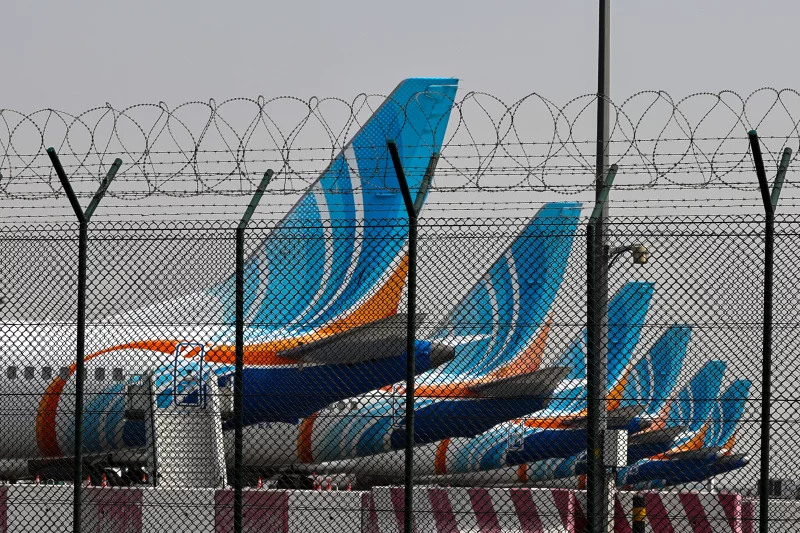
Limited commercial flights began operating again across parts of the Middle East on Monday, offering cautious relief to stranded passengers after days of airspace closures triggered by escalating regional conflict. Yet despite the partial reopening of key hubs, hundreds of thousands of travelers remain displaced, facing ongoing cancellations and uncertainty.
Major aviation corridors linking Europe, Asia, Africa, and the Americas were abruptly disrupted after airstrikes targeted sites in the Gulf region. Airlines grounded aircraft, airports suspended operations, and airspace restrictions rippled across neighboring countries. Although some departures have resumed, the recovery remains fragile.
Major Hubs Restart Limited Operations
Dubai International Airport, one of the busiest transit hubs globally, confirmed that operations resumed with a limited number of departures. According to updates from Dubai Airports, priority is being given to previously booked passengers as airlines attempt to clear backlogs.
Similarly, Abu Dhabi International Airport announced partial operations after suspending flights over the weekend. Early departures included services operated by Etihad Airways, one of the region’s flagship carriers. In neighboring Qatar, however, authorities reported that flights in and out of Doha’s main airport remain temporarily suspended, reflecting continued security assessments.
Airlines across the region canceled more than 3,400 flights on Monday alone, pushing total cancellations since the start of hostilities to nearly 10,000. Data compiled by FlightRadar24 showed aircraft diversions, rerouted long-haul services, and extended ground holds across multiple Gulf airports.
These hubs collectively handle an average of 90,000 transit passengers per day on just three major carriers — Emirates, Etihad, and Qatar Airways — highlighting the scale of disruption. Even a brief closure creates cascading effects for global travel networks.
Travelers Caught in Extended Delays
For many passengers, the gradual restart offers little immediate relief. Business travelers and tourists alike have been forced to extend hotel stays, rebook flights repeatedly, and monitor airline alerts in real time.
Kristy Ellmer, a consultant from New Hampshire who traveled to Dubai for meetings, described a series of daily cancellations that have left her uncertain about when she will return home. Flights scheduled on successive days were scrapped, and rebookings remain tentative as airlines adjust to evolving security conditions.
Airlines such as Emirates Airlines stated they would resume a limited schedule while prioritizing customers with earlier reservations. At the same time, carriers cautioned that many routes remain suspended until further notice, depending on airspace clearance and regional stability.
Passengers transiting through the Gulf often rely on tightly coordinated connections linking continents. When even one segment is canceled, entire itineraries unravel. With aircraft and crews displaced across airports, restoring regular service may take days or weeks.
Travelers are also grappling with rising accommodation costs and limited seat availability on the few flights that are operating. Although no comprehensive estimate exists for the number of people stranded, aviation analytics firms suggest the figure likely reaches into the hundreds of thousands given the volume of daily transit traffic.
Ongoing Uncertainty Across Regional Airspace
Airspace closures over the weekend extended beyond the immediate conflict zone, as neighboring countries imposed temporary restrictions as a precaution. Military activity and drone interceptions near energy infrastructure heightened security alerts, prompting aviation authorities to reroute long-haul flights to avoid potential risk corridors.
The pace at which normal operations return depends heavily on whether strikes and counter-strikes subside. Even after airports reopen, airlines must reposition aircraft, reassign crews, and manage passenger backlogs. Insurance considerations and evolving risk assessments further complicate scheduling decisions.
Despite the disruption, some travelers have emphasized perspective. While facing inconvenience and prolonged uncertainty, they acknowledge that residents of affected areas are experiencing far more severe consequences. For now, passengers remain in a holding pattern — watching departure boards, refreshing airline apps, and waiting for broader stability to restore confidence in one of the world’s most critical aviation crossroads.