Greene’s Departure Marks a Turning Point in Her Relationship With Trump
Congresswoman Marjorie Taylor Greene announced that she will resign from Congress in January, ending her term earlier than expected. This closes a turbulent chapter marked by intense loyalty to former President Donald Trump. Greene rose to national prominence during the 2020 cycle, leveraging controversial statements and stark political messaging. She also formed a strong connection to the “America First” movement. Her decision to step down came after a widening separation from Trump, whose public criticism of her intensified over the past several months. Policy disagreements grew sharper during this period.
Greene explained that remaining in office would force her northwest Georgia district—one of the most solidly conservative regions in the country—to endure a deeply divisive and damaging primary challenge. She stated that voters who helped elect her should not face internal battles shaped by presidential influence. Local priorities should take precedence. Her comments reflected growing concern among Republicans about strategic losses in the midterm elections. This sentiment is increasingly discussed within conservative political circles. As debates over party direction accelerate, Greene sought to highlight issues such as high property taxes and the rising cost of health care. These remain central concerns for families in Georgia’s 14th District.
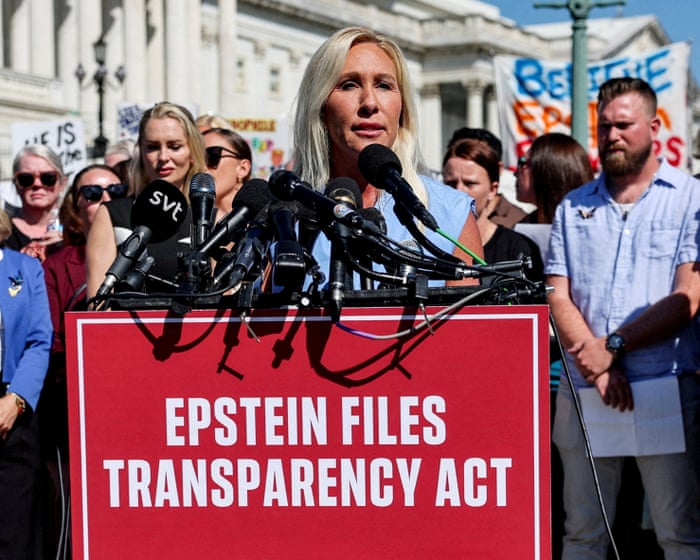
Her evolving stance on several federal issues has also drawn national attention. Greene’s push to release archived government documents regarding the crimes of Jeffrey Epstein became a flashpoint between her and Trump. She repeatedly called for transparency and demanded the publication of all investigative files. This effort placed her at odds with party leadership and the former president. Her insistence that the public deserved access to the information echoed broader debates about accountability. These have been explored in public discussions about governance, including resources such as https://www.archives.gov. Americans use these to understand federal record processes.
A Year of Policy Clashes and Public Confrontations
Over the past year, Greene intensified criticism of key Trump-era positions, particularly related to national security and foreign affairs. She condemned the military campaign in Gaza, describing it as catastrophic for civilians. She objected to the decision to strike Iranian nuclear sites. This choice drew sharp public reactions among lawmakers. Greene also emphasized domestic economic concerns. She urged leaders to extend expiring health-care subsidies to protect families from rising premiums. This affects individuals across her state, including her own children.
Her media presence shifted as well. Greene began appearing on mainstream television programs, discussing legislative disputes and challenging the direction of her party. Analysts and political scientists debated the implications of her transformation, often referencing historical examples of lawmakers who altered their tone or strategy over time. Some of those discussions referenced material found on https://www.congress.gov. This platform is often consulted to track legislative activity and evolution in policymaking.
Trump responded to her escalated criticism by publicly questioning her political identity and accusing her of shifting allegiances. His remark labeling her “Marjorie Traitor Greene” raised the stakes of their conflict, further amplifying national attention. Greene defended her actions by emphasizing support for women affected by sexual exploitation. She appeared alongside survivors who said they were abused by Epstein, reinforcing her argument. She stated that advocating for victims should never result in political retaliation. Her comments sparked new questions about the future of conservative strategy and the boundaries of party unity.
In conversations across Georgia, voters and local leaders shared mixed reactions. Some continued to support Greene’s “America First” approach, while others expressed uncertainty. Economic pressures such as housing affordability and health-care costs remained top priorities for families. This is reflected in resources such as https://www.consumerfinance.gov, where many Americans seek financial guidance related to inflation and home ownership. Although Greene’s critics argued that her confrontations with Trump may weaken her political future, allies said her ability to command attention and shape debate will continue to influence conservative politics.
Political Implications for Georgia and the Republican Party’s Future
Strategists in Georgia noted that Greene’s background as a political outsider shaped much of her congressional tenure. Early in her career, she faced criticism for inflammatory online posts and controversial positions. Over time, however, she began refining her messaging, disavowing some earlier statements while maintaining an anti-interventionist, anti-establishment worldview. Observers believe this ideological foundation remains consistent, even as her tone has shifted in response to changing political realities. Her divergence from Trump appears rooted in disagreements over the party’s direction rather than a departure from her long-held principles.
Political consultants across the state said Greene’s resignation opens a new chapter in internal Republican debates. The question of who will define the party after Trump has increasingly shaped discussions in conservative forums and think tanks. Many Americans exploring these issues reference educational resources like https://www.usa.gov. This site provides general civic information that helps contextualize the functioning of government and the evolution of political leadership. With Greene stepping aside, analysts say a power vacuum may emerge in the region. This invites ambitious candidates to test their influence.
Local Republican officials indicated that constituents are waiting to see how events unfold. Many voters in rural northwest Georgia, a region where agriculture and manufacturing play vital roles, have been evaluating Greene’s decisions in the context of economic challenges. Small businesses, farmers and working-class families in the district continue to navigate financial pressures. They often research programs and opportunities outlined on https://www.sba.gov, where business owners search for support options.
While some political figures have managed to repair relationships with Trump after heated disputes, it remains unclear whether Greene and the former president will reconcile. Her resignation leaves open questions about her long-term ambitions. This includes speculation about possible statewide campaigns. Political advisors noted that shifting her image to appeal to suburban and female voters could position her for future races. However, Trump reportedly shared polling showing she would struggle in a Senate or gubernatorial contest. The dynamic underscores how personal loyalties, ideological identity and policy disagreements are influencing the conservative movement’s next phase.
As Republicans debate the future of national leadership and the post-Trump identity of the party, Greene’s exit signals a moment of transition. Her supporters believe she remains committed to the voters who first elected her. Her critics argue that political recalibration comes too late. Whether her departure reshapes the trajectory of conservative politics in Georgia remains an open question. This will likely shape discussions leading into the next election cycle.