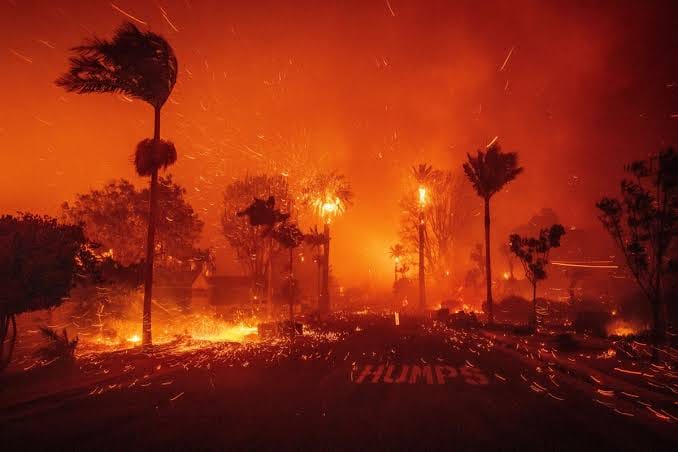
Los Angeles has long been associated with wildfires, but the fires that tore through the Pacific Palisades at the start of 2025 marked something fundamentally different. Beyond the physical destruction of homes, streets, and landscapes, the disaster underscored how climate-related emergencies are increasingly colliding with densely populated urban environments. For residents, first responders, and journalists alike, the fires became a deeply personal and professional reckoning with a new age of disaster that no longer feels distant or theoretical.
The Pacific Palisades, a community embedded in the cultural and historical fabric of Los Angeles, was transformed within days. Streets once known for schools, parks, and family homes became evacuation corridors, while emergency crews worked around the clock to contain flames driven by dry conditions and erratic winds. City officials coordinated responses across agencies, reflecting the scale and complexity of modern wildfire management in urban settings, a challenge increasingly discussed by local authorities and emergency planners across California and beyond. Efforts led by municipal and state institutions, including the City of Los Angeles, illustrate how urban governance is being reshaped by climate pressure as fires move closer to population centers and critical infrastructure (https://www.lacity.gov).
Wildfires and the Personal Cost of Urban Destruction
What distinguished the Los Angeles fires from many past events was not only their intensity, but the deeply personal nature of the loss experienced by those who grew up in the affected neighborhoods. Entire blocks that once represented decades of shared memory were reduced to ash, forcing residents to confront displacement, uncertainty, and long-term recovery challenges. The destruction highlighted how climate disasters increasingly erase personal histories along with physical structures, leaving emotional and psychological impacts that extend far beyond immediate property damage.
As communities evacuated, emergency shelters filled with families facing sudden upheaval. Recovery planning quickly became a central concern, with federal and state frameworks guiding assistance, rebuilding, and long-term mitigation. Agencies such as the Federal Emergency Management Agency play a critical role in coordinating disaster relief and financial support, particularly as climate-driven events grow in frequency and cost, often resulting in damages that reach into the billions of dollars nationwide (https://www.fema.gov). These fires reinforced the reality that urban wildfires are no longer isolated incidents but part of a broader pattern tied to environmental change.
Journalism on the Front Lines of Climate Emergencies
The Los Angeles fires also revealed how journalism itself is evolving in response to climate disasters. Reporters on the ground were not merely observers but active participants in documenting evacuation efforts, emergency responses, and community resilience in real time. Street-level reporting became an essential public service, providing residents with timely information while capturing the human dimension of the catastrophe.
This form of frontline journalism mirrors the work of first responders, requiring physical presence, emotional endurance, and rapid decision-making under dangerous conditions. As wildfires increasingly intersect with major metropolitan areas, journalists are being forced to rethink safety protocols, ethical responsibilities, and the long-term impact of repeatedly covering traumatic events. The California Department of Forestry and Fire Protection has emphasized the growing complexity of wildfire behavior, which now demands constant situational awareness from everyone operating near fire zones, including members of the press (https://www.fire.ca.gov).
A New Climate Reality for Los Angeles and Beyond
The broader implications of the Los Angeles fires extend well beyond the city limits. Scientists have consistently warned that rising temperatures, prolonged droughts, and shifting weather patterns are creating conditions for larger, faster-moving fires across the western United States. These dynamics are increasingly monitored by federal climate and weather agencies, which point to a future where urban regions must adapt to persistent wildfire risk rather than treating such events as anomalies (https://www.noaa.gov).
For Los Angeles, this new reality is reshaping conversations about land use, emergency preparedness, insurance markets, and long-term urban planning. Communities are being forced to consider how to rebuild in ways that acknowledge ongoing risk while preserving social and cultural identity. The fires in the Pacific Palisades became a stark example of how climate change is no longer a distant concern but an immediate force redefining daily life, professional responsibility, and the relationship between people and the places they call home.
As Los Angeles continues to recover, the lessons from these fires are likely to influence policy, journalism, and public awareness nationwide. The event stands as a powerful illustration of how climate-driven disasters are rewriting the rules for cities, demanding resilience, adaptation, and a deeper understanding of what it means to live on the front lines of environmental change.