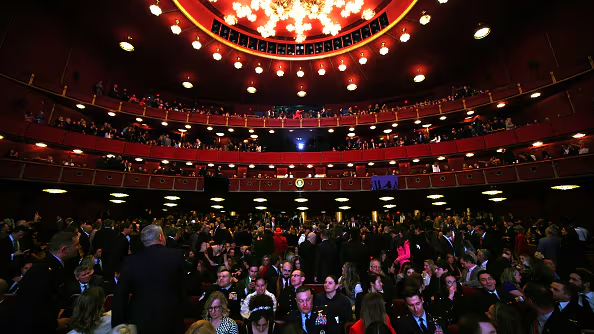
President Donald Trump announced that Washington, D.C.’s Kennedy Center for the Performing Arts will close for two years beginning in July, marking one of the most dramatic transformations of the historic cultural institution since it opened in 1971. The decision represents a major escalation in Trump’s efforts to reshape the identity, structure, and governance of one of the nation’s most prominent artistic landmarks, and it immediately sparked widespread debate across political, cultural, and artistic circles.
The announcement was made through a social media statement, in which Trump described the Kennedy Center as financially and structurally deteriorated and argued that the closure is necessary to implement an ambitious renovation program. According to the president, the construction project aims to transform the venue into what he called a “world-class bastion of arts, music, and entertainment.” The plan is subject to approval by the center’s board of trustees, which Trump currently chairs after restructuring its leadership following his return to the White House. Information about the center’s governance structure and mission can be found on its official website, https://www.kennedy-center.org, which outlines its role as a national cultural institution and public performing arts complex.
The proposed shutdown comes at a time of heightened tension surrounding the Kennedy Center, as several major artists and institutions have canceled performances in protest of recent administrative and symbolic changes. Trump’s broader strategy of imprinting his brand and vision on iconic Washington landmarks has intensified scrutiny, with the Kennedy Center emerging as one of the most visible flashpoints in that campaign.
A sweeping construction plan and political implications
Trump framed the closure as an essential step to modernize the complex, asserting that the Kennedy Center has suffered from years of neglect. He emphasized that the renovation would address structural deficiencies, improve financial sustainability, and significantly enhance the audience experience. While the administration has not released detailed architectural plans or budget estimates, analysts expect the total cost to reach into the hundreds of millions of dollars, potentially rivaling other large-scale federal redevelopment projects in the capital.
The move is consistent with Trump’s broader approach to reshaping Washington’s architectural and cultural landscape. Since returning to office, he has announced a series of high-profile initiatives, including a $400 million ballroom project at the White House and proposals for new monumental structures near the National Mall. Details about the executive branch’s infrastructure and development agenda are published through the White House’s official portal, https://www.whitehouse.gov, which highlights the administration’s priorities and public works initiatives.
Critics argue that the sudden closure risks undermining the center’s mission as a continuously operating national stage for artistic expression. The Kennedy Center traditionally hosts more than two thousand performances annually, drawing millions of visitors from across the United States and around the world. A two-year suspension of programming could disrupt long-standing partnerships with orchestras, ballet companies, opera ensembles, and educational programs, many of which rely heavily on the venue’s facilities.
Artist backlash and cultural consequences
The announcement has intensified the wave of cancellations already affecting the center’s calendar. Prominent composers, orchestras, and performing arts organizations have withdrawn their scheduled appearances, citing concerns about political interference and the symbolic transformation of the venue. Among the most notable departures is the Washington National Opera, which confirmed plans to relocate its productions after more than five decades of residency at the Kennedy Center.
Several artists have publicly stated that the center’s evolving identity conflicts with the core values of artistic independence and cultural inclusivity. They argue that the renaming of the building, coupled with leadership changes and now a prolonged closure, threatens to alter the institution’s historical role as a unifying national stage. Congressional oversight of federally supported cultural institutions is documented through https://www.congress.gov, where legislative frameworks governing public landmarks and memorials outline the complex approval processes typically required for major changes.
The controversy has also reignited debates about the preservation of cultural heritage sites. As a living memorial to President John F. Kennedy, the center occupies a unique symbolic position within the nation’s capital. Its location along the Potomac River, near other major monuments, places it within a broader ecosystem of federally managed landmarks, many of which fall under the stewardship of the National Park Service, detailed at https://www.nps.gov.
The future of the Kennedy Center amid transformation
Despite mounting criticism, the administration maintains that the closure will ultimately benefit both artists and audiences by delivering a modernized venue capable of hosting more ambitious productions. Supporters of the plan argue that infrastructure upgrades, technological enhancements, and expanded performance spaces could strengthen the center’s long-term viability and international standing.
However, uncertainty remains regarding how the extended shutdown will affect Washington’s cultural economy. Local businesses, hospitality services, and tourism operators depend heavily on the steady flow of visitors drawn by the Kennedy Center’s year-round programming. A prolonged pause in performances could ripple across the broader metropolitan economy, impacting employment and revenue in adjacent sectors.
As the July closure date approaches, attention will focus on the final approval process by the board of trustees and the release of detailed construction plans. The scope, cost, and artistic direction of the renovation will likely define not only the next chapter of the Kennedy Center but also the broader debate over how political leadership shapes national cultural institutions. What emerges after two years of construction will stand as a lasting reflection of Trump’s vision for the future of American performing arts in the nation’s capital.