Federal Judge Halts Continued Federal Control Over California National Guard
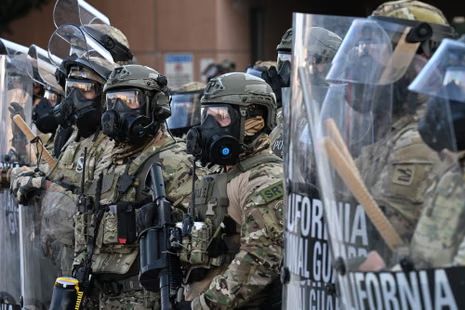
A federal court ruling delivered in San Francisco has temporarily halted the Trump Administration’s decision to extend federal control over the California National Guard, ordering that authority be returned to state leadership. U.S. District Judge Charles Breyer issued a preliminary injunction blocking the administration’s attempt to maintain command over Guard troops deployed in Los Angeles as part of federal immigration enforcement operations.
California officials challenged the federalization that began in June, arguing that the administration’s actions undermined the state’s role in managing its own National Guard and introduced an unprecedented expansion of presidential authority. Judge Breyer noted that the administration’s interpretation of federal law could allow indefinite extensions once a Guard unit has been federalized, effectively enabling the creation of a federally controlled force operating without state oversight.
Concerns of Executive Overreach Intensify Amid Legal Battles
The dispute over the Los Angeles deployment is one of several legal challenges sparked by the administration’s use of National Guard troops in multiple cities. Federal officials have claimed the deployments are necessary to secure communities affected by immigration-related demonstrations, protect federal personnel, and support ongoing enforcement actions.
At the height of the Los Angeles deployment, more than 4,000 troops were sent to the city; that number has diminished to roughly 100 personnel. However, the administration sought to maintain federal control until February, asserting that the presence of National Guard forces remained essential. Legal scholars have highlighted that the move tests traditional boundaries between federal and state authority, raising questions about the long-term implications for American federalism and the future of domestic military involvement in civil matters.
To provide additional context about federal and state powers, readers can explore discussions about constitutional frameworks through reputable resources such as Cornell Law School’s Legal Information Institute (https://www.law.cornell.edu), while broader issues of government structure and federal authority can be examined via the National Conference of State Legislatures (https://www.ncsl.org). Understanding how federal courts interpret executive actions is also supported through public-access materials available at USA.gov (https://www.usa.gov), and readers interested in national security policies can find further background through Homeland Security’s public information pages (https://www.dhs.gov).
Legal and Political Implications as Ruling Faces Appeal Window
Judge Breyer’s ruling emphasized that enabling a president to indefinitely control state-based military forces would fundamentally disrupt the balance of power enshrined in the U.S. constitutional system. The opinion stressed that unchecked executive authority would contradict the principles of shared governance between states and the federal government.
The administration maintains that the deployment falls within presidential authority and has expressed confidence that higher courts will ultimately side with federal power. The ruling is paused until Monday to allow the administration time to file an appeal, setting the stage for another major court confrontation over the limits of presidential control during periods of domestic tension. The outcome has potential implications for future administrations, shaping how National Guard forces may be used during political demonstrations, public safety operations, and immigration enforcement efforts.
As debates continue, officials and scholars are watching closely to see how this case could influence future interpretations of executive power, state sovereignty, and federal intervention in local matters.