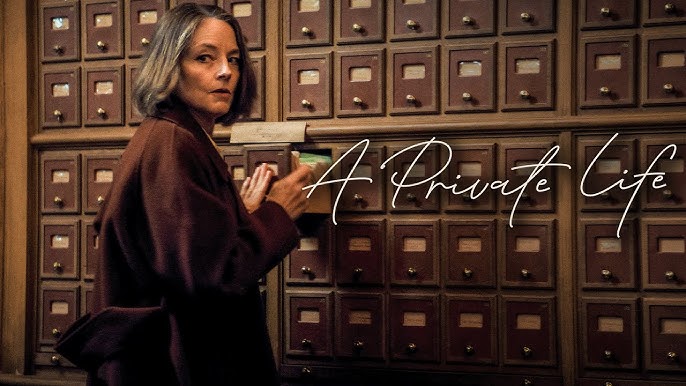
Jodie Foster is entering a new creative chapter by committing more fully to French-language cinema following her leading role in A Private Life (Vie privée). After more than six decades in the film industry, the Academy Award–winning actress has chosen to challenge herself in a way that few performers attempt at this stage of their careers: starring in a full-length French production as the central character. Her portrayal of Lilian Steiner, a Parisian therapist whose composed professional life unravels after the mysterious death of a patient, marks her first time carrying a film entirely in French. The project signals not just a linguistic achievement but a broader artistic repositioning that aligns her with Europe’s auteur-driven film tradition, often showcased at international festivals such as the Cannes Film Festival, where French-language cinema remains a defining cultural force.
A New Identity Through Language and Performance
Foster’s performance stands out for its near-native fluency and subtle emotional control. Having attended Le Lycée Français de Los Angeles, she developed her French at a young age, which now allows her to move between cultures with unusual ease. Yet she has acknowledged that acting in French reshapes her screen persona. Her vocal tone rises, her expressions soften, and her delivery becomes more tentative, creating a version of herself that feels distinct from her English-language roles. This transformation is central to the character of Lilian Steiner, an American who built her professional identity in France and now finds herself emotionally destabilized by grief, suspicion, and unresolved personal history.
Director Rebecca Zlotowski incorporated bilingual moments into the script, allowing Foster to slip into English for brief asides and bursts of frustration. These linguistic shifts deepen the realism of the character and underline the cultural hybridity at the heart of the story. The film’s narrative blends psychological drama with dark comedy, as Steiner’s investigation into her patient’s death becomes both a personal reckoning and a symbolic search for control in a life that feels increasingly unmanageable. This layered storytelling approach aligns with the style of contemporary European cinema often supported by institutions such as the British Film Institute, which promotes character-driven narratives that prioritize emotional nuance over spectacle.
Artistic Partnerships and Thematic Depth
The supporting cast further anchors the film within French cinematic tradition. Daniel Auteuil, a veteran of European cinema, plays Steiner’s ex-husband, bringing gravitas and emotional complexity to their rekindled relationship. Virginie Efira’s brief but pivotal role as the deceased patient provides the emotional catalyst for the plot, introducing themes of loss, guilt, and psychological displacement. Together, the ensemble crafts a story that examines how private grief intersects with professional responsibility, a theme that resonates strongly in a cultural climate increasingly focused on mental health awareness.
The film’s title, Vie privée, operates as a double entendre, referring both to an inner life shielded from public view and to a life that has been taken away. This linguistic ambiguity mirrors Foster’s own reflections on privacy. Throughout her career, she has guarded her personal life with unusual determination, choosing educational and professional paths that preserved her sense of autonomy. Her insistence on boundaries—whether attending college away from Hollywood’s glare or declining constant media access—has allowed her to sustain a long-term career without the burnout that has derailed many child actors. These values echo the film’s core question: how much of oneself should remain private in a world that constantly demands visibility?
Future Plans and Cultural Expansion
Following the positive reception of A Private Life, Foster has expressed interest in pursuing additional French-language roles. She views this transition not as a novelty but as a serious extension of her craft, offering opportunities to explore characters and narratives that differ from mainstream Hollywood productions. Her openness to working within France’s film ecosystem positions her alongside international performers who have successfully crossed linguistic and cultural boundaries, expanding their artistic range and global appeal.
This move also reflects broader industry trends. As streaming platforms such as Netflix continue to invest heavily in non-English content, the demand for cross-cultural storytelling is rising. Foster’s decision to deepen her presence in French cinema places her at the forefront of this shift, bridging American star power with European narrative sensibilities. By embracing roles that challenge her linguistic comfort zone and thematic привычки, she is redefining what longevity in film can look like.
Rather than slowing down, Foster appears to be accelerating into a phase defined by experimentation, cultural dialogue, and creative risk. Her work in A Private Life is not a detour from her established career but a deliberate evolution that underscores her commitment to artistic growth. As she continues to explore French roles, audiences can expect performances that blend technical mastery with the vulnerability of an artist willing to begin again in a new cinematic language.