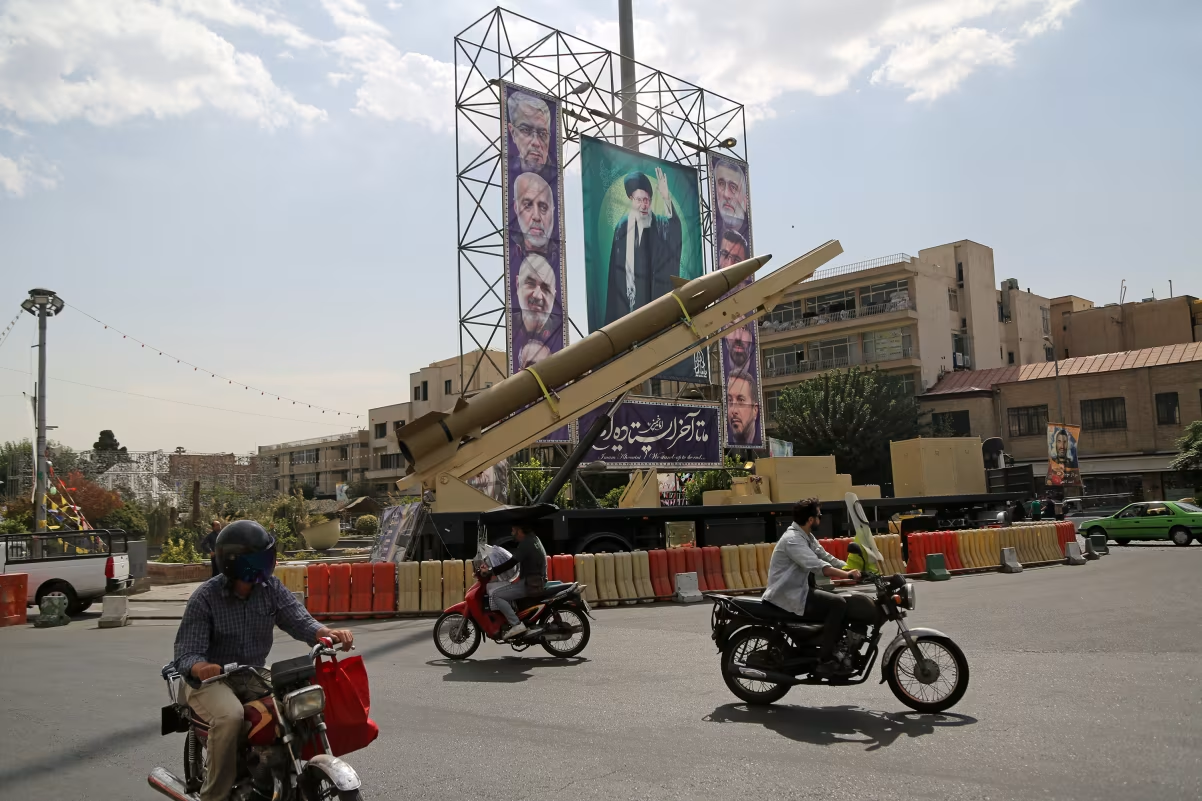
Iran has spent decades preparing for a conflict scenario in which it faces a militarily superior adversary. Rather than attempting to mirror U.S. conventional strength, Tehran has built a layered deterrence strategy designed to impose high political, military, and economic costs on its opponents. As U.S. naval assets increase their presence in the Middle East and political rhetoric hardens, the Iranian leadership is once again signaling that any direct attack would trigger responses extending far beyond its borders, with consequences that could reverberate through global markets and international security institutions.
Despite suffering setbacks from Israeli and U.S. operations in recent years and confronting internal political pressure, Iran retains significant capabilities. These tools are calibrated to allow Tehran to escalate gradually or rapidly, depending on how it defines the threat. Iranian officials have repeatedly framed potential confrontation not as a limited military exchange, but as a struggle that could reshape regional order and global economic stability, challenging frameworks upheld by organizations such as the United Nations.
Missile forces and asymmetric strike capacity
Iran’s missile and drone arsenal remains central to its deterrence posture. The country has invested heavily in ballistic and cruise missile programs, alongside large inventories of unmanned aerial vehicles designed for saturation attacks. These systems are capable of reaching U.S. military installations across the Middle East and targets in Israel, complicating defensive planning and increasing the risk of miscalculation.
Recent conflicts have demonstrated Iran’s willingness to test air defense networks through coordinated launches designed to overwhelm interception systems. Military analysts note that while Iran cannot sustain a prolonged conventional war against the United States, it does not need to. Even limited strikes that penetrate defenses could have outsized psychological and political effects, particularly if they involve U.S. casualties or disrupt allied infrastructure. This dynamic feeds into broader alliance concerns monitored within frameworks associated with NATO, where escalation control and collective defense calculations remain tightly linked to Middle East stability.
Iran’s reliance on asymmetric warfare also extends to cyber operations and electronic warfare, areas in which attribution is often murky and retaliation thresholds are unclear. These tools provide Tehran with plausible deniability while still imposing costs on adversaries, reinforcing its strategy of staying below the level of full-scale war while signaling resolve.
Regional proxies and multi-front pressure
Beyond its own forces, Iran’s network of allied groups remains a critical component of its response options. While Israeli operations have degraded some of these actors, they have not eliminated Tehran’s ability to activate multiple fronts simultaneously. Armed groups in Iraq, Lebanon, Syria, and Yemen provide Iran with geographic depth, allowing it to pressure U.S. interests and partners without direct attribution.
This proxy-based approach enables Iran to stretch adversary defenses and complicate diplomatic efforts to contain escalation. Attacks on shipping lanes, military convoys, or energy infrastructure carried out by allied groups can trigger responses that draw in regional governments, increasing the risk of broader confrontation. The persistence of these networks underscores why regional instability continues to challenge international security norms and crisis-management mechanisms endorsed by multilateral institutions.
At the same time, Iran must balance escalation with restraint. Overuse of proxy forces risks provoking overwhelming retaliation or undermining political support in countries where these groups operate. This tension shapes Tehran’s calculations, as it seeks to maintain leverage without crossing thresholds that could justify a unified international response.
Energy chokepoints and global economic leverage
Iran’s most powerful retaliatory option may lie not in missiles or proxies, but in its ability to disrupt global energy flows. The Strait of Hormuz remains one of the world’s most critical maritime chokepoints, carrying a substantial share of globally traded oil and liquefied natural gas. Even partial disruption could drive energy prices sharply higher, fueling inflation and threatening economic growth worldwide.
Iran has repeatedly warned that it would not hesitate to use this leverage if faced with what it perceives as an existential threat. Such actions would place immediate strain on global markets, forcing responses from energy-importing nations and international financial institutions such as the International Monetary Fund, which closely monitors systemic risks tied to commodity shocks and balance-of-payments crises.
Data from agencies like the U.S. Energy Information Administration highlight how sensitive global supply chains are to disruptions in the Persian Gulf. Insurance premiums for shipping, freight costs, and energy futures would likely spike within days of any sustained incident, transmitting economic pressure far beyond the Middle East. While Iran would also suffer economically from such disruptions, its leadership has historically demonstrated a willingness to absorb domestic pain in pursuit of strategic objectives.
Taken together, these military, proxy, and economic tools form a retaliation playbook that prioritizes leverage over symmetry. Iran’s strategy is not built on winning a conventional war, but on making conflict so costly and unpredictable that adversaries are forced to reconsider escalation. As tensions rise, the challenge for global leaders is not only preventing war, but managing the cascading risks that even limited confrontation could unleash across security systems and the world economy.