An English teacher from rural eastern India expected questions about her research when she received a prestigious American scholarship. Instead, she found herself answering inquiries about childcare and marital duties. Her selection for the Fulbright Distinguished Awards in Teaching Program marked a professional milestone, but the reaction it triggered revealed the enduring weight of gender expectations.
The educator, who has spent more than two decades teaching first-generation learners in Bankura, a district in India’s eastern state of West Bengal, described the award as transformative. The fellowship brought her to the United States for four months to study equitable language learning practices. Yet almost immediately after sharing the news, she faced pointed questions unrelated to her academic work: Who would care for her children? What about her husband’s conjugal life?
Those questions, she said, underscored how women’s professional achievements are often viewed as conditional, framed within domestic responsibilities rather than intellectual contributions.
A Scholarship and the Weight of Expectations
The teacher’s fellowship falls under the broader Fulbright Program, administered by the <a href=”https://eca.state.gov/fulbright”>U.S. Department of State</a>, which promotes international educational exchange. Participants collaborate with institutions across the United States, conducting research and sharing best practices in teaching and learning.
For this educator, the opportunity meant studying language equity in American classrooms, particularly how schools support students from diverse linguistic backgrounds. During her term in Pennsylvania, she observed well-equipped schools where digital tools and structured support systems are integrated into everyday instruction. Educators are recognized as trained professionals, and students routinely draft essays on laptops rather than recycled paper.
However, she noted that gender disparities persist even in advanced educational environments. Female teachers in the United States, she observed, continue to juggle professional obligations with caregiving expectations, highlighting that structural inequality transcends geography.
The fellowship connects educators from around the world through academic collaboration and institutional support, including host universities such as the <a href=”https://www.upenn.edu”>University of Pennsylvania</a>, where fellows often engage in seminars and research initiatives focused on pedagogy and social equity.
Language as Opportunity and Barrier
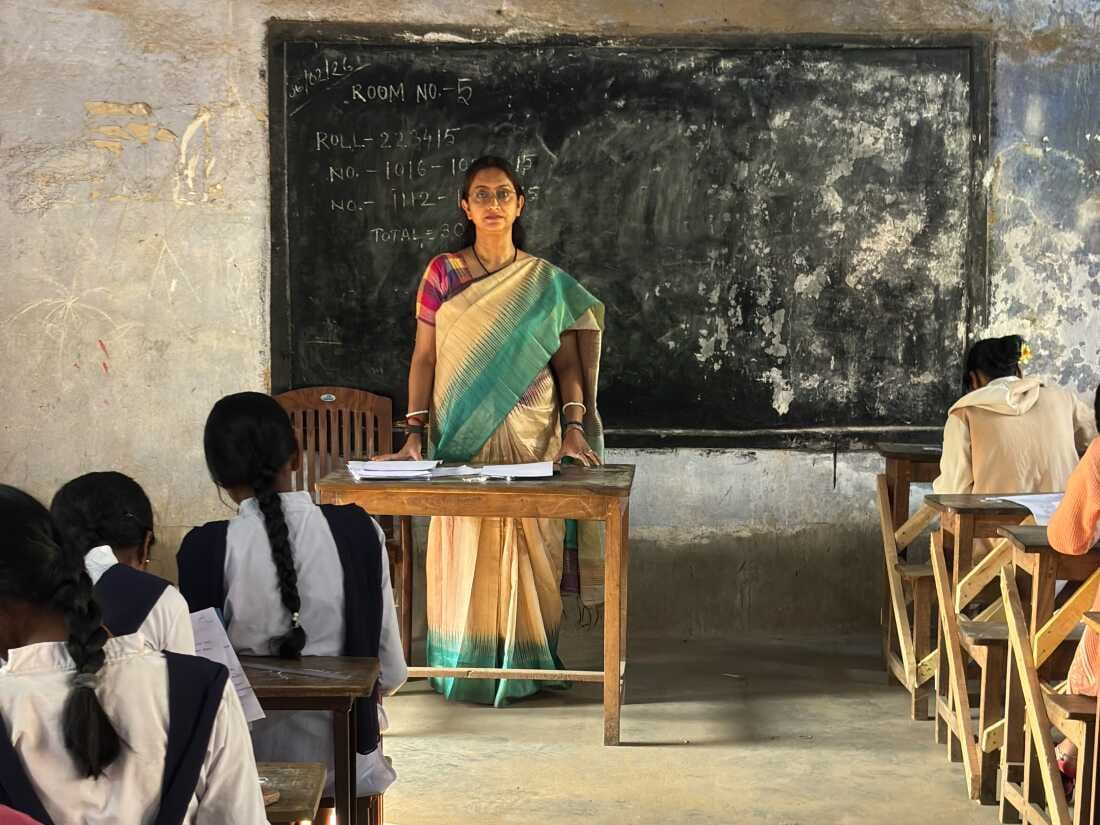
Back home in Bankura, her classroom serves children who speak Bengali or Santali at home. Many are first-generation learners whose parents have limited literacy. The teacher describes English not as a colonial remnant but as a gateway to opportunity in India, where fluency often correlates with economic mobility and professional advancement.
According to data from organizations such as <a href=”https://www.unicef.org/india”>UNICEF India</a>, early marriage remains a pressing concern in parts of the country, particularly among girls with limited access to education. National surveys have shown that nearly one in four young women in India marry before turning 18. Among girls without schooling, the rate is significantly higher. Early marriage frequently narrows educational prospects and limits economic independence.
In this context, language instruction becomes more than grammar and vocabulary. It becomes a pathway to agency. The teacher recounts how one student, a 15-year-old girl, could flawlessly copy English text from the blackboard but struggled to explain its meaning. That moment inspired the development of what she calls a “Dual Toolkit,” a classroom strategy designed to prioritize comprehension over memorization. By integrating home languages into English instruction, she aims to ensure students understand concepts rather than merely reproduce them.
The approach aligns with research supported by institutions like the <a href=”https://www.worldbank.org”>World Bank</a>, which has emphasized the importance of foundational literacy in driving long-term development outcomes.
Gender, Education and Global Parallels
Her experience highlights a broader global conversation about women’s professional mobility and societal norms. While educational exchange programs foster collaboration and innovation, they also expose the cultural frameworks that shape women’s lives across continents.
In India, female educators in government-sponsored schools often face limited resources and infrastructure challenges. In the United States, resources may be more abundant, but debates around work-life balance and gender equity remain active topics in academic and policy circles.
The teacher describes her Fulbright fellowship as a bridge between two identities: the researcher analyzing classroom methodology and the woman navigating expectations imposed by family and society. She argues that educational empowerment must extend beyond curriculum reform to include cultural transformation.
For the students she left behind in Bankura—girls seated on wooden benches in modest classrooms—the scholarship represents more than personal success. It signals that professional ambition can coexist with social responsibility. Yet her story also reveals how women’s achievements are often accompanied by scrutiny that their male counterparts rarely face.
As global education systems strive for inclusivity and opportunity, her journey underscores a persistent reality: progress in policy and infrastructure must be matched by shifts in social attitudes. Without that cultural change, scholarships and international recognition may open doors, but the questions waiting on the other side can still weigh heavily on those who walk through them.