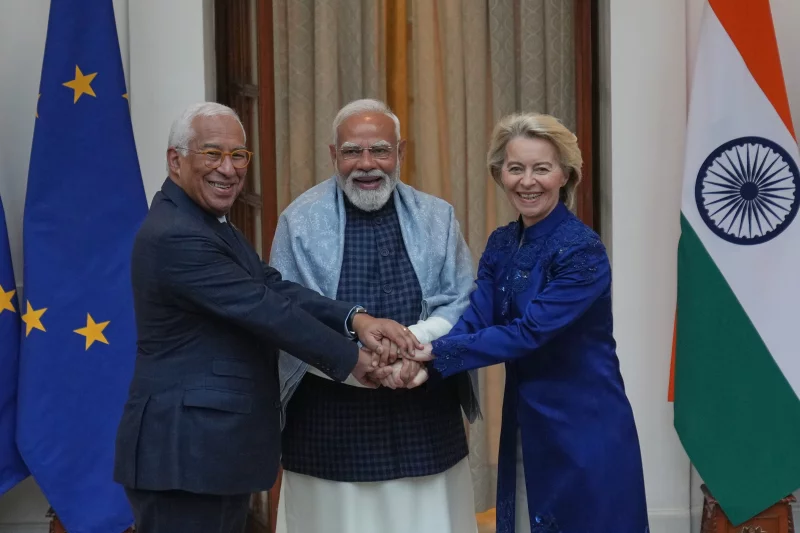
Europe and India have entered a new phase of economic and strategic cooperation after finalizing one of the most ambitious free trade agreements negotiated in recent decades. The accord links two of the world’s largest markets, representing nearly 25% of global GDP and more than one-third of international trade, at a moment when global commerce is being reshaped by rising tariffs, geopolitical rivalry, and supply chain realignments. The agreement is designed to eliminate or sharply reduce trade barriers across almost all goods, while also expanding cooperation in security, investment, technology, and labor mobility.
Negotiated over nearly twenty years, the deal reflects a decisive shift toward diversification for both partners. European policymakers view India as a long-term growth engine capable of absorbing industrial exports and investment flows, while New Delhi sees the European Union as a stabilizing counterweight in a fragmented global trading system increasingly influenced by protectionist policies elsewhere.
Tariff reductions and industrial integration accelerate
At the core of the agreement is a broad dismantling of tariffs covering nearly all traded goods between India and the 27-member bloc. India has committed to reducing or eliminating duties on approximately 96% of EU exports by value, while Brussels will phase in comparable reductions covering close to 99% of Indian shipments. According to projections discussed within the European Commission, the tariff cuts alone are expected to save exporters more than $4,700,000,000 annually once fully implemented.
Key European sectors poised to benefit include automobiles, pharmaceuticals, chemicals, machinery, and premium agricultural products such as wine and spirits. Tariffs on EU-made vehicles, which previously reached as high as 110%, will be gradually reduced to levels as low as 10%, while duties on car parts will be fully eliminated within five to ten years. For Indian exporters, expanded access to the European Union market will boost industries such as textiles, apparel, engineering goods, leather products, footwear, handicrafts, and marine exports.
Beyond tariffs, the agreement aims to reduce regulatory friction that has long slowed trade flows. Harmonization of standards, streamlined customs procedures, and improved transparency are expected to deepen supply chain integration and encourage joint manufacturing projects spanning both regions. These structural changes are projected to unlock investment measured in tens of billions of dollars over the next decade.
Strategic cooperation extends beyond trade
While the economic scope of the agreement is vast, its strategic implications are equally significant. India and the EU have agreed on a parallel framework to strengthen cooperation in defense, maritime security, and emerging technologies, reflecting shared concerns about regional stability and critical infrastructure protection. These discussions align with broader global security dialogues taking place within institutions such as NATO, particularly as trade, technology, and defense policy become increasingly interconnected.
The pact also includes provisions to ease mobility for skilled workers, researchers, and students, signaling a recognition that long-term competitiveness depends on talent flows as much as on capital and goods. European companies operating in India are expected to gain improved access to local labor markets, while Indian professionals will benefit from clearer pathways into EU economies facing demographic pressures.
This strategic dimension has gained urgency as both India and Europe navigate heightened trade tensions with the United States. Higher U.S. tariffs have accelerated New Delhi’s efforts to diversify export destinations, while Brussels has intensified its pursuit of strategic autonomy through expanded partnerships beyond traditional allies.
Global trade realignment and long-term impact
Trade between India and the EU already exceeds $136,500,000,000 annually, and officials on both sides have set a target of reaching approximately $200,000,000,000 by 2030. Analysts expect the agreement to act as a stabilizing corridor at a time when the multilateral trading system is under strain and global growth is increasingly shaped by regional blocs rather than universal rules.
The deal’s ratification process will move through legal reviews and approval by the European Parliament, with implementation expected to begin in phases once finalized. While certain sensitive sectors remain excluded on both sides, the overall scope marks a decisive break from incremental trade liberalization toward a comprehensive partnership.
As global commerce continues to fragment under the pressure of tariffs, sanctions, and strategic competition, the India-EU agreement stands out as a deliberate effort to anchor growth in cooperation rather than confrontation. Its long-term impact will be measured not only in trade volumes and investment flows, but in its ability to provide resilience and predictability in an increasingly volatile global economic order.