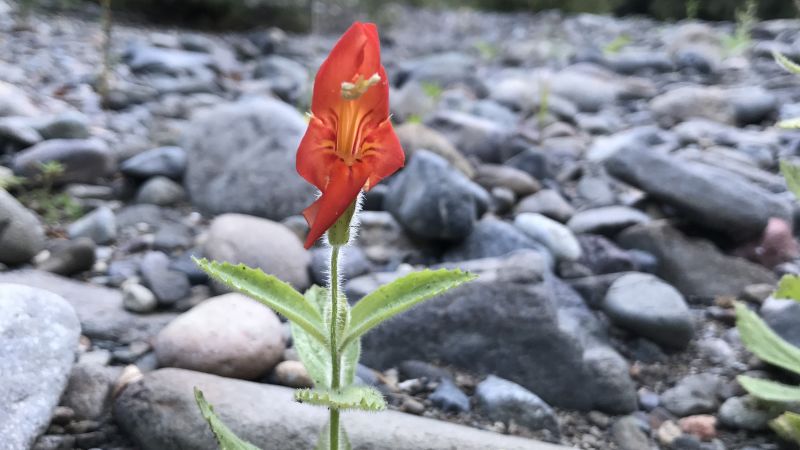
In the face of an intense, multi-year drought across the western United States, scientists have uncovered how certain plant species are adapting at remarkable speed. A new study highlights the survival of the scarlet monkeyflower, revealing how rapid genetic changes allowed some populations to endure extreme environmental stress.
The research, published in Science, offers one of the most detailed insights yet into how plants can evolve in real time to cope with climate-driven challenges. By analyzing populations across California and Oregon, scientists identified key traits that improved drought resilience and increased survival rates.
Rapid Evolution in Response to Extreme Climate
The concept at the heart of the study is rapid evolution, a process where organisms undergo significant genetic changes over a relatively short period. In this case, the prolonged drought acted as a powerful selective force, favoring plants that could conserve water more effectively.
Researchers tracked multiple populations over several decades, combining field observations with advanced genetic sequencing. Their findings show that evolution is not always a slow, gradual process; under intense environmental pressure, it can occur quickly enough to be observed within a human lifetime.
This discovery challenges traditional assumptions about how long adaptation takes and highlights the dynamic nature of ecosystems facing climate change.
The Role of Stomata in Water Conservation
A critical factor in the monkeyflower’s survival was the adaptation of its stomata. These microscopic openings regulate how plants exchange gases and release water vapor.
In drought conditions, excessive water loss can be fatal. The study found that the most resilient populations evolved to keep their stomata closed more often, significantly reducing water loss while still maintaining essential biological functions.
This adjustment allowed the plants to “hunker down” during the harshest periods, effectively balancing survival with growth. The ability to fine-tune such a fundamental physiological process underscores the sophistication of plant adaptation mechanisms.
Further insights into plant responses to environmental stress can be explored through resources like <a href=”https://www.nature.com/”>Nature</a> and plant biology overviews from <a href=”https://www.britannica.com/science/plant”>Encyclopaedia Britannica</a>.
Implications for Climate Resilience and Conservation
The findings carry broader implications for understanding how ecosystems may respond to increasing climate variability. As megadroughts become more frequent and severe, the ability of species to adapt quickly could determine which populations persist and which decline.
Organizations such as the <a href=”https://www.usgs.gov/”>U.S. Geological Survey</a> and the <a href=”https://www.fs.usda.gov/”>U.S. Forest Service</a> are closely monitoring how vegetation responds to changing environmental conditions, particularly in drought-prone regions.
The study also provides valuable insights for conservation strategies. By identifying traits associated with resilience, scientists may be able to better predict which species are most vulnerable and prioritize efforts to protect biodiversity.
Ultimately, the survival of the scarlet monkeyflower illustrates a powerful example of nature’s capacity to adapt. Even under extreme stress, life can find ways to persist—reshaping itself in response to a rapidly changing world.