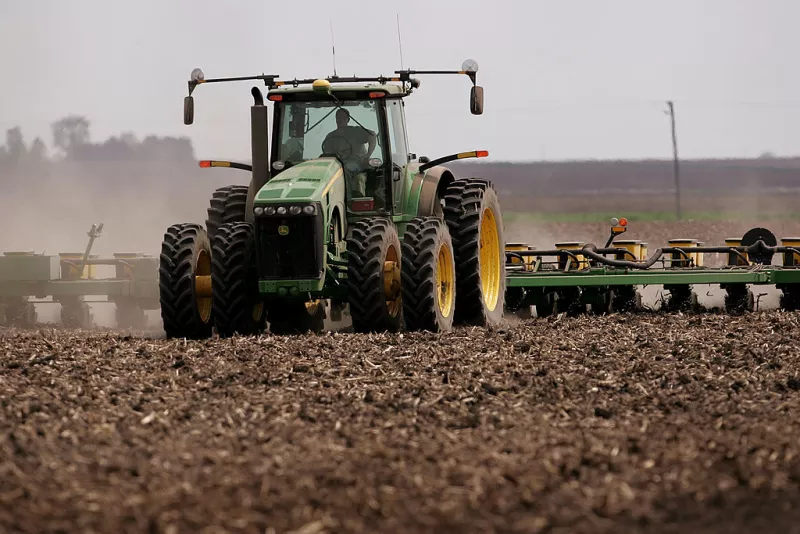
Rising Costs Squeeze Agricultural Operations
Farmers across key agricultural regions are facing intensifying financial strain as global tensions disrupt essential supply chains. The ongoing conflict involving Iran has significantly affected the movement of critical inputs, particularly fertilizers and fuel, both of which are vital for modern farming operations.
The disruption of shipping routes through the Strait of Hormuz has sharply reduced the availability of nitrogen-based fertilizers, pushing prices up by as much as $30 per ton in certain markets. These increases are compounded by rising diesel costs, which are essential for operating heavy machinery during planting and harvesting seasons. According to data referenced by the <a href=”https://www.usda.gov”>U.S. Department of Agriculture</a>, fuel expenses alone can account for a substantial portion of total farm operating costs, making sudden spikes particularly damaging.
For many producers, the combined burden of higher input costs is forcing difficult financial decisions. Farmers who once operated with narrow profit margins now find themselves balancing escalating expenses with uncertain crop revenues. The situation is especially challenging for those cultivating corn, where fertilizer use is intensive and unavoidable.
Trade Tensions and Market Instability
Beyond production costs, farmers are also grappling with shifting global trade dynamics. Diplomatic tensions have delayed key negotiations with major agricultural importers, including China, which remains a dominant buyer of soybeans. This uncertainty has contributed to volatile commodity prices, with soybean values dropping by nearly $1 per bushel in recent weeks.
Market analysts tracking developments through platforms such as the <a href=”https://www.cmegroup.com”>Chicago Mercantile Exchange</a> note that these fluctuations are being driven not only by geopolitical risks but also by changing planting strategies. As fertilizer prices climb, some farmers are reducing corn acreage in favor of soybeans, which require less nitrogen input. However, this shift increases supply pressure on soybean markets, further suppressing prices.
Tariffs and logistical constraints are adding another layer of complexity. Increased costs for imported machinery and parts—many of which are sourced internationally—are delaying equipment upgrades and maintenance. This creates operational inefficiencies at a time when productivity is critical to offset rising expenses.
Government Support and Long-Term Uncertainty
In response to mounting pressures, federal authorities have introduced financial relief measures aimed at stabilizing the agricultural sector. Programs totaling over $30 billion have been allocated to help farmers cope with increased production costs and disrupted export markets. Details on agricultural assistance initiatives can be explored through the <a href=”https://www.farmers.gov”>Farmers.gov portal</a>, which outlines eligibility and funding distribution.
While these subsidies provide short-term relief, many experts argue they are not a sustainable solution. Analysts from institutions such as the <a href=”https://www.worldbank.org”>World Bank</a> emphasize that repeated financial bailouts can distort market incentives and fail to address the root causes of instability.
Farmers themselves are expressing growing concern about long-term viability. The unpredictability of global conflicts, combined with fluctuating policy decisions, makes it increasingly difficult to plan future investments. High land prices and tight credit conditions are also limiting opportunities for younger farmers to enter the industry, raising concerns about generational continuity.
At the operational level, uncertainty is influencing everything from crop selection to capital expenditures. Large-scale investments—such as purchasing new equipment or expanding acreage—are being postponed as producers wait for clearer signals from both markets and policymakers.