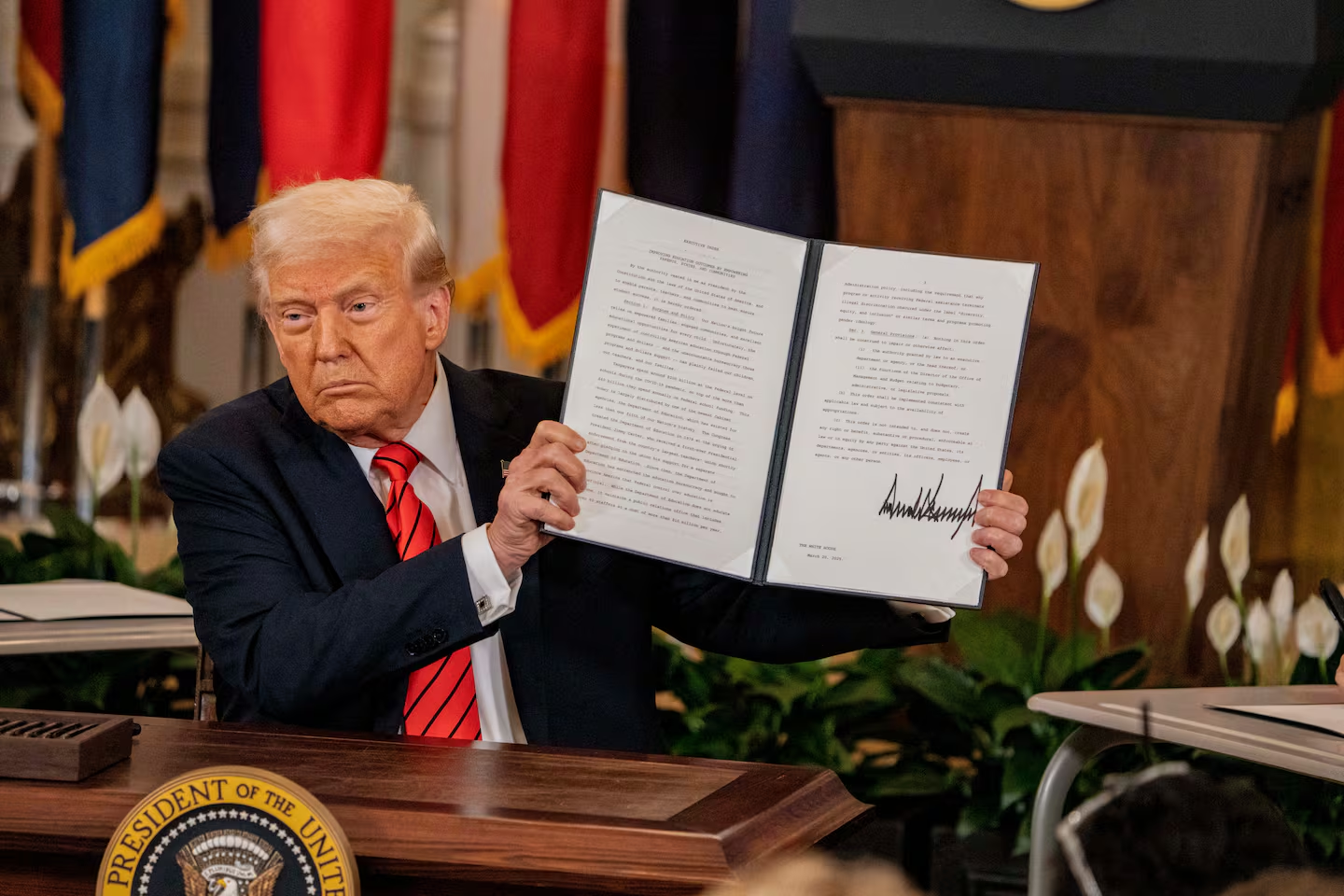
In the opening year of his return to the White House, President Donald Trump has pursued a far-reaching consolidation of executive authority that is reshaping the balance of power in Washington. Supporters argue that the Constitution gives the presidency wide latitude to act decisively, while critics say the administration is eroding long-standing democratic norms and pushing institutional boundaries that have historically constrained presidential power. With a Republican-led Congress largely aligned with the president’s agenda, Trump has advanced sweeping changes that reach into areas traditionally overseen by the legislative and judicial branches, from federal spending to trade policy and the structure of government agencies.
The administration’s approach has triggered a wave of legal disputes, court challenges, and institutional pushback. Federal judges have raised concerns about compliance with court orders, particularly in cases involving immigration enforcement and the handling of sensitive personal data. Meanwhile, watchdog groups and constitutional scholars warn that the pace and scope of executive action represent a significant departure from modern precedent. Even as Trump maintains strong support among his political base, national opinion polls show broad public unease about the direction of governance and the concentration of power in the executive branch.
Consolidating Authority Over Congress and Federal Spending
One of the most consequential shifts has been the administration’s effort to assert greater control over federal spending, a domain constitutionally assigned to Congress. Trump’s aides have delayed or withdrawn funds that lawmakers had already appropriated, raising fundamental questions about the separation of powers. While the White House contends that such actions are justified under existing statutes and emergency authorities, critics argue they undermine Congress’s constitutional role as the steward of the federal purse.
This rebalancing of power has extended into trade policy, where Trump has imposed sweeping tariffs on foreign goods by invoking longstanding legal authorities in novel ways. The administration’s tariff strategy has affected global supply chains and drawn retaliation from trading partners, intensifying debates over whether the president is stretching statutory powers beyond their original intent. Legislative leaders have so far stopped short of mounting a unified challenge, reinforcing perceptions that congressional oversight has weakened during Trump’s second term.
For context on the constitutional framework governing these powers, the structure of the federal government is outlined in detail on usa.gov, while current legislative authorities and appropriations laws are tracked through congress.gov. Together, these resources illustrate the legal boundaries that are now being tested by an increasingly assertive presidency.
Remaking Federal Institutions and Weakening Oversight
Beyond fiscal and trade policy, Trump has pursued a systematic remaking of federal institutions. Entire departments have been reorganized, downsized, or eliminated, often with limited consultation with Congress. Inspectors general and agency appointees who were designed to operate independently of the White House have been fired or sidelined, reducing internal checks on executive conduct.
The administration has also blurred the traditional line separating the White House from the Department of Justice. Trump has openly pressed the DOJ to investigate political adversaries, framing such actions as necessary for accountability while critics see them as a weaponization of law enforcement. This approach has reignited concerns about the independence of federal prosecutors and the integrity of the justice system.
Information about the structure and responsibilities of federal agencies is available through usa.gov, while official DOJ policies and enforcement priorities are published on justice.gov. Legal challenges to executive actions, many of which are now moving through the courts, can be followed via supremecourt.gov, where cases testing the limits of presidential authority are expected to shape future constitutional interpretation.
Targeting Media, Culture, and the Flow of Information
Trump’s second-term strategy has not been limited to formal institutions. The administration has mounted an aggressive campaign to control information and influence cultural narratives. Public media outlets have faced defunding efforts, while journalists report increasing obstacles to accessing government officials and records. Trump has publicly threatened reporters who refuse to disclose confidential sources, intensifying fears about press freedom and the chilling effect on investigative journalism.
The White House has also intervened in cultural institutions, directing national museums to revise exhibits and pressuring educational institutions to align with the administration’s views. Visa applications have reportedly been denied based on alleged involvement in “censorship,” broadening the administration’s reach into academic and cultural exchange. These moves, critics say, amount to an attempt to reshape public discourse and historical memory through executive pressure rather than democratic debate.
The official positions of the administration on these matters are outlined on whitehouse.gov, where policy announcements and executive orders are published. Yet even as the White House frames these actions as a defense of free expression and national values, civil liberties groups warn that they risk undermining the very freedoms they claim to protect.
As Trump enters the second year of his renewed presidency, the cumulative impact of these policies is redefining the modern American presidency. With Congress largely aligned and the courts moving slowly, the long-term consequences for constitutional governance remain uncertain. What is clear is that the scope of executive power is being tested in ways that will shape the political and legal landscape for years to come.