Trump defends economic record while launching broad attacks
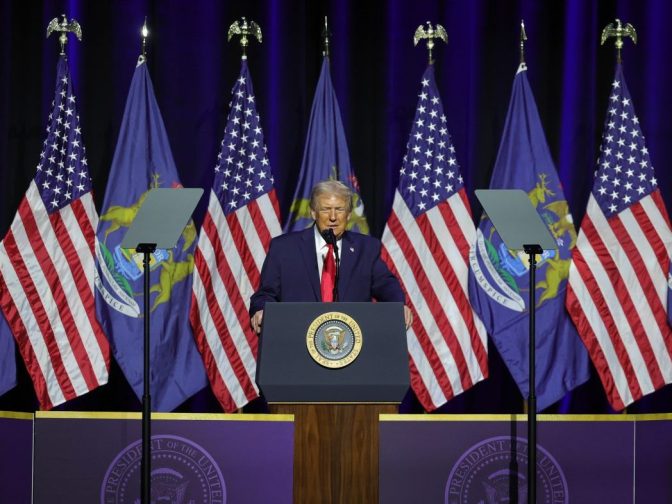
President Donald Trump delivered a lengthy address at the Detroit Economic Club on Tuesday that was intended to highlight his administration’s economic achievements but instead became a wide-ranging speech filled with criticism of political rivals and key financial officials. Trump opened the address by asserting that the United States had gone “from the worst numbers on record to the best and strongest numbers” under his leadership, a claim aimed at reassuring business leaders and voters that the economy has improved.
In his remarks, Trump highlighted planned measures designed to appeal to working-class voters, including proposals to cap credit card interest rates at 10% for one year and plans to combat fraud within federal programs. He also suggested freezing federal payments to states that designate themselves as sanctuary cities and teased broader initiatives on health care and housing affordability.
Despite these policy points, much of Trump’s Detroit speech was dominated by attacks on former President Joe Biden and Federal Reserve Chairman Jerome Powell. Trump blamed Biden’s administration for high inflation and repeatedly criticized Powell for not lowering interest rates, calling him “that jerk” and suggesting he would soon be removed from his position.
Economic signals continue to concern voters amid political rhetoric
Trump’s speech took place as many Americans continue to express concerns about affordability and cost of living pressures, particularly with inflation still above pre-pandemic levels and everyday expenses rising for households. According to recent consumer price index data referenced by economic analysts, average prices were 2.7% higher in the most recent 12-month period, undermining assertions that inflation has fully subsided.
While the White House has pointed to lower gas prices and dips in mortgage rates as victories, many voters remain skeptical about the economic narrative. Polling from several reputable organizations shows that public confidence in Trump’s handling of the economy remains low, particularly among independents and suburban voters. The Federal Reserve’s monetary policy, including decisions on interest rates, remains a central issue for markets and household budgets alike, and Trump’s direct confrontation with Powell underscores the political stakes of central bank decisions. For a broader perspective on the role of interest rates in the U.S. economy, visit the Federal Reserve’s official overview of monetary policy. (https://www.federalreserve.gov/monetarypolicy.htm)
Critics argue that Trump’s focus on political targets during an economic address risks obscuring substantive discussion on key issues such as wage growth, labor participation, and long-term inflation trends. For more detailed economic data and analysis, economists often consult the U.S. Bureau of Labor Statistics, which provides timely reports on consumer prices, employment, and other indicators. (https://www.bls.gov)
Domestic politics and policy implications ahead of elections
Trump’s Detroit speech also carried clear political undertones as the administration prepares for upcoming election cycles. The president’s emphasis on criticisms of Biden and Powell, as well as comments on immigration and federal policy, signal a broader messaging strategy aimed at rallying his base and shaping public discourse on economic leadership.
Despite these efforts, independent analysts note that economic perceptions among voters will likely remain a crucial factor in electoral outcomes. Issues such as housing affordability, healthcare costs, and credit accessibility are frequently cited in voter surveys and are likely to remain front-and-center in policy debates this year. The White House Office of Management and Budget offers insights into federal spending priorities and economic projections that inform these national discussions. (https://www.whitehouse.gov/omb)
Moreover, commentators across the political spectrum are watching how Trump’s tariff policies, regulatory actions, and international trade postures will impact industries such as automotive manufacturing and supply chains, which are central to Michigan’s economy. For information on trade statistics and their influence on domestic markets, refer to the U.S. International Trade Commission’s resources. (https://www.usitc.gov)
As the midterm elections approach, Trump’s blending of economic promotion with sharp criticism of opponents underscores the dynamic intersection of policy, politics, and public perception in shaping the national economic narrative.