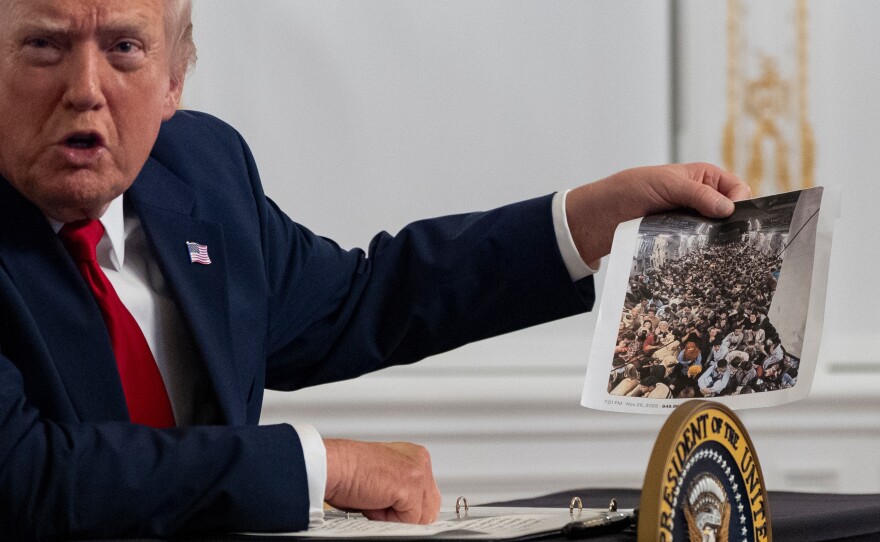
President Donald Trump escalated his immigration stance during the Thanksgiving holiday, declaring that he would “permanently pause migration” from low-income nations as he reacted to a high-profile shooting involving a foreign-born individual. His statement circulated widely across social media, marking one of his most forceful declarations of the year and signaling a renewed push for restrictive migration measures as the administration highlights national security challenges abroad and at home.
Rhetoric Intensifies Following Deadly Incident in Washington, D.C.
The president’s comments came after the Wednesday shooting of two National Guard members assigned to patrol Washington, D.C., resulting in the death of one service member hours before Trump connected by video with U.S. troops on Thanksgiving evening. Authorities charged a 29-year-old Afghan national who previously assisted U.S. intelligence operations during the war in Afghanistan and later resettled in the United States under a special immigration program.
Trump claimed that “only reverse migration” could address what he described as rising security risks, adding pointed criticism of individuals he views as threatening to the country’s values and stability. His message also suggested a broader reassessment of programs tied to resettlement and humanitarian pathways, including those connected to military cooperation abroad. For context on how such policies have historically operated, background information about humanitarian immigration programs is available through resources like https://www.uscis.gov/humanitarian.
Economic and Social Implications Drive National Debate
A nationwide pause in migration could reshape multiple sectors of the U.S. economy, especially as immigrant labor represents nearly 31 million jobs across construction, agriculture, healthcare and service industries. Analyses from labor institutions, including datasets accessible through https://www.bls.gov, show that foreign-born workers continue to play a significant role in maintaining employment levels and productivity in several states.
Trump suggested that most foreign-born residents rely on welfare or come from “failed nations,” criminal networks or institutions, statements that contradict extensive academic literature. Multiple studies, including long-term criminological research, indicate that immigration does not correlate with higher crime rates. Economic research published in recent years also finds that immigrants are significantly less likely to be incarcerated than U.S.-born individuals, a trend consistent for over a century.
Despite the data, the administration has emphasized more aggressive vetting measures, renewed deportation initiatives and broader national-security-based screening protocols. Information outlining how the U.S. government structures background checks and eligibility standards can be found through agencies such as the Department of Homeland Security at https://www.dhs.gov.
Intensified Screening of High-Risk Countries
The administration has increased its scrutiny of migration pathways following the incident, prompting calls from within the White House to reinvestigate Afghan arrivals admitted under the previous administration. The director of U.S. Citizenship and Immigration Services announced that the agency will heighten screening for individuals from 19 countries labeled as high-risk, though the specific nations were not named publicly.
Earlier in the year, the government imposed travel restrictions on citizens of multiple countries, citing national security concerns. These updates align with a broader shift toward prioritizing threat-based policies and reshaping migration channels, including those for refugees, temporary visitors and long-term applicants. Readers seeking general information on travel restrictions and immigration procedures may reference the U.S. State Department’s travel platform at https://travel.state.gov.
Trump has also pointed to demographic shifts in states with large immigrant populations, referencing communities in Minnesota and reiterating claims about crime rates despite longstanding research showing no link between immigrant presence and rising criminal activity.
As political pressure mounts and national debate continues, the administration’s messages signal that immigration policy will remain at the forefront of domestic and international discussions in the coming months, particularly as high-profile incidents prompt renewed scrutiny of refugee programs, asylum pathways and screening protocols across multiple federal agencies.