From Open Hostility to a Surprising Encounter
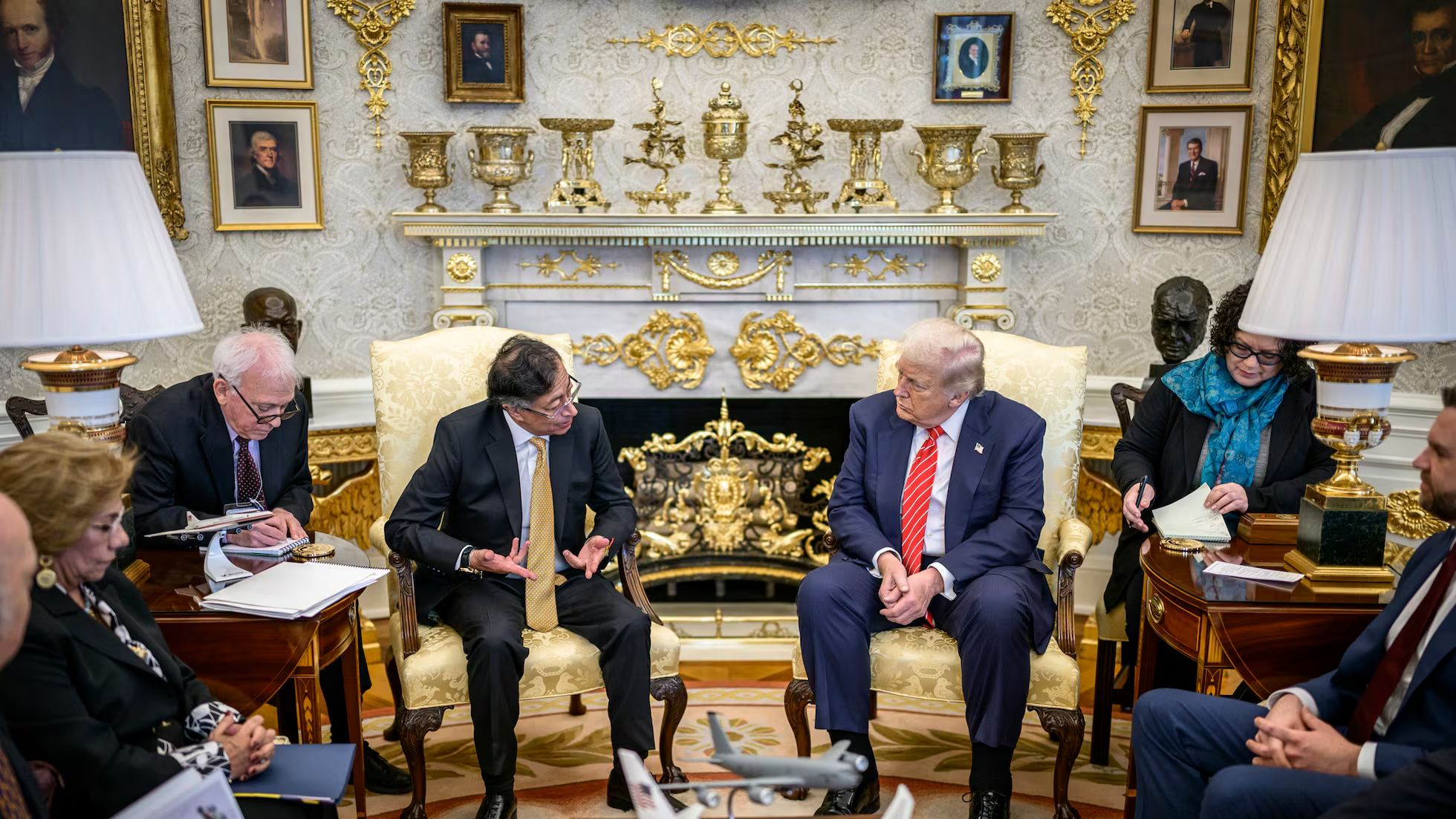
President Donald Trump hosted Colombian President Gustavo Petro at the White House in a meeting that few observers would have predicted only months earlier. The encounter marked a sharp tonal shift after years of public sparring in which Petro emerged as one of Trump’s most outspoken critics in the region. Petro has repeatedly condemned U.S. military actions tied to drug trafficking routes and denounced Washington’s foreign policy positions in the Middle East, while Trump has accused Colombia’s leadership of allowing cocaine flows to reach U.S. cities.
Despite that history, the two-hour meeting unfolded with visible cordiality. Images shared afterward showed the leaders smiling and exchanging pleasantries, a stark contrast to their previous confrontations. Trump praised Colombia directly, while Petro highlighted the symbolic nature of the encounter, framing it as proof that dialogue remained possible even after sustained diplomatic turbulence.
A Relationship Shaped by Ideology and Retaliation
The friction between the two presidents intensified early in Trump’s second term, when Petro refused to accept U.S. military flights carrying undocumented migrants back to Colombia. Trump responded with threats of a trade war and punitive economic measures, forcing Bogotá to reverse course within days. The episode cemented Trump’s view of Petro as an unreliable partner and emboldened the U.S. administration to apply pressure through tariffs and visa restrictions.
Tensions escalated further when Petro, while attending the United Nations General Assembly in New York, publicly urged U.S. soldiers to disobey Trump’s orders. That move triggered swift retaliation, including the revocation of Petro’s U.S. visa and financial sanctions targeting him and senior members of his government. The standoff unfolded as cocaine production in Colombia surged to roughly 3,000 tons in 2024, according to the U.N. Office on Drugs and Crime, fueling Trump’s narrative that Bogotá had lost control of its drug war.
Strategic Reality Behind the Diplomatic Pause
Behind the scenes, sustained backchannel diplomacy helped cool the temperature. A lengthy phone call between the two leaders earlier this year paved the way for the Washington meeting, signaling a mutual recognition that outright confrontation carried risks for both sides. Colombia remains Washington’s closest ally in Latin America and a critical trade partner, a status built over decades of U.S. financial and military support.
Analysts note that the current détente is pragmatic rather than warm. Experts at the Washington Office on Latin America describe the relationship as a temporary alignment driven by strategic necessity and personality management rather than deep policy convergence. With Petro’s term set to end in August, the window for cooperation may be limited, but for now both leaders appear willing to lower the temperature and test whether dialogue can stabilize one of the hemisphere’s most consequential bilateral relationships.