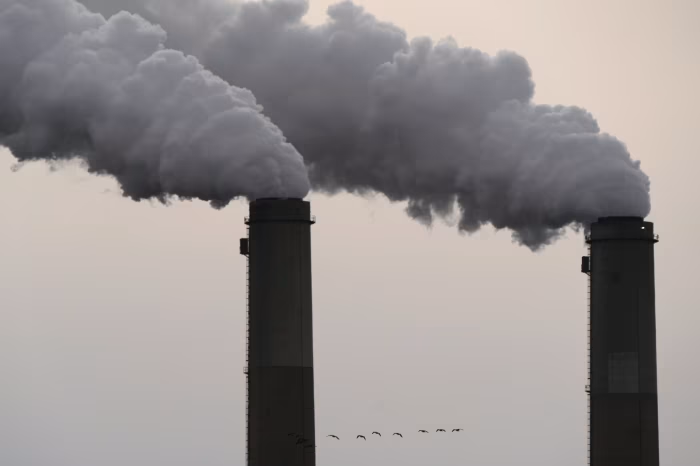
The Trump administration is preparing to implement one of the most far-reaching regulatory reversals in modern U.S. environmental policy, announcing plans to rescind the Environmental Protection Agency’s landmark 2009 endangerment finding. This scientific and legal determination established that greenhouse gases such as carbon dioxide and methane endanger public health and welfare, providing the foundation for regulating climate pollution under the Clean Air Act. By overturning this central finding, the administration is poised to dismantle large portions of federal climate regulations, signaling a decisive shift in national environmental governance.
The decision is expected to be formalized during a White House event involving President Donald Trump and EPA Administrator Lee Zeldin, underscoring the administration’s commitment to rolling back federal oversight of emissions standards. According to senior administration officials, the repeal would mark the most extensive deregulatory effort in American history, fundamentally altering how the federal government addresses climate change, environmental protection, and industrial compliance. The announcement follows years of political debate over the federal government’s authority to regulate greenhouse gases and reflects the administration’s broader effort to reduce regulatory burdens on industry and energy producers.
This move has broad implications across multiple sectors, including transportation, power generation, manufacturing, and energy development. The endangerment finding has served as the legal backbone for numerous federal initiatives aimed at reducing emissions, promoting cleaner technologies, and aligning the United States with international climate goals. Without it, many of those regulations could be rendered unenforceable, reshaping the trajectory of environmental policy for years to come.
A Fundamental Shift in Environmental Authority
At the heart of the administration’s decision is a legal reinterpretation of the Clean Air Act. The EPA now contends that the statute does not grant explicit authority to regulate greenhouse gases, challenging long-standing judicial and administrative precedents. Since 2009, the endangerment finding has enabled the federal government to regulate emissions from vehicles, power plants, and industrial facilities, helping drive investments in cleaner energy sources and more efficient technologies.
The agency’s updated position argues that Congress did not intend for the Clean Air Act to serve as a comprehensive framework for regulating climate change, asserting instead that such authority should come directly from new legislation. This reinterpretation aligns with the administration’s broader deregulatory agenda, which emphasizes reducing federal intervention in economic activity and promoting domestic energy production.
More information about the agency’s regulatory framework and responsibilities can be found on the official website of the Environmental Protection Agency at https://www.epa.gov, which outlines the scope of federal environmental programs and enforcement mechanisms.
Critics argue that reversing the endangerment finding disregards decades of scientific research demonstrating the link between greenhouse gas emissions and rising global temperatures, extreme weather events, and public health risks. Environmental advocates warn that weakening regulatory authority could lead to higher emissions, slower adoption of clean technologies, and increased vulnerability to climate-driven disasters.
Transportation, Industry and Economic Impacts
One of the most immediate consequences of the repeal is expected to be the dismantling of federal vehicle emissions standards. Transportation remains the largest source of direct greenhouse gas emissions in the United States, and existing regulations have played a central role in improving fuel efficiency, lowering pollution levels, and encouraging the development of electric and hybrid vehicles.
By rescinding the endangerment finding, the administration could eliminate or weaken these standards, potentially reshaping the automotive industry’s approach to innovation and compliance. Federal transportation policies, including emissions and fuel efficiency programs, are detailed by the U.S. Department of Transportation at https://www.transportation.gov, where guidelines and regulatory objectives are published.
Industry groups supporting the move argue that reducing regulatory constraints will lower operational costs, stimulate economic growth, and enhance U.S. competitiveness in global markets. Energy producers, particularly those involved in fossil fuel extraction and refining, are likely to benefit from relaxed emissions oversight. The administration maintains that increased domestic energy production will strengthen national energy security and stabilize prices for consumers.
The U.S. Department of Energy, accessible at https://www.energy.gov, highlights ongoing investments in energy infrastructure and innovation, emphasizing the administration’s focus on expanding domestic resources while balancing environmental considerations. However, analysts caution that regulatory rollbacks could discourage long-term investment in renewable technologies, potentially leaving the U.S. behind in the rapidly evolving global clean energy economy.
Legal Battles and Global Repercussions
The decision to revoke the endangerment finding is expected to trigger extensive legal challenges from environmental organizations, state governments, and public interest groups. These lawsuits will likely argue that the repeal violates statutory obligations, ignores scientific consensus, and undermines public health protections. Prolonged court proceedings could create regulatory uncertainty for businesses and policymakers alike, with potential cases eventually reaching the U.S. Supreme Court.
Beyond domestic legal disputes, the move carries significant international implications. The United States has historically played a central role in shaping global climate policy, and regulatory reversals could weaken its standing in international negotiations. Diplomatic partners may view the shift as a retreat from collective efforts to address climate change, complicating cooperation on environmental, economic, and security issues.
The White House, whose policy priorities are outlined at https://www.whitehouse.gov, has emphasized its commitment to economic growth, energy independence, and regulatory reform. Administration officials argue that environmental protection can coexist with economic expansion, asserting that technological innovation and market forces will drive progress more effectively than federal mandates.
As climate-related disasters continue to intensify worldwide, the long-term consequences of this regulatory shift remain uncertain. The repeal of the endangerment finding represents a pivotal moment in U.S. environmental policy, redefining the balance between federal oversight, economic priorities, and environmental responsibility. With legal challenges looming and international scrutiny mounting, the administration’s decision is set to influence climate policy debates and regulatory frameworks for years to come.