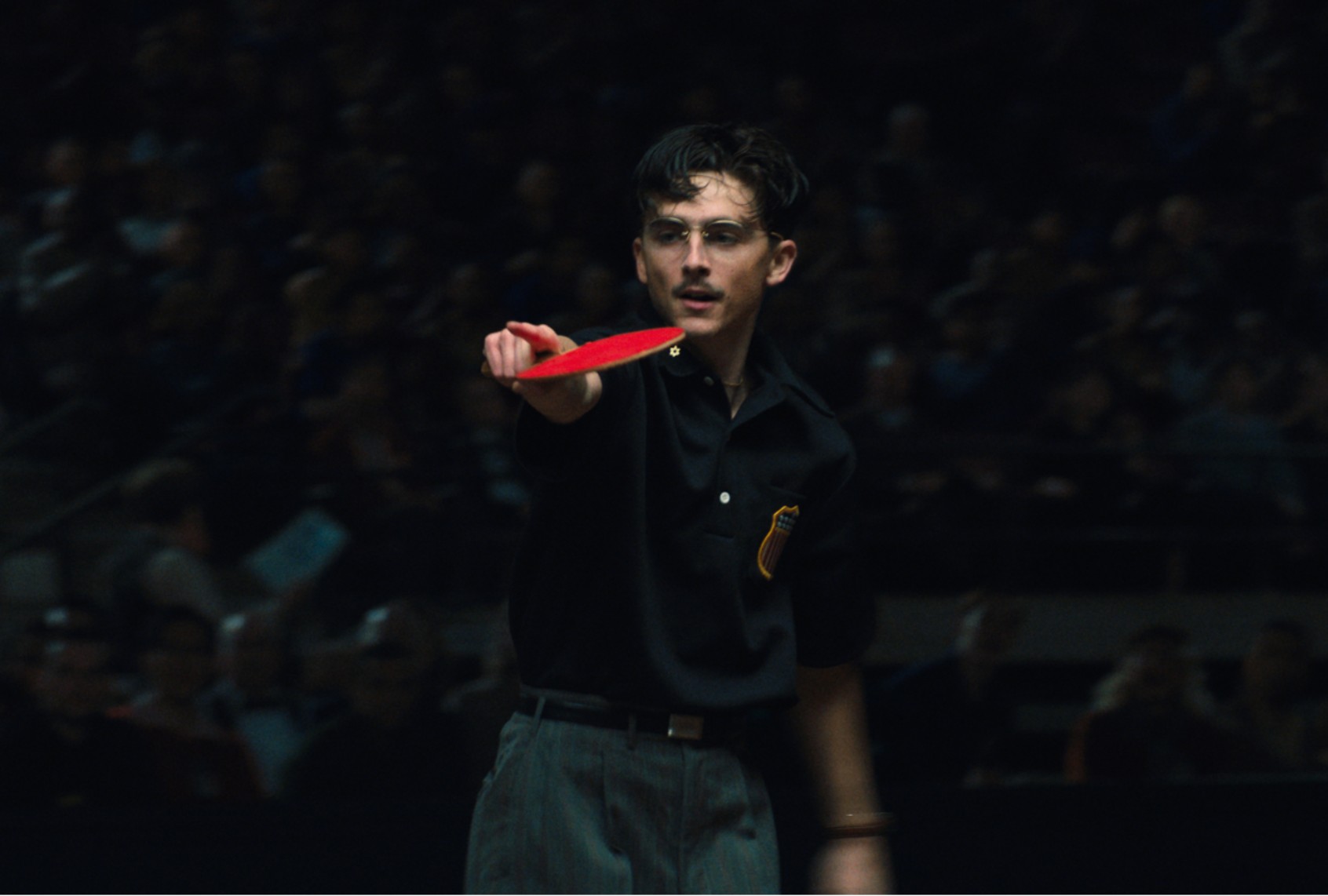
Timothée Chalamet’s performance in Marty Supreme marks a defining moment in his career, not because it abandons ambition, but because it embraces it fully. Set in 1952 New York, the film follows Marty Mauser, a gifted but financially desperate table-tennis prodigy whose talent alone cannot buy him entry into the elite international circuit. Chalamet’s portrayal is restless, sharp-edged, and unrelenting, capturing a young man who believes greatness is not granted but taken, often at a personal cost.
The film arrives after Chalamet’s acclaimed turn as Bob Dylan in A Complete Unknown, a role that expanded his reputation for immersion and intensity. Rather than retreating into safer material, Marty Supreme demands even more: emotional velocity, physical precision, and the ability to anchor a story that rarely pauses to catch its breath. The result is a character study that aligns Chalamet with a tradition of driven cinematic antiheroes while remaining distinctly his own.
A Hustler’s Journey Through Postwar Manhattan
Marty Mauser’s world is defined by motion. He moves through postwar Manhattan with urgency, navigating dingy apartments, underground game rooms, and the blurred boundaries between sport, survival, and deception. Production design plays a central role in grounding the film’s intensity, creating a city that feels both historically precise and emotionally claustrophobic. This version of New York is not a backdrop but an active force, shaping Marty’s choices and amplifying his desperation.
Josh Safdie’s direction leans into kinetic storytelling, echoing the pulse-driven style seen in his earlier work while adapting it to a period setting. Marty’s schemes are not romanticized; they are portrayed as necessary risks taken by someone who understands that brilliance without access means stagnation. The table-tennis sequences themselves are staged with the urgency of chase scenes, reinforcing the idea that for Marty, competition is another form of escape.
The character’s Jewish identity is woven into the narrative without becoming didactic. Marty’s hunger for recognition exists alongside a deeper need for validation in a world still reeling from the trauma of World War II. His ambition becomes a response to historical rupture, an insistence on visibility and survival through excellence.
Performance, History, and Cinematic Lineage
Although Marty Supreme draws loose inspiration from real-life table-tennis champion Marty Reisman, the film avoids biographical rigidity. Instead, it uses historical fragments to explore broader themes of identity, assimilation, and postwar reinvention. Supporting performances, including Odessa A’zion as Rachel, add emotional weight by grounding Marty’s relentless drive in personal consequences that cannot be outrun.
Chalamet’s physical commitment is evident throughout, particularly in scenes that require rapid shifts between charm and panic. His Marty is persuasive, abrasive, and often self-sabotaging, yet consistently compelling. The performance reinforces why Chalamet remains one of the most closely watched actors of his generation, frequently discussed across platforms such as https://www.imdb.com, https://www.rottentomatoes.com, https://www.a24films.comy https://www.oscars.org.
Marty Supreme ultimately functions as more than a sports drama. It is a portrait of ambition sharpened by scarcity, of talent colliding with systems designed to exclude. In embracing chaos, the film allows Chalamet to explore the edge where aspiration turns into obsession, leaving a lasting impression that extends beyond its final rally.