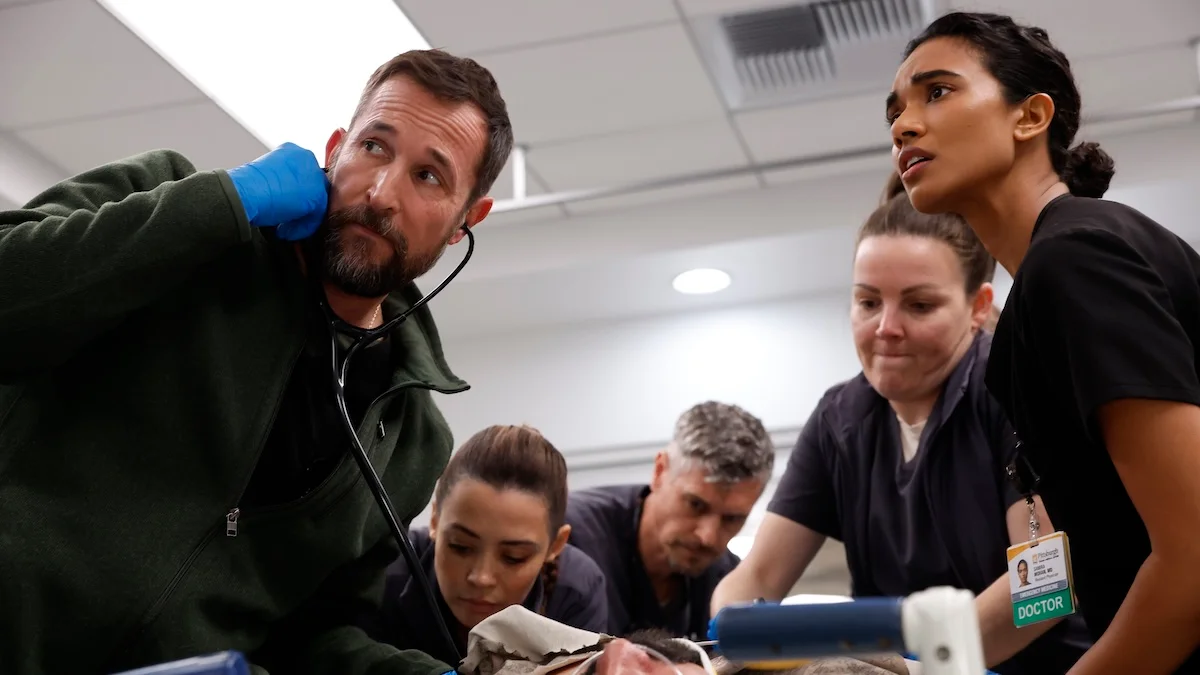
The second season of The Pitt deepens the emotional and psychological terrain established in its Emmy-winning debut, transforming the series from a high-intensity medical procedural into a layered study of long-term trauma, power dynamics, and moral complexity. While each episode continues to track a single hour inside a relentless Pittsburgh emergency department, the larger narrative now stretches across months, forcing characters—and viewers—to confront how crises linger long after the chaos fades. In doing so, the show cements itself as one of the most thoughtful explorations of modern medicine and emotional resilience currently streaming on <a href="/es/”https://www.hbomax.com”/" target="”_blank”">HBO Max</a>.
At the heart of the series remains Dr. Michael “Robby” Rabinovitch, portrayed with remarkable emotional restraint by Noah Wyle. Once a model of empathy and composure, Robby enters the new season visibly changed. His unhelmeted motorcycle rides to work signal more than rebellion; they reveal a man quietly unraveling. The aftermath of his emotional collapse in Season 1 does not produce immediate healing, but instead exposes how trauma often embeds itself deeper into daily life. This slow-burning deterioration becomes a central narrative engine, reshaping Robby’s relationships with colleagues, students, and patients alike.
The Weight of Trauma and the Cost of Leadership
Season 2 places heavy emphasis on how unresolved pain corrodes leadership. Robby’s interactions grow colder, his patience thinner, and his once-inspiring mentorship increasingly selective. His emotional withdrawal from Dr. Langdon, who returns after rehabilitation, underscores the persistent complexity of forgiveness and accountability. Rather than presenting redemption as a neat arc, the series allows distrust, resentment, and hesitation to coexist, reflecting the real-world struggles faced by healthcare professionals navigating betrayal within high-pressure environments.
This emotional realism is a defining feature of The Pitt, which aligns closely with contemporary conversations about physician burnout and psychological safety in hospitals, themes explored in depth by organizations such as the <a href="/es/”https://www.aamc.org”/" target="”_blank”">Association of American Medical Colleges</a>. By focusing on the cumulative toll of trauma rather than singular dramatic moments, the show dismantles the myth of the endlessly resilient doctor and replaces it with a far more human portrait.
The arrival of Dr. Al-Hashimi further complicates this dynamic. Her progressive ideas, particularly her openness to generative AI for medical documentation, clash with Robby’s entrenched skepticism. Yet as episodes unfold, she emerges not as a threat, but as a capable, compassionate physician whose modern approach reflects shifting realities in healthcare. Her presence introduces vital ethical questions surrounding technology, efficiency, and emotional labor, echoing broader debates shaping modern clinical practice, including those discussed by the <a href="/es/”https://www.nejm.org”/" target="”_blank”">New England Journal of Medicine</a>.
Addiction, Trust, and the Complexity of Forgiveness
Langdon’s return from rehab introduces one of the season’s most emotionally charged storylines. His sincere attempts at accountability collide with Robby’s unresolved anger, producing a tense standoff that reflects the deep scars left by broken trust. Rather than offering easy reconciliation, The Pitt presents forgiveness as a prolonged, uncomfortable process that unfolds unevenly.
This approach extends to the broader ensemble, particularly Santos, whose sense of alienation deepens amid lingering suspicion and workplace judgment. Her arc exposes how institutional cultures can unintentionally isolate those who act ethically, raising essential questions about loyalty, justice, and professional responsibility. These dynamics mirror ongoing discussions about whistleblower protection and accountability within medical systems, topics addressed by institutions like the <a href="/es/”https://www.jointcommission.org”/" target="”_blank”">Joint Commission</a>.
The series’ commitment to portraying addiction as a chronic, daily battle rather than a resolved storyline adds further depth. Langdon’s vulnerability contrasts sharply with Robby’s emotional armor, highlighting two divergent responses to pain: confrontation and avoidance. Their parallel journeys underscore how healing is rarely linear, and often depends on community, timing, and emotional readiness.
Technology, Ethics, and the Future of Medicine
One of Season 2’s most compelling narrative threads involves the ethical implications of integrating artificial intelligence into clinical workflows. Dr. Al-Hashimi’s advocacy for AI-assisted documentation reflects real-world innovations aimed at reducing physician burnout, while Robby’s skepticism voices legitimate concerns about accuracy, accountability, and patient safety.
This storyline resonates strongly in an era where AI tools are increasingly embedded in healthcare, as explored by research initiatives at institutions such as <a href="/es/”https://www.nih.gov”/" target="”_blank”">The National Institutes of Health</a>. By framing the debate through character-driven conflict rather than abstract theory, The Pitt transforms a technical discussion into a deeply human one, centered on exhaustion, empathy, and the struggle to balance efficiency with care.
Ultimately, The Pitt Season 2 distinguishes itself by refusing simplistic resolutions. Its characters are not fixed archetypes but evolving individuals shaped by grief, fatigue, ambition, and regret. Robby’s gradual emotional detachment, far from offering dramatic spectacle, becomes the most unsettling development of all. His diminishing empathy, selective mentorship, and growing isolation suggest that untreated trauma may be more dangerous than overt collapse.
Through its nuanced storytelling, emotional realism, and ethical complexity, The Pitt transcends traditional medical drama, offering a profound meditation on resilience, leadership, and the fragile line between dedication and self-destruction. As the series continues, its exploration of these themes positions it as one of the most intellectually and emotionally resonant shows in contemporary television.