Tesla is entering a decisive phase of transformation as Elon Musk redefines the company’s long-term priorities, moving its center of gravity away from electric vehicles and toward humanoid robotics. After more than a decade in which Tesla’s identity was built around cars, batteries, and energy storage, management is signaling that the next chapter of growth will be driven by artificial intelligence, advanced automation, and large-scale robot manufacturing. The shift comes as Tesla faces mounting pressure from global competition, regulatory uncertainty, and a cooling EV market that has forced a broader reassessment of capital allocation and manufacturing capacity.
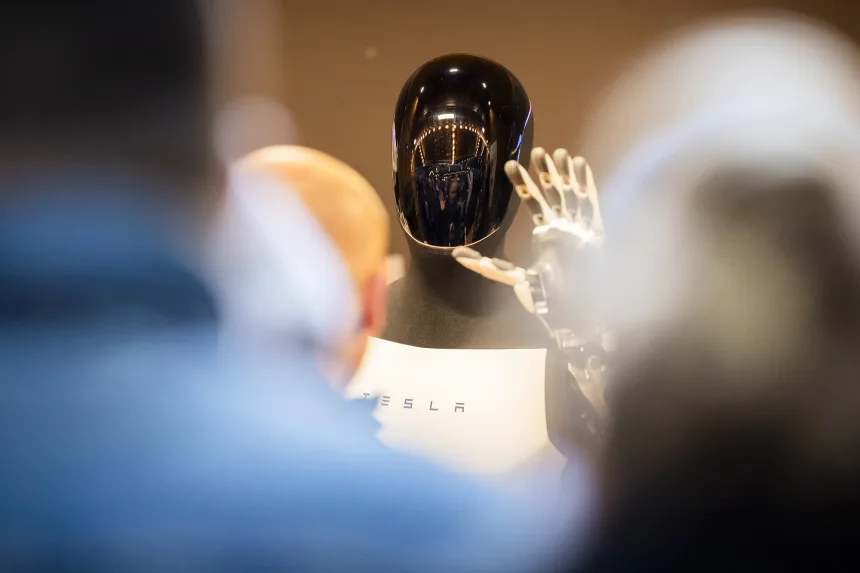
During recent earnings discussions, Musk outlined plans to repurpose existing production space in California to support large-scale assembly of the Optimus humanoid robot. This reallocation reflects a strategic bet that robotics can deliver higher margins, more scalable revenue streams, and a longer technological runway than vehicles alone. Tesla’s leadership argues that the company’s expertise in batteries, motors, software, and high-volume manufacturing provides a foundation that can be leveraged beyond transportation, positioning Optimus as a platform rather than a single product line.
Manufacturing realignment and capital priorities
The decision to convert vehicle production capacity into robot manufacturing represents a fundamental rethinking of Tesla’s asset base. By shifting factory space traditionally used for premium vehicle models toward robotics, Tesla is signaling confidence that demand for humanoid robots could eventually rival, or surpass, that of high-end electric cars. This move aligns with the company’s broader emphasis on operational efficiency and return on invested capital, priorities that are increasingly scrutinized by regulators and investors through disclosures filed with the U.S. Securities and Exchange Commission.
Tesla’s internal projections suggest that Optimus could eventually be produced at volumes exceeding 1,000,000 units annually, a scale that would place robotics alongside vehicles as a core revenue driver. Musk has repeatedly suggested that long-term revenue potential from humanoid robots could reach into the trillions of dollars, though the timeline remains uncertain. Analysts note that while the upfront investment is significant, the marginal cost of production could decline rapidly if Tesla succeeds in standardizing components and automating assembly, mirroring the cost curves previously achieved in battery manufacturing.
This pivot also reflects a response to shifting market conditions. Global EV sales growth has slowed, price competition has intensified, and government incentives have become less predictable. By contrast, automation and robotics are viewed as structural growth markets tied to labor shortages, aging populations, and productivity demands across industries.
The competitive landscape for humanoid robotics
Tesla is not entering an empty field. The humanoid robotics sector has expanded rapidly, with dozens of companies developing machines designed to operate in human environments. Research firms and consultancies tracking automation trends, including McKinsey & Company, estimate that the global humanoid robot market could grow into a multi-trillion-dollar industry over the coming decades as adoption expands from factories into logistics, healthcare, and household applications.
Tesla’s differentiation strategy centers on vertical integration and software. Unlike many competitors that rely on third-party suppliers, Tesla controls much of its hardware stack and develops its own AI systems, enabling tighter coordination between perception, movement, and decision-making. The company has already begun deploying early Optimus units in controlled factory settings, using real-world data to refine balance, object manipulation, and task execution.
Still, significant technical hurdles remain. Dexterous hands, reliable autonomy in unstructured environments, and long-duration battery performance are among the most difficult challenges in robotics. Experts caution that widespread deployment is likely to take years, if not decades, even for well-capitalized players. Financial institutions such as Goldman Sachs have highlighted both the upside potential and execution risk, noting that profitability will depend on achieving scale without sacrificing safety or reliability.
Investor expectations and long-term implications
Musk’s emphasis on robotics also carries implications for Tesla’s valuation and governance. Shareholders have approved compensation structures that are closely tied to ambitious growth milestones, making the success of Optimus materially relevant to executive incentives. At the same time, the shift toward robotics introduces new regulatory, ethical, and safety considerations that extend beyond the automotive sector, potentially increasing oversight from labor and technology regulators.
Market reaction has been mixed. Some investors view the robotics push as a natural extension of Tesla’s mission to apply AI and automation at scale, while others question whether the company is stretching itself too thin amid ongoing challenges in its core vehicle business. Industry analysts following technology adoption trends, including data published by Morgan Stanley, suggest that humanoid robots could eventually become a meaningful contributor to global productivity, but warn that commercialization timelines are often longer than initial projections.
For Tesla, the bet on humanoid robots represents both risk and reinvention. If successful, Optimus could redefine the company’s role in the global economy, shifting it from automaker to diversified technology and automation leader. If progress stalls, the reallocation of capital and focus could weigh on near-term performance. What is clear is that Tesla’s future strategy is no longer defined solely by cars, but by a broader vision of machines designed to work alongside humans at scale.