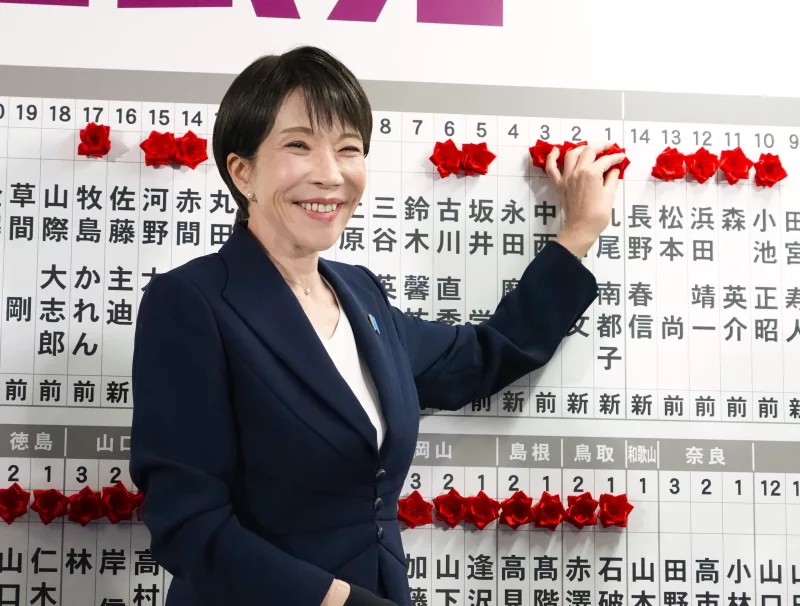
Japan entered a new political phase after Prime Minister Sanae Takaichi delivered the most decisive electoral victory in the modern history of the ruling party, consolidating power in a snap vote held under unusually difficult conditions. Despite the shortest campaign period of the postwar era and severe winter weather across large parts of the country, voter support surged behind Takaichi’s leadership style and policy direction, handing her government a commanding majority that reshapes the balance of power in Tokyo.
The result gives the governing bloc control well beyond a simple working majority, allowing it to override resistance in the upper chamber and move forward on long-delayed priorities. For Takaichi, Japan’s first woman to hold the premiership, the outcome is both a personal milestone and a strategic opening to pursue reforms that she has acknowledged could sharply divide public opinion.
A dominant mandate inside parliament
Riding high approval ratings, the Liberal Democratic Party secured roughly two-thirds of the seats in the lower house, an extraordinary margin that few analysts predicted at the start of the campaign. The scale of the victory means the government can initiate constitutional revisions, including steps toward a national referendum on changes to Japan’s pacifist framework, a goal the party has carried since its founding in 1955.
Markets reacted swiftly to the political clarity. The Nikkei stock index climbed to record levels in early trading after the vote, while bond yields rose as investors priced in increased government spending tied to defense and industrial policy. The yen initially weakened before stabilizing, reflecting both optimism about growth and lingering concern over Japan’s already heavy public debt burden.
Takaichi used her victory speech to argue that the electorate had endorsed difficult choices, including a reorientation of fiscal priorities and a tougher security posture. With opposition parties numerically sidelined, she now faces fewer procedural barriers to advancing legislation that had previously stalled in committee or been diluted through compromise.
Security, diplomacy, and regional posture
Foreign and defense policy is expected to move quickly to the top of the agenda. Takaichi has reiterated her intention to revise Japan’s National Defense Strategy and related planning documents, signaling a willingness to rethink long-standing taboos around military capabilities. While details remain scarce, she has repeatedly stressed that deterrence and intelligence capacity must keep pace with regional threats.
At the core of this approach is the Japan-U.S. alliance, which Takaichi has described as the cornerstone of national security. She plans to meet President Donald Trump in the coming weeks, even as Washington presses allies to shoulder a greater share of defense responsibilities. The timing is delicate, with Trump expected to travel to China soon and tensions with Beijing already elevated over Taiwan-related remarks attributed to the Japanese leader.
Takaichi has also pledged to deepen the vision of a free and open Indo-Pacific, aligning Japan more closely with partners that support a rules-based regional order. Her rhetoric suggests continuity with previous administrations, but the strength of her mandate could allow her to push the concept further than her predecessors dared.
Political realignment and risks ahead
Domestically, the election underscored a broader rightward shift in Japanese politics. The LDP’s long-time centrist partner exited the coalition, only to suffer heavy losses after forming a new alliance that failed to resonate with voters. In its place, Takaichi has embraced cooperation with more conservative forces, reshaping the governing landscape.
Analysts note that Japanese politics often hinge on leadership personalities as much as party platforms. Research institutions such as the RAND Corporation have long observed that strong leaders can leverage personal authority to overcome institutional inertia. With her unprecedented majority, Takaichi no longer faces the familiar excuse of parliamentary obstruction.
Still, significant challenges loom. Financing ambitious defense upgrades and economic reforms will test fiscal limits at a time when government debt already exceeds twice the size of the economy. Internationally, sharper rhetoric toward China risks diplomatic backlash, while domestically, constitutional change remains controversial despite the electoral mandate.
For now, Takaichi appears determined to act quickly, betting that political momentum and numerical strength will allow her to redefine Japan’s policy trajectory in ways few leaders before her could attempt.