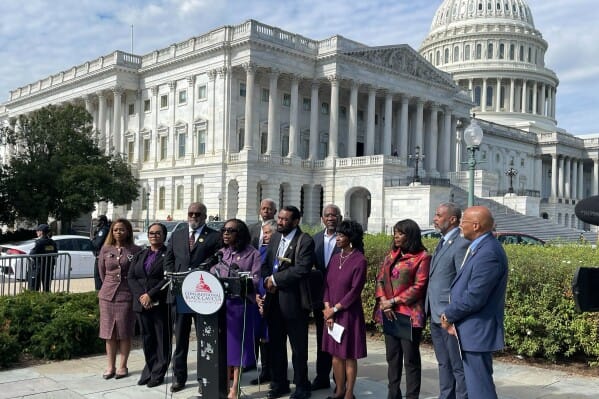
The United States faces a pivotal moment for congressional representation as the Supreme Court prepares to rule on a redistricting case that could alter how the Voting Rights Act is applied. The outcome may have long-term implications for Black representation in the U.S. House of Representatives, particularly in states where electoral maps have historically been drawn to preserve minority voting power. The case centers on how Section 2 of the Voting Rights Act is interpreted when congressional districts are redrawn, a process that occurs after each census and shapes political influence for an entire decade.
For decades, Section 2 has served as a key legal safeguard ensuring that racial minorities have a realistic opportunity to elect candidates of their choice. This provision has been instrumental in shaping districts where Black voters form a substantial portion of the electorate, especially in Southern states with deeply polarized voting patterns. Many of these districts emerged as a response to historical discrimination and were designed to comply with federal law while reflecting demographic realities documented by the U.S. Census Bureau and enforced through frameworks overseen by institutions such as the Supreme Court of the United States.
How Redistricting Has Supported Black Representation
The growth of Black representation in Congress over recent decades has been closely tied to the way district lines are drawn. In states with a white majority that tends to vote Republican and a Black minority that largely supports Democratic candidates, redistricting has often resulted in majority-minority or influence districts. These districts allow minority voters to collectively influence election outcomes, aligning with the intent of the Voting Rights Act when it was expanded in the wake of the Civil Rights Movement.
Legal standards developed through decades of court decisions have required mapmakers to consider race as one of several factors when drawing districts, ensuring that minority voting strength is not diluted. Organizations monitoring democratic processes, including the U.S. Department of Justice, have historically played a role in enforcing these standards. If the Supreme Court narrows the scope of Section 2 protections, states could gain greater discretion to redraw maps without prioritizing minority representation, potentially reshaping districts that have existed for generations.
Why the Supreme Court Case Is Considered High Stakes
At the heart of the current case is whether states must continue to create districts that give minority voters a realistic opportunity to elect preferred candidates, or whether such considerations amount to unconstitutional race-based decision-making. During oral arguments, several justices questioned whether the existing framework goes too far, signaling openness to revisiting long-standing interpretations of the law.
A ruling that weakens Section 2 could place at least 15 congressional districts currently represented by Black lawmakers at risk. These districts are largely located in states where Republican-controlled legislatures oversee redistricting. While partisan calculations may lead some states to preserve certain districts for strategic reasons, the legal obligation to protect minority voting power would be significantly reduced. Guidance and historical data from bodies like the U.S. House of Representatives illustrate how even small changes in district composition can alter electoral outcomes.
Potential Historical Impact on Congress
The possible reduction in Black representation would not be unprecedented, but it could surpass any decline seen since the late 19th century. The largest historical drop occurred during the 45th Congress beginning in 1877, when the number of Black representatives fell sharply amid the rollback of Reconstruction-era protections. A modern decline, driven not by explicit disenfranchisement but by changes in redistricting law, would mark a significant shift in how representation evolves in the United States.
Beyond individual seats, the broader impact would extend to policy debates, committee leadership, and the ability of Congress to reflect the nation’s diversity. Civil rights organizations and legal scholars warn that changes to Section 2 could influence future litigation and legislative efforts aimed at protecting voting access. As election laws continue to evolve, resources provided by institutions such as Congress.gov and the U.S. Courts system underscore how judicial decisions can reverberate far beyond a single election cycle.
As the Supreme Court deliberates, state lawmakers and advocacy groups remain in a holding pattern, aware that the ruling could redefine the balance between race, representation, and redistricting for years to come. The decision will not only determine the fate of specific districts but also signal how the nation interprets one of its most consequential civil rights laws in a rapidly changing political landscape.