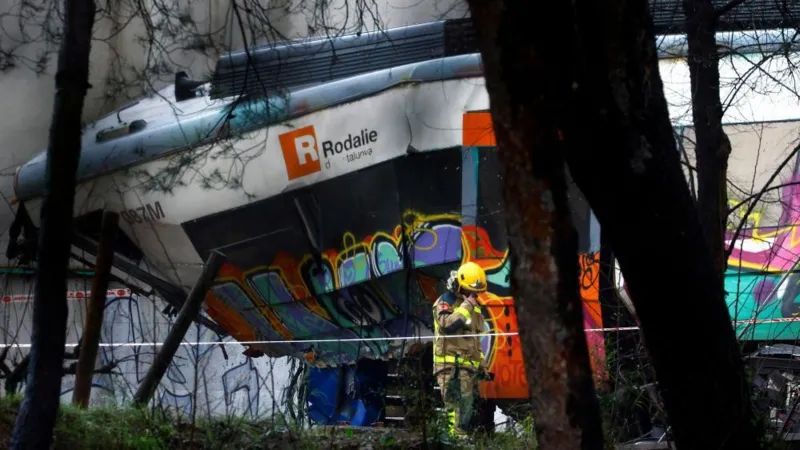
A deadly train derailment near Barcelona kills a driver and injures dozens, forcing the suspension of Catalonia’s rail network and intensifying concerns over rail safety in Spain.
A commuter train derailment near Barcelona has left one train driver dead and at least 37 passengers injured, triggering a full suspension of rail services across Catalonia and deepening national concerns about the safety of Spain’s railway infrastructure. The incident occurred on a Rodalies line when the train struck a retaining wall that collapsed onto the tracks between the towns of Gelida and Sant Sadurní, approximately 35 kilometers west of Barcelona, amid severe storm conditions.
Emergency protocols were immediately activated by regional authorities, with all passengers evacuated from the damaged train. According to officials from the Generalitat de Catalunya, the first carriage sustained the most severe impact after the collapse struck the driver’s cab, concentrating injuries among passengers seated at the front of the train. Rescue teams worked under difficult weather conditions as heavy rain continued to batter northeastern Spain.
Extreme Weather and Infrastructure Vulnerability
Authorities believe that intense rainfall following prolonged drought weakened the terrain supporting the retaining wall, causing it to give way as the train passed shortly after $9:00 PM local time. Weather alerts had been issued across large parts of eastern Spain, with civil protection agencies monitoring flood risks and infrastructure instability. Ongoing weather advisories and emergency response coordination are published through Spain’s national meteorological and civil protection framework at proteccioncivil.es.
Rail infrastructure inspections are now underway across affected corridors. Spain’s rail infrastructure manager has confirmed that engineers are conducting structural assessments before authorizing any service resumption, with technical updates issued through the official infrastructure authority at adif.es. Officials have stressed that no trains will return to operation until safety conditions are fully verified.
Injured passengers were transported to multiple hospitals across the Barcelona metropolitan area and surrounding municipalities. Emergency services reported that at least five individuals remain in serious condition, while others were treated for moderate and minor injuries.
Network Shutdown and Union-Led Response
The derailment has effectively shut down Catalonia’s Rodalies commuter network, disrupting daily travel for an estimated 400,000 passengers. The scale of the disruption has amplified pressure on national and regional authorities, particularly as the crash followed another deadly rail accident in southern Spain days earlier.
Spain’s train drivers’ union has responded by calling for strike action, citing what it describes as a pattern of deteriorating safety conditions across the rail system. Statements from the union emphasize the need for immediate investment and systemic reform, positions formally outlined through the Spanish Train Drivers Union’s official site at semaf.org. Union representatives argue that repeated incidents demonstrate structural vulnerabilities rather than isolated failures.
Passenger rail operations managed by Spain’s state-owned operator remain suspended across large sections of the network. Service alerts and passenger guidance continue to be issued via the official Renfe platform at renfe.com, as authorities work to restore mobility while prioritizing safety assurances.
Additional Derailment Deepens Safety Concerns
Compounding the crisis, a separate commuter train also derailed in northeastern Catalonia after its axle struck debris dislodged by storm conditions. That train, traveling between Blanes and Maçanet-Massanes, was carrying approximately 10 passengers at the time of the incident. While no fatalities were reported, the derailment further reinforced concerns about the resilience of rail infrastructure during extreme weather events.
With multiple accidents occurring within days, the fatal derailment near Barcelona has become a defining moment in Spain’s rail safety debate. Investigations continue as authorities face mounting pressure to address infrastructure maintenance, climate resilience, and operational oversight across one of Europe’s busiest commuter rail systems.